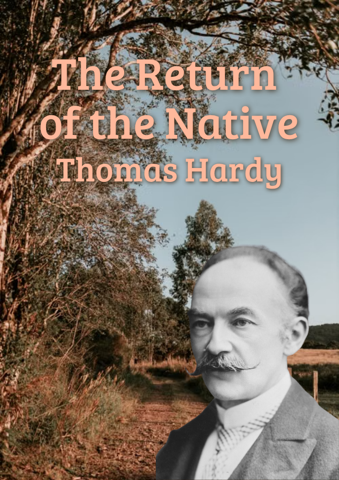
Background:
Published in 1878 and revised in later editions, Hardy's novel makes Egdon Heath more than scenery: seasonal labor, paths, weather, custom, and limited mobility organize what the characters can see and imagine. The book belongs to the developing Wessex sequence and to Victorian debates about marriage, vocation, and rural change.
What kind of book is it?
Clym Yeobright returns from Paris while Eustacia Vye longs to escape the heath; their plans intersect with existing attachments and family expectations. The resulting conflicts depend on mismatched ideas of home and ambition rather than on a single villain.
Literary style:
An elevated narrator, dense landscape description, symbolic seasonal events, chance meetings, overheard speech, and restricted communication create tragic pressure. Hardy repeatedly contrasts human time with the heath's deep time, making small social decisions appear both urgent and transient.
Director: Jack Gold
Production country: United States / United Kingdom
Cast: Catherine Zeta-Jones, Clive Owen, Ray Stevenson
Why it matters: A useful, identifiable screen version for comparison.
Difference from the book: compresses the six-book structure and foregrounds the romantic triangle over the narrator's long landscape meditations.
Main editions and translations:
the selected digital edition is the selected complete English text, replacing the audio-only an alternate transcription mistakenly cited in the preliminary list. Hardy revised the novel and supplied a later ending under publishing pressure; edition histories should therefore state which conclusion and chapter structure they reproduce.
Reading recommendation:
Hardy revised the novel, and its ending has a significant publication history. Check which ending an edition prints, whether it retains all six Books, and whether it records the serial and later revisions; a critical edition is preferable for textual study.
Cultural significance:
The novel's strong environmental presence and contested ending have made it central to discussions of Hardy's tragic form. Screen adaptations often foreground romance, but the book's deeper argument concerns how place, work, gender, and aspiration constrain the futures people can plausibly choose.
Place in the author's writing:
The novel is an important stage in Hardy's construction of Wessex, where landscape, custom, work, and chance constrain private intention. Its disputed ending and tragic pattern anticipate the sharper institutional pressures of Tess of the d'Urbervilles and Jude the Obscure, while Egdon Heath shows his ability to give setting the force of an historical presence.
Miva: the next reading experience beyond audiobooks
Listen like an audiobook, then ask anything, anytime.
Start Miva's narrationMiva does not just narrate. It keeps explaining based on what you ask.