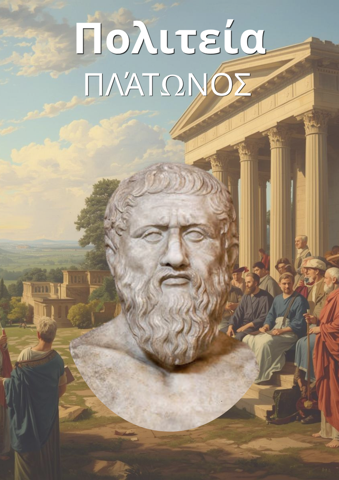
The Most Influential Work of Political Philosophy Ever Written
The Book That Invented the Philosophical Dialogue • The Allegory That Shaped Western Thought
Praised by Augustine, Challenged by Popper, Taught in Every University on Earth
What is justice? Plato asked the question in 380 BC. He wrote ten books attempting to answer it. We are still arguing about the answer.
Written around 380 BC, The Republic is not a political manifesto. It is a conversation—a long, probing, occasionally maddening dialogue in which Socrates and his interlocutors attempt to define a single word: justice. What begins as a philosophical inquiry into personal virtue expands, by an almost irresistible logic, into a complete reimagining of the human soul, the structure of society, the nature of knowledge, and the relationship between truth and power.
Plato's method is his argument. By dramatizing philosophy as dialogue—as a process of question, challenge, and refinement rather than declaration—he demonstrates that truth is not possessed but pursued. The form enacts the content. The Republic is not a book that tells you what to think. It is a book that shows you how thinking works, and what it costs.
"The price good men pay for indifference to public affairs is to be ruled by evil men."
—Plato, The Republic
"Until philosophers are kings, or the kings and princes of this world have the spirit and power of philosophy, cities will never have rest from their evils."
—Plato, The Republic
At the heart of The Republic lies an analogy of extraordinary elegance: the structure of the just city mirrors the structure of the just soul. Both are divided into three parts. The Rulers—philosopher-kings, governed by reason—correspond to the rational faculty of the mind. The Auxiliaries—warriors governed by courage—correspond to the spirited faculty. The Producers—governed by appetite—correspond to desire. Justice, in both city and soul, is not a rule imposed from outside but a condition of internal harmony: each part performing its function, none overreaching into the domain of the others.
It is a vision of breathtaking coherence. It is also, as Karl Popper argued in The Open Society and Its Enemies, a blueprint for totalitarianism—a society in which the philosophers decide everything, the warriors enforce it, and the producers comply. The debate between these two readings has never been resolved. Both are correct. Both are insufficient. That is precisely what makes the book inexhaustible.
The Allegory of the Cave has become one of the most reproduced images in the history of ideas: prisoners chained in a cave, watching shadows on a wall, mistaking the shadows for reality—and the philosopher as the one who turns, climbs toward the light, and returns to tell the others what he has seen, only to be disbelieved and perhaps killed for it. Augustine absorbed it into Christian theology. Descartes built his epistemology from its questions. Heidegger wrote an entire essay on its implications. It appears in undergraduate syllabi, in The Matrix, in every serious conversation about the relationship between perception and truth.
The concept of the Philosopher-King—the idea that those who understand truth should govern, and that political power without philosophical wisdom is a catastrophe—has been invoked to justify everything from Enlightenment technocracy to authoritarian rule, and challenged by every democratic theorist since Aristotle, who disagreed with his teacher almost immediately.
The Republic has been read, translated, annotated, refuted, and taught continuously for over two thousand years. No other work of political philosophy has lasted as long or provoked as much.
Plato wrote a dialogue about justice. It became the foundation of Western political thought, the origin of academic philosophy, and an argument that has never, in twenty-four centuries, been conclusively settled.
Miva: the next reading experience beyond audiobooks
Listen like an audiobook, then ask anything, anytime.
Start Miva's narrationMiva does not just narrate. It keeps explaining based on what you ask.