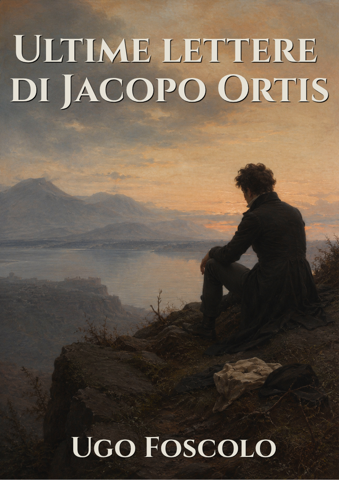
The First Great Modern Novel in Italian Literature
A Foundational Work of European Pre-Romanticism
The Epistolary Tragedy That Forged the Romantic Hero
The Novel That Shaped a Generation of the Risorgimento
A young man's love is impossible. So is his country's freedom. Ugo Foscolo fuses both into a single, unbearable letter.
Published in its definitive form in 1802, The Last Letters of Jacopo Ortis was born during the most turbulent years of Napoleon's campaigns in Italy, profoundly reflecting the political, moral, and existential crisis of an entire generation of young Italian intellectuals. Through a series of letters addressed to his friend Lorenzo Alderani, Jacopo Ortis recounts his exile, his political despair, and his impossible love for Teresa—already promised to another man chosen by her family for economic reasons.
What Foscolo constructed was not merely an epistolary romance. It was a private tragedy fused with a national one: behind Jacopo's heartbreak lies the collapse of the revolutionary hopes born with Napoleon, and the end of the dream of a free Italian homeland. Foscolo never separates the two; Jacopo's grief for Teresa and his grief for oppressed Italy become a single, indivisible wound. Through his journeys, encounters, and meditations—most famously his visit to the tombs of Petrarch and Dante—a deeper conviction emerges: that poetry and memory alone can defy nothingness and preserve human greatness beyond death.
Critics have long placed the novel beside Goethe's The Sorrows of Young Werther*, though Foscolo's version carries a far more explicit and dramatic political charge—private suffering inseparable from the fate of a nation.*
—On the novel's place in European pre-Romanticism
The influence of Ortis during the Italian Risorgimento was immense. Entire generations read Jacopo as a symbol of youth sacrificed to the fatherland, and of the tension between individual freedom and political oppression. The novel also helped transform the figure of the writer into that of the poet-exile—the tragic witness of history, the nation's restless conscience.
Jacopo cannot reconcile his ideals with the world. Two centuries later, the question he leaves behind—what a person owes to a cause larger than themselves—still hasn't found an answer.
Miva: the next reading experience beyond audiobooks
Listen like an audiobook, then ask anything, anytime.
Start Miva's narrationMiva does not just narrate. It keeps explaining based on what you ask.