I. Core Overview and Philosophical Positioning of the Shijing
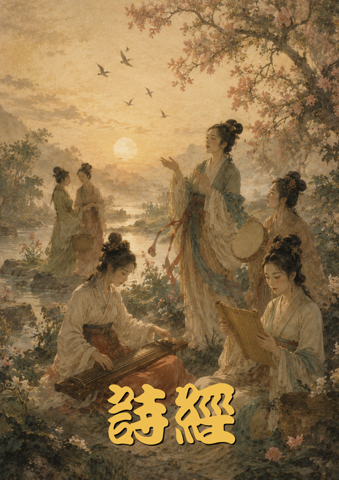
The Shijing (Classic of Poetry) is the earliest existing collection of Chinese poems. During the Pre-Qin period, it was simply referred to as Shi (Poetry), or commonly as the Three Hundred Poems (Shi Sanbai) due to the number of pieces it contained. This anthology collects poems spanning approximately five hundred years, from the beginning of the Western Zhou to the middle of the Spring and Autumn period (approx. 11th century to 6th century BCE). It consists of 305 poems, plus 6 "Sheng poems" (Shengshi) that have titles but no surviving lyrics (Nangai, Baihua, Huashu, Yougeng, Chongqiu, and Youyi).
Starting from the Han Dynasty, Confucian scholars revered it as a supreme political and moral classic, ranking it among the "Five Classics" alongside the I Ching, Book of Documents, Book of Rites, and Spring and Autumn Annals. However, historical evidence suggests that the formal title "Shijing" did not appear until roughly the early Southern Song Dynasty.
The Shijing serves as a highly realistic mirror of society during the Zhou Dynasty. Its content is all-encompassing, reflecting labor and love, war and corvée labor, oppression and resistance, customs and marriage, ancestral worship, and feasts. It even records astronomical phenomena, topography, flora, and fauna of the Yellow River basin. As the source of Chinese literature, it is often paired with Qu Yuan’s Li Sao as the "Feng-Sao" tradition, establishing the realist tradition that has defined Chinese literature for thousands of years.
II. Compilation Process and Historical Transmission
1. Compilation and Editing Order
Academic research indicates the Shijing was compiled gradually over centuries. Chronologically, the oldest works are the Zhou Song (Hymns of Zhou), followed by the Da Ya (Greater Odes), then the Xiao Ya (Lesser Odes), with the Shang Song, Lu Song, and Guo Feng (Airs of the States) being the latest. The earliest works date back to the early Western Zhou (such as "The Owl" in the Airs of Bin, attributed to the Duke of Zhou), while the latest date to the mid-Spring and Autumn period (such as "Zhu Lin" in the Airs of Chen).
There are three mainstream theories regarding how these poems were collected:
- Theory of Royal Officials Collecting Poetry: Suggests the Zhou court employed officials (Qiuren) to travel the country during busy farming seasons to collect folk songs and nursery rhymes to present to the Emperor. This allowed the ruler to "observe customs and know successes or failures."
- Theory of Presenting Poetry: Suggests the Emperor ordered feudal lords and high officials to periodically present poems to the royal court to examine local customs and morality.
- Theory of Confucius Editing the Poetry: Sima Qian's Records of the Grand Historian claims there were originally over 3,000 poems, which Confucius pruned down to 305 based on Confucian ritual standards. However, many scholars have doubted this since the Tang and Qing dynasties because the Zuo Zhuan records that before Confucius was ten years old, the order of music and dance performed for Prince Jizha of Wu in the State of Lu was already identical to the current Shijing. Most scholars now believe the Shijing was a collective compilation by Zhou historians and musicians, while Confucius participated in refining the music and promoting the text as core teaching material.
2. The Four Schools of Han Dynasty and Version Evolution
After the burning of books by Qin Shi Huang, the Shijing survived through oral tradition. In the early Han Dynasty, four major schools of transmission emerged:
- Modern Script Classics (The Three Schools): The Qi (Yuan Gu), Lu (Shen Pei), and Han (Han Ying) schools. These three used Han Dynasty clerical script and were most popular in the early Han. Influenced heavily by hermeneutics, they often viewed romantic poems as indecent and forced political interpretations upon them. These three have since been lost, with only the 10-volume Han Shi Wai Zhuan remaining.
- Ancient Script Classics (Mao Shi): Transmitted by Mao Heng and Mao Chang, who claimed the lineage traced back to Confucius's disciple Zixia. It used the scripts of the six states from before the Qin Dynasty. The Mao school often used historical events from the Zuo Zhuan to explain poem meanings. Though not authoritative in the Western Han, it became the dominant school during the Wei and Jin dynasties. The Shijing we read today is the surviving Mao Shi version.
Modern archaeology has further enriched our understanding. The "An-Da Bamboo Slips" (Warring States period, c. 400–350 BCE) found in 2015 are the earliest and most complete ancient copies found to date. Furthermore, a complete version of the Shijing from the Qin-Han period was discovered in the Tomb of the Marquis of Haihun in 2025, providing invaluable materials for textual comparison.
III. Classification: "Four Beginnings and Six Principles"
Ancient scholars summarized the structure and techniques of the Shijing as the "Four Beginnings and Six Principles" (Si Shi Liu Yi). The "Four Beginnings" refer to the first poems of the four major sections. The "Six Principles" refer to the classification and writing techniques.
1. Content and Music Classification: Feng, Ya, Song
- Feng (Airs of the States): 160 poems divided into fifteen regions. These are folk songs from the royal domain and various vassal states (e.g., Zheng, Wei, Qin). The Guo Feng is the literary essence of the Shijing, featuring diverse styles and strong local color, mostly composed by commoners.
- Ya (Odes): 105 poems, referring to the elegant music of the royal capital. Divided into Xiao Ya (Lesser Odes, 74 poems) used for private banquets by officials, and Da Ya (Greater Odes, 31 poems) used for grand court ceremonies and ancestral rites. The authors were mostly aristocrats and officials.
- Song (Hymns): 40 poems. These were solemn ritual tracks accompanied by dance, used for worshipping gods and ancestors in ancestral temples. They include the Zhou Song, Lu Song, and Shang Song.
2. Literary Techniques: Fu, Bi, Xing
Zhu Xi of the Song Dynasty provided the classic definitions for these three techniques:
- Fu (Direct Narrative): "To spread out and state the matter directly." It is a straightforward description of events, scenery, or emotions, common in the Da Ya and Song.
- Bi (Comparison/Metaphor): "Using that object to compare to this object." For example, in "Big Rat" (Shuo Shu), a greedy ruler is directly compared to a fat, loathsome rat.
- Xing (Evocation/Stimulus): "Speaking of another thing first to lead into the subject of the poem." The poet describes a natural scene to evoke a subjective emotion. For example, in "Guan Ju," the sound of ospreys on a river island evokes the thought of a "fair and gentle lady" being a "good mate for a gentleman."
IV. Table of Contents and Structure
The 305 poems in the Mao system are strictly divided into:
- Guo Feng (Nos. 001–160): 160 poems from fifteen regions including Zhou Nan, Shao Nan, Bei, Yong, Wei, Wang, Zheng, Qi, Wei, Tang, Qin, Chen, Gui, Cao, and Bin.
- Xiao Ya (Nos. 161–234): 74 poems, including several decades (shi). Note that three titles are lost (Yougeng, Chongqiu, Youyi).
- Da Ya (Nos. 235–265): 31 poems.
- Song (Nos. 266–305): 40 poems including the Hymns of Zhou, Lu, and Shang.
V. Literary Achievement and Modern Reflections
1. Historical High Praise
The Shijing is honored as the "Ancestor of Pure Literature" and the "Representative of Commoner Literature." Confucius praised it highly, stating:
- "The three hundred poems can be summed up in one phrase: 'having no depraved thoughts' (Si Wu Xie)."
- "Gentle and kind, such is the teaching of the Poetry."
Confucius believed that without studying the Poetry, one could not master proper diplomatic speech. He noted that reading it enhances observation and social skills: "It can stimulate the mind, it can be used for observation, it can be used for socializing, and it can be used to express grievances."
2. Modern Schools and Bold Interpretations since the May Fourth Movement
In the modern era, Hu Shi and other leaders of the New Culture Movement broke the moral sanctification of the Shijing. Hu Shi argued it should be treated as a collection of "ancient folk songs"—secular material for studying society, politics, and linguistics—criticizing ancient scholars for forcing moralistic interpretations.
Under this secularized criticism, modern scholars have found more human and even shocking interpretations:
- Hu Shi’s New Philology: He proposed that certain particles previously thought to mean "going to" were actually ancient auxiliary words. He even interpreted "Little Stars" (Xiao Xing) as a realist poem about lower-class concubines or servants grieving their fate while working late at night.
- Li Ao’s Vulgar Philology: The writer Li Ao and others argued from a perspective of sexual folklore that the Shijing preserved ancient street slang. For example, in "Jian Chang," the final character "qie" (且), traditionally seen as a particle, was identified through oracle bone script as a pictograph for male genitalia. Thus, a line traditionally read as elegant becomes a spirited piece of ancient flirtation: "You crazy boy, what are you so cocky about!" Similarly, "Shan You Fu Su" is transformed from a moralistic lecture into a spicy dialogue about missing a handsome cousin and bumping into a "foolish prick" instead.
This shift from "Sacred Classic" to "Lively Folk Song" does not diminish the Shijing; rather, it allows modern readers to see a more authentic, flesh-and-blood ancient China across two millennia.