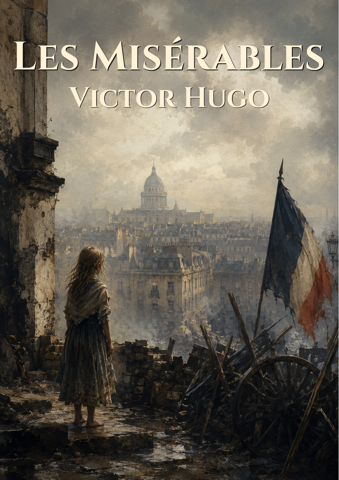
Les Misérables is a vast historical, social, and philosophical novel written by Victor Hugo and published in 1862. Considered one of the absolute masterpieces of French and world literature, the novel tells the fate of several characters living in 19th-century France, while offering a profound reflection on justice, poverty, redemption, love, and the human condition.
The story begins in 1815, shortly after the fall of Napoleon, and ends within the context of the Parisian barricades of the June Rebellion of 1832. Through this immense social fresco, Victor Hugo describes a society marked by inequality, misery, and political tension, but also by hope, compassion, and the possibility of moral change.
The central character of the novel is Jean Valjean, a former convict sentenced for stealing a loaf of bread to feed his sister's starving children. After nineteen years of hard labor, he regains his freedom but remains rejected by society because of his criminal past. His existence changes radically when he meets the Bishop of Digne, Monseigneur Myriel, who welcomes him with kindness. When Valjean steals the bishop's silverware and is then arrested by the police, Myriel pretends to have given him these objects and even gives him two additional silver candlesticks. This gesture of mercy profoundly moves Jean Valjean and marks the beginning of his inner transformation. From then on, he decides to devote his life to doing good.
Under the name of Monsieur Madeleine, Jean Valjean becomes a prosperous industrialist and the respected mayor of Montreuil-sur-Mer. However, his past continues to pursue him through Inspector Javert, a rigid and obsessive policeman convinced that a former criminal can never change. The conflict between Valjean and Javert constitutes one of the major axes of the novel: it opposes inflexible law to compassion and forgiveness.
In parallel, Hugo tells the tragedy of Fantine, a young woman abandoned by her lover after the birth of their daughter, Cosette. Forced to work to survive, Fantine entrusts her child to the Thénardiers, cruel and greedy innkeepers who exploit and mistreat the little girl while always demanding more money. Gradually, Fantine sinks into misery: she loses her job, sells her hair and teeth, then becomes a prostitute in order to pay the Thénardiers' demands. Exhausted by poverty and disease, she dies before seeing her daughter again, after obtaining a promise from Jean Valjean that he will save Cosette.
Valjean keeps his promise and snatches Cosette from the brutal world of the Thénardiers. He raises her as his own daughter and tries to offer her a peaceful existence in Paris. Cosette grows up in a protected environment and becomes a cultured and beautiful young woman. Later, she meets Marius Pontmercy, a young idealistic and republican student, with whom she falls in love.
Around Marius gravitate the Friends of the ABC, a group of revolutionary students led by Enjolras. These young men dream of a more just society and participate in the republican insurrection of June 1832. The famous scenes of the barricades represent one of the summits of the novel. Hugo blends heroism, tragedy, and political reflection, showing both revolutionary enthusiasm and the violence of failure. Several characters find their death there, notably Gavroche, a brave and insolent street child who became a symbol of the Parisian people.
During this insurrection, Jean Valjean saves the seriously wounded Marius by carrying him through the sewers of Paris in a scene that has become legendary. He also spares the life of Javert, even though he could have taken revenge on him. This gesture plunges the policeman into a deep moral crisis: unable to accept that a former convict could show such nobility, Javert loses all his certainties and ends up committing suicide by throwing himself into the Seine.
After the events of the barricades, Marius gradually discovers the moral greatness of Jean Valjean. The latter, weakened by the years and the sacrifices he has made, finally passes away in peace after seeing Cosette happy and loved.
Through this story, Victor Hugo develops several major universal themes. Above all, the novel denounces the social misery and injustices of its time: poverty, child labor, the exploitation of women, judicial violence, and the exclusion of the weakest. Hugo shows how society can push individuals toward suffering and crime. However, he also affirms that human beings always possess the capacity to change. Jean Valjean thus becomes the symbol of redemption and restored dignity.
The work also explores different forms of love: Fantine's maternal love for Cosette, Jean Valjean's paternal love, the romantic love between Cosette and Marius, but also the sacrificial love of Éponine, a tragic character deeply attached to Marius without being loved in return.
Victor Hugo's style gives the novel a monumental dimension. The author alternates dramatic scenes, historical descriptions, philosophical reflections, and long digressions devoted to various subjects such as the Battle of Waterloo, the sewers of Paris, convents, and even popular slang. These passages show the encyclopedic ambition of the writer, who seeks to paint not only individual fates but an entire civilization.
From its publication, Les Misérables enjoyed immense international success. Despite some criticism from contemporaries like Gustave Flaubert or Charles Baudelaire, the novel quickly became a global classic. Its influence is immense and continues today thanks to countless adaptations for the stage, cinema, and especially the famous musical created by Alain Boublil and Claude-Michel Schönberg in 1980.
More than a simple historical novel, Les Misérables is a profoundly humanistic work. Victor Hugo affirms that as long as ignorance, poverty, and injustice exist in the world, literature must bear witness to human suffering and defend the weakest. It is this universal reach, combined with the emotional power of its characters, that still makes Les Misérables one of the greatest novels ever written.
Miva: the next reading experience beyond audiobooks
Listen like an audiobook, then ask anything, anytime.
Start Miva's narrationMiva does not just narrate. It keeps explaining based on what you ask.