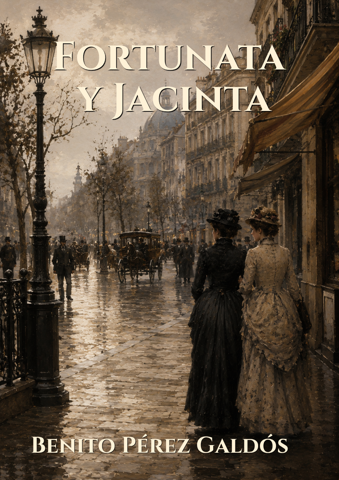
Fortunata and Jacinta (1886–1887) is considered the masterpiece of Benito Pérez Galdós and one of the most important novels of European realism. Set in late 19th-century Madrid, the novel portrays Spanish society of the time in enormous detail: the bourgeoisie, the slums, religion, marriage, social inequality, and moral hypocrisy.
The story revolves around two completely different women: Fortunata, a poor, impulsive, and passionate young woman; and Jacinta, a refined and sterile bourgeois woman. Both are linked by Juanito Santa Cruz, heir to a wealthy Madrid family and a symbol of a selfish, superficial, and morally empty bourgeoisie.
Juanito seduces Fortunata and then abandons her when he grows tired of her. Later, he marries his cousin Jacinta, who dreams of starting a family but cannot have children. From this conflict, the novel develops a complex web of family relationships, passions, jealousy, betrayals, and social struggles.
Fortunata tries to rebuild her life by marrying Maximiliano Rubín, a sickly and sensitive young man who loves her sincerely. However, Juanito's obsession and social pressure drag Fortunata back into a destructive relationship. Meanwhile, Jacinta lives tormented by the impossibility of being a mother and by the constant suspicion of her husband's infidelities.
More than a simple love story, the novel is an immense social fresco. Galdós shows streets, markets, convents, cafes, bourgeois houses, and miserable neighborhoods with almost documentary precision. Madrid becomes another character in the work.
One of the most revolutionary aspects of Fortunata and Jacinta is the psychological depth of its female characters. Fortunata does not appear as a simple "fallen woman," but as a character full of humanity, desire, contradictions, and dignity. Jacinta, although belonging to the privileged class, is also a victim of social structures and the bourgeois model of marriage.
The novel harshly criticizes the double standards of Spanish society. Men, especially Juanito, can lie and betray without real consequences, while women bear the moral and social weight of every decision. Galdós also questions institutional religion, class differences, and the hypocrisy of the Madrid bourgeoisie.
The character of Maximiliano Rubín adds another dimension to the work: madness, existential suffering, and the inability to escape a tragic fate. His progressive mental degradation anticipates psychological techniques that later 20th-century modern novelists would develop.
Due to its narrative scope, complexity of characters, and social analysis, Fortunata and Jacinta has frequently been compared to Tolstoy's Anna Karenina or Balzac's La Comédie humaine. Many critics consider it the definitive novel about 19th-century Madrid.
The work has been adapted several times for film, theater, and television. The television adaptation directed by Mario Camus in 1980 helped make the novel an even more popular classic among the Spanish public.
Today, Fortunata and Jacinta remains one of the great novels of universal literature: a monumental work on love, desire, motherhood, social class, and human tragedy.
Miva: the next reading experience beyond audiobooks
Listen like an audiobook, then ask anything, anytime.
Start Miva's narrationMiva does not just narrate. It keeps explaining based on what you ask.