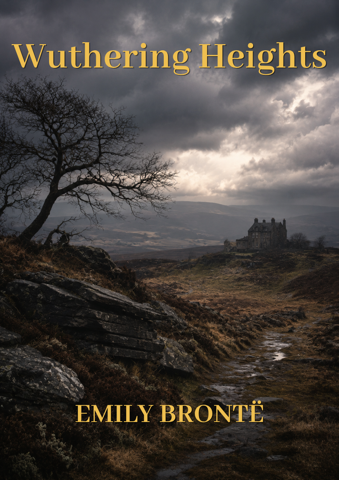
Love Becomes Possession on the Yorkshire Moors
Emily Brontë's Only Novel
Two Houses, Two Generations, and Heathcliff's Revenge
The Gothic Masterpiece First Published as Ellis Bell
Before the celebrated masterpieces came Wuthering Heights: a first book in which Emily Brontë's defining concerns were already taking shape.
Wuthering Heights is the only novel by the English author Emily Brontë, initially published in 1847 under her pen name Ellis Bell. It concerns two extensive upland estates and their landowning families on the West Yorkshire moors, the Earnshaws and the Lintons; and their turbulent relationships with the Earnshaws' foster son, Heathcliff. Driven by themes of love, possession, revenge, and reconciliation, the novel is influenced by Romanticism and Gothic fiction. It is considered a classic of English literature. Wuthering Heights was accepted by publisher Thomas Newby along with Anne Brontë's Agnes Grey before the success of their sister Charlotte Brontë's novel Jane Eyre, but Jane Eyre was published before the other two. The first American edition was published in April 1848 by Harper & Brothers of New York. After Emily's death, Charlotte edited a second edition of Wuthering Heights, which was published in 1850.
The original text as published by Thomas Cautley Newby in 1847 is available online in two parts. The novel was first published together with Anne Brontë's Agnes Grey in a three-volume format: Wuthering Heights filled the first two volumes and Agnes Grey made up the third. In the 1850 edition, the Wuthering Heights chapters were renumbered as a single volume: Volume I of the 1847 edition corresponds to chapters 1 to 14, while Volume II corresponds to chapters 15 to 34.
The story reaches the reader through layered narrators, chiefly Lockwood and the housekeeper Nelly Dean. Their incomplete, interested accounts make the history of Heathcliff and Catherine difficult to possess, just as the characters themselves confuse love with ownership and memory with a right to revenge.
Its violence initially disturbed reviewers, but the novel's fractured chronology, doubled households, and refusal to offer simple moral comfort later became central to its stature. Adaptations often isolate the doomed romance; the book itself ranges further, tracing how trauma and power pass from one generation to the next before reconciliation becomes possible.
Why Wuthering Heights Still Matters
Read today, Wuthering Heights offers more than the curiosity of a famous writer's beginning. It preserves the risks, experiments, and unresolved tensions of a literary voice before later success made that voice familiar.
Return to the beginning, and discover how Wuthering Heights first opened the path ahead.
Wuthering Heights follows two generations of the Earnshaw and Linton families whose lives are entwined, ruined, and eventually reconciled through the dark, tempestuous passion of an orphan named Heathcliff. The narrative begins in 1801 when Mr. Lockwood, a tenant at Thrushcross Grange, visits his sullen landlord, Heathcliff, at Wuthering Heights. After a nightmarish night filled with supernatural occurrences, Lockwood becomes ill and asks his housekeeper, Nelly Dean, to recount the history of the estates. Nelly recounts how Mr. Earnshaw originally brought the ragged orphan Heathcliff to Wuthering Heights. Earnshaw's daughter, Catherine, forms an instant, transcendent bond with Heathcliff, while her brother, Hindley, grows to despise him. When Mr. Earnshaw dies, Hindley inherits the estate, degrades Heathcliff to a common servant, and subjects him to brutal mistreatment. Despite this degradation, Catherine and Heathcliff remain inseparable, roaming the wild moors together. However, after an unexpected stay at the grand Thrushcross Grange, Catherine is drawn to the refined culture and social status of Edgar Linton. Driven by social ambition, Catherine accepts Edgar’s marriage proposal, confiding to Nelly that while her soul is identical to Heathcliff’s, marrying him would degrade her. Overhearing only that marrying him would be a degradation, a devastated Heathcliff disappears into the night. Three years later, Heathcliff returns as a wealthy, polished man consumed by a desire for vengeance against those who degraded him. He gains control over Wuthering Heights by feeding Hindley's gambling and drinking habits. To spite Catherine and secure power over the Lintons, Heathcliff seduces and marries Edgar’s naive sister, Isabella, subjecting her to psychological and physical cruelty. The emotional turmoil of Heathcliff’s return and Edgar’s jealousy severely destabilizes Catherine's health. In a final, agonizing reunion with Heathcliff, Catherine falls gravely ill and dies shortly after giving birth to a daughter, Cathy. Driven mad by grief, Heathcliff implores Catherine’s ghost to haunt him for the rest of his days. Following Catherine's death, Hindley dies in severe debt, leaving Heathcliff as the sole owner of Wuthering Heights. Heathcliff takes Hindley's son, Hareton, under his care, deliberately keeping the boy illiterate and uneducated to exact revenge on his father. Meanwhile, Edgar Linton raises the young Cathy in peaceful isolation at Thrushcross Grange, away from Heathcliff’s reach. Sixteen years pass before Heathcliff’s grand scheme targeting the second generation unfolds. He forces his own sickly, manipulated son, Linton, to marry young Cathy, thereby securing legal ownership of Thrushcross Grange upon Edgar’s death. Shortly after the marriage, both Edgar and the young Linton pass away, leaving Cathy widowed, destitute, and trapped at Wuthering Heights alongside the crude, uneducated Hareton. Despite Heathcliff’s absolute control, his revenge ultimately unravels from within. As Cathy and Hareton spend time together, their initial hostility softens into mutual affection, and Cathy begins teaching Hareton how to read. Seeing the two young people fall in love, Heathcliff recognizes Hareton's striking physical resemblance to his lost Catherine. Exhausted by decades of hatred and increasingly tormented by visions of Catherine’s spirit lingering on the moors, Heathcliff loses his appetite and his drive for vengeance. He dies alone in his room, leaving Cathy and Hareton as the rightful heirs to both estates. Peace is restored to the region as Cathy and Hareton prepare for their upcoming wedding, while local villagers swear that the ghosts of Catherine and Heathcliff can still be seen wandering the quiet moors together.
I’ve no more business to marry Edgar Linton than I have to be in heaven; and if the wicked man in there had not brought Heathcliff so low, I shouldn’t have thought of it. It would degrade me to marry Heathcliff now; so he shall never know how I love him: and that, not because he’s handsome, Nelly, but because he’s more myself than I am. Whatever our souls are made of, his and mine are the same; and Linton’s is as different as a moonbeam from lightning, or frost from fire.Wuthering Heights CHAPTER IX. This iconic declaration defines the core tragedy of the novel by capturing Catherine's fundamental division between societal expectation and existential love, introducing the dynamic that drives the entire plot.
And the thing that irks me most is this shattered prison, after all. I’m tired of being enclosed here. I’m wearying to escape into that glorious world, and to be always there: not seeing it dimly through tears, and yearning for it through the walls of an aching heart: but really with it, and in it.Wuthering Heights CHAPTER XV. It beautifully encapsulates Catherine's psychological desperation and romantic mysticism, viewing her physical body and mortal life merely as a prison that prevents ultimate spiritual liberation.
May she wake in torment! he cried, with frightful vehemence, stamping his foot, and groaning in a sudden paroxysm of ungovernable passion. Why, she’s a liar to the end! Where is she? Not there—not in heaven—not perished—where? Oh! you said you cared nothing for my sufferings! And I pray one prayer—I repeat it till my tongue stiffens—Catherine Earnshaw, may you not rest as long as I am living; you said I killed you—haunt me, then!Wuthering Heights CHAPTER XVIII. It is one of the most powerful depictions of violent grief in English literature, exposing Heathcliff's refusal to accept separation and setting up the haunting presence that dominates the remainder of the book.
Be with me always—take any form—drive me mad! only do not leave me in this abyss, where I cannot find you! Oh, God! it is unutterable! I cannot live without my life! I cannot live without my soul!Wuthering Heights CHAPTER XVIII. This raw, desperate plea showcases the terrifying intensity of Heathcliff's obsession, encapsulating the theme that his identity is entirely intertwined with Catherine's existence.
While the emotional core of the novel remains universally striking, modern readers often face an initial hurdle with its complex narrative structure and regional dialect. The story is told through a framed narrative, featuring the newcomer Mr. Lockwood listening to the domestic servant Nelly Dean recount past events. This layered approach requires readers to keep track of shifting timelines and two generations of characters who share similar names. Furthermore, the broad Yorkshire dialect spoken by the servant Joseph presents a distinct linguistic challenge that often requires careful reading or reliance on footnotes. Beyond these formal elements, the characters themselves resist easy sympathy, as Brontë avoids traditional heroes and heroines in favor of morally ambiguous, volatile personalities. Once a reader adjusts to the dramatic pacing, the dialect, and the atmospheric setting of the moors, the novel transforms into an extraordinarily compelling experience that continues to hold readers captive.
Emily Brontë's masterpiece stands as a classic because it radically broke away from the Victorian conventions of its era, offering an unfiltered look at human emotion, obsession, and psychological power dynamics. Rather than presenting a conventional moral tale or a sweet romance, the novel constructs a raw, atmospheric world where passion and cruelty are intimately linked. Brontë's complex use of double narration grants the story a mythic quality while maintaining a sense of realism. Her poetic language and vivid portrayal of the West Yorkshire landscape elevate the setting itself into a central character. The enduring resonance of Catherine and Heathcliff lies in their refusal to abide by societal bounds, making the book a monumental bridge between Gothic literature and modern psychological fiction that continues to provoke critical study and artistic adaptation worldwide.
The final sequence of the novel brings the long, turbulent history of Wuthering Heights to an unexpected turning point on the moors. As the long-standing hostility between the remaining heirs gives way to a quiet, shared understanding, the driving force behind the estate's decade-long darkness begins to fracture from within. What unfolds in the quiet chambers of the house and along the wild, windswept paths is a strange, transcendent resolution that transforms the fate of both families. The precise nature of the final physical surrender, the shifting atmosphere that settles over the countryside, and the mysterious sightings reported by the local villagers offer an unforgettable conclusion best discovered directly in Brontë's haunting final pages.
Although often categorized as a romance, the novel is fundamentally a dark tragedy that critiques romanticized notions of love. The connection between Catherine and Heathcliff is fiercely intense, but it manifests through obsession, control, and mutual destruction rather than healthy affection. Their choices inflict severe psychological and physical suffering on everyone around them, turning potential domestic peace into a cycle of revenge. Brontë presents their bond as an inescapable force of nature rather than a conventional storybook romance, challenging the reader to witness the destructive limits of a passion stripped of empathy and moral restraint.
The contrasting estates of Wuthering Heights and Thrushcross Grange represent the core thematic binary of the entire novel. Wuthering Heights, exposed to the harsh weather of the moors, symbolizes untamed nature, stormy passion, and social chaos. In contrast, Thrushcross Grange sits in a sheltered valley, representing civilization, wealth, social refinement, and order. The movement of characters between these two locations drives the plot, showing how the calm elegance of the Grange is repeatedly invaded and destabilized by the raw, volatile energy emanating from the Heights.
The West Yorkshire moors serve as far more than a simple backdrop; they act as a vital thematic character that reflects the inner psychological states of Catherine and Heathcliff. Wild, dangerous, and beautiful, the moors represent total freedom away from societal rules and class constraints. Catherine and Heathcliff's childhood bond is forged on the heath, and their spiritual survival remains tied to that open landscape. Brontë uses the changing weather and unforgiving terrain to mirror the emotional violence and enduring passion that define the entire narrative.
Miva: the next reading experience beyond audiobooks
Listen like an audiobook, then ask anything, anytime.
Start Miva's narrationMiva does not just narrate. It keeps explaining based on what you ask.