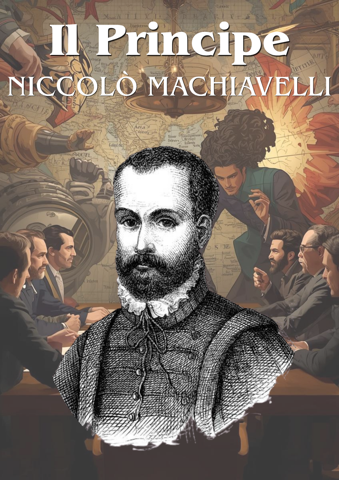
The Book That Divorced Politics from Ethics — And Has Never Been Forgiven For It
Written in 1513 • Banned by the Pope • Required Reading for Every Ruler Since
The Origin of the Word "Machiavellian" • Still Shocking Five Centuries Later
Before Machiavelli, political philosophy asked: what should a ruler be? Machiavelli asked a different question: what does a ruler actually need to do? The answer made everyone uncomfortable. It has not stopped being accurate.
Niccolò Machiavelli wrote The Prince in 1513 as a man who had lost everything. A senior diplomat and official of the Florentine Republic, he had been stripped of his position, imprisoned, and tortured when the Medici returned to power. He wrote the treatise partly as an intellectual exercise, partly as a desperate attempt to demonstrate his usefulness to the very family that had destroyed his career. The Medici never hired him. The book outlasted everyone involved.
Published posthumously in 1532, The Prince did something no political text before it had dared to do with such systematic clarity: it separated the question of what a ruler should be from the question of what a ruler must do to survive. Before Machiavelli, political philosophy was a branch of ethics—from Aristotle to Cicero, the good ruler and the virtuous man were the same person. Machiavelli severed that connection with surgical precision. Politics, he argued, is a technical craft. Its subject is power: how to acquire it, how to hold it, and how to avoid losing it to the torrential, unpredictable river of fortuna that governs half of human affairs.
"It is much safer to be feared than loved, because love is a link of obligation broken by self-interest, whereas fear is maintained by a dread of punishment which never leaves you."
—Niccolò Machiavelli, The Prince
"A ruler must be both a lion to drive off wolves and a fox to recognize snares."
—Niccolò Machiavelli, The Prince
The concept Machiavelli places at the center of his argument is virtù—not virtue in the Christian sense of moral goodness, but something colder and more useful: ingenuity, efficacy, the capacity to act decisively under pressure, and the willingness to deploy force when force is what the situation requires. The prince who survives is the one who can read fortune accurately, adapt to its shifts, and do what necessity demands without being paralyzed by the gap between his actions and his public image.
The candor is the point. Machiavelli does not argue that cruelty is good. He argues that cruelty, used well—swiftly, decisively, and not repeated—is less damaging than cruelty used badly. He does not argue that a prince should be immoral. He argues that a prince who cannot enter into evil when necessary will be destroyed by those who can.
His prime example of virtù in action is Cesare Borgia. The choice is instructive: Borgia was eventually destroyed by fortune anyway. Machiavelli includes this without apparent irony. Even the best application of his principles cannot guarantee survival. It merely improves the odds.
The Church placed The Prince on the Index of Prohibited Books in 1559. Napoleon annotated his personal copy extensively. Rousseau argued it was a satire—a warning to the people about how princes actually behave, disguised as advice to princes. Frederick the Great of Prussia wrote a rebuttal before becoming king, then governed in a manner that suggested he had re-read the original more carefully than his own response.
Shakespeare knew the text. Cromwell was accused of following it. Mussolini wrote his doctoral thesis on it. Henry Kissinger wrote his on Metternich, but the intellectual lineage is unmistakable. The word "Machiavellian" has entered every major language as shorthand for the cynical, calculating manipulation of power—which is, depending on your reading, either a profound misreading of the text or its most accurate summary.
The Prince does not tell you that evil wins. It tells you that the world does not reliably reward goodness, that fortune is indifferent, and that the gap between how people should behave and how they actually behave is the only terrain on which politics takes place.
Machiavelli did not invent political ruthlessness. He was simply the first to write it down clearly enough that no one could pretend not to understand it.
Miva: the next reading experience beyond audiobooks
Listen like an audiobook, then ask anything, anytime.
Start Miva's narrationMiva does not just narrate. It keeps explaining based on what you ask.