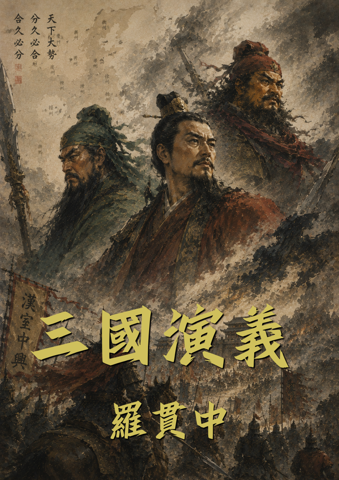
I. Basic Positioning and Background
Romance of the Three Kingdoms, full name Sanguozhi Tongsu Yanyi (Popular Romance of the Records of the Three Kingdoms), is the first full-length historical novel in Chinese literature. It is ranked as one of the "Four Great Classical Novels" and the "Four Masterworks" of Chinese literature.
Stories of the Three Kingdoms have been popular in Chinese folk culture for centuries. By the late Tang Dynasty, these tales were already circulating; during the Song and Yuan Dynasties, storytelling performances known as "Shuo Sanfen" (Telling of the Three Parts) were highly popular in urban entertainment centers. In the late Yuan and early Ming Dynasties, the author Luo Guanzhong synthesized these folk legends, operas, and prompt books (such as the Sanguozhi Pinghua) with official histories like Records of the Three Kingdoms (including Pei Songzhi's annotations), Book of the Later Han, and Zizhi Tongjian. Combining these with his own insights into society and life, he created this classic masterpiece.
II. Evolution of Core Editions
The novel underwent several revisions throughout its history, falling into three major stages:
Early Ming Dynasty (Jiajing Edition)
Published in 1522 (the first year of the Jiajing era), this is the earliest extant printed edition, commonly known as the "Jiajing Edition." It consists of 24 volumes and features relatively simple prose and straightforward content.
Qing Dynasty Kangxi Era (Mao Edition)
Revised by the father-son duo Mao Lun and Mao Zonggang, who corrected historical facts, added or deleted text, and refined the prose. They removed some unrealistic elements and superstitions from the Ming editions, creating the 120-chapter version most common today, known as the "Mao Edition."
Modern Annotated Edition (Shen Edition)
Recently edited by scholar Shen Bojun, the Shen Annotated Edition corrected over 700 technical errors found in the original texts, earning high acclaim in modern historical and literary academic circles.
III. 120-Chapter Story Outline
Romance of the Three Kingdoms depicts nearly a century of historical turbulence (184 AD to 280 AD) from the late Eastern Han Dynasty to the early Western Jin Dynasty. The plot can be summarized into six major stages:
- The Yellow Turban Rebellion and the Chaos of Dong Zhuo (Chapters 1-9): Corruption and eunuch power in the late Han lead to rebellion. General He Jin invites Dong Zhuo to the capital, but Dong Zhuo seizes power. After a failed assassination attempt by Cao Cao, an alliance of lords is formed. Eventually, Lu Bu kills Dong Zhuo under Wang Yun's plot.
- The Rivalry of Warlords and the Unification of the North (Chapters 10-33): Warlords fight for territory. Cao Cao takes the Emperor under his protection to command the lords, eventually defeating Yuan Shao at the Battle of Guandu to unify the North. Meanwhile, Sun Ce and his brother Sun Quan establish a base in the East (Jiangdong).
- Three Visits to the Hut and the Battle of Red Cliffs (Chapters 34-57): After repeated defeats, Liu Bei seeks out the brilliant strategist Zhuge Liang. Cao Cao marches south, and Liu Bei forms an alliance with Sun Quan. The allied forces defeat Cao Cao with fire at the Battle of Red Cliffs, setting the stage for the tripartite division of China.
- Tripartite Division and the Deaths of Guan and Zhang (Chapters 58-77): Liu Bei seizes Hanzhong and declares himself King. Cao Pi usurps the Han throne to establish Cao Wei; Liu Bei declares himself Emperor of Shu Han. Eastern Wu's Sun Quan retakes Jing Province, leading to the death of the great general Guan Yu. Shortly after, Zhang Fei is assassinated by his subordinates.
- Defeat at Yiling and Entrustment at Baidi City (Chapters 78-90): Ignoring advice, Liu Bei attacks Wu to avenge his brothers but is defeated by Lu Xun's fire strategy. On his deathbed, Liu Bei entrusts the state to Zhuge Liang. Zhuge Liang stabilizes the rear by capturing Meng Huo seven times and restores the alliance with Wu.
- Six Campaigns from Mount Qi and the Unification by Jin (Chapters 91-120): Zhuge Liang launches northern expeditions against Wei, engaging in a battle of wits with Sima Yi, but eventually dies of exhaustion at Wuzhang Plains. Jiang Wei continues his legacy. Eventually, the Sima family seizes power in Wei. Shu Han falls, and later, Sima Yan establishes the Western Jin Dynasty, conquering Wu and unifying China.
IV. Artistic Features and Limitations
- Pro-Liu and Anti-Cao Stance: The novel reflects the people's hope for the restoration of the Han Dynasty, centering on Liu Bei's group.
- Artistic Archetypes: The book successfully portrays nearly 200 characters, with core figures becoming icons: Zhuge Liang (wisdom), Cao Cao (the magnificent yet treacherous villain), Guan Yu (loyalty and righteousness), and Liu Bei (the benevolent ruler).
- Grand Scenes and Stratagems: Excellent at depicting shifting tides of war and strategic mind games.
- Accessibility: The language blends classical and vernacular styles, making it vivid and readable.
- Limitations: The structure is "tight at the start and loose at the end." Historian Zhang Xuecheng famously criticized it as being "seven parts fact and three parts fiction," leading many to mistake fictionalized events for true history.
V. Cultural Influence
- Everyday Vocabulary: It is the source of many idioms (e.g., "Three visits to the cottage," "Speak of Cao Cao and he appears").
- Strategic Application: Used as a guide for military and political strategy by leaders like Nurhaci and modern business managers.
- Pop Culture: It continues to inspire countless films, TV shows, manga (e.g., The Ravages of Time), and video games (e.g., Dynasty Warriors, Romance of the Three Kingdoms series).
Miva: the next reading experience beyond audiobooks
Listen like an audiobook, then ask anything, anytime.
Start Miva's narration
Miva does not just narrate. It keeps explaining based on what you ask.