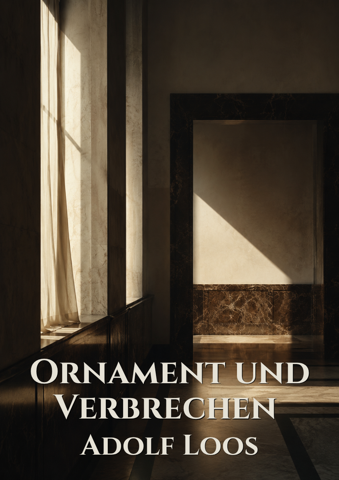
One of the Most Influential Texts in Modern Architectural Theory
A 1910 Lecture That Helped Define Modernism
Foundational to the Bauhaus, Functionalism, and 20th-Century Architecture
Celebrated, Contested, and Still Impossible to Ignore
He did not merely argue against decoration. He argued that decoration was a moral failure.
Delivered as a lecture in Vienna in 1910 and first published in French in 1913, Ornament and Crime by Austrian architect Adolf Loos remains one of the most provocative and consequential texts in the history of design. Its central argument was as radical as it was uncompromising: the elimination of ornament from utilitarian objects was not an aesthetic preference — it was the very measure of cultural progress.
For Loos, decorative forms made objects fashionable too quickly, wasting labor, material, and capital. The modern person, he argued, should turn instead toward function, material quality, and clarity. In doing so, he positioned himself in direct opposition to Art Nouveau, the Vienna Secession, and the Wiener Werkstätte — the dominant decorative movements of his time.
"The evolution of culture is synonymous with the removal of ornament from utilitarian objects." — Adolf Loos
What Loos Actually Meant
His argument was more nuanced than pure austerity. Loos deeply valued luxurious materials — marble, fine woods, brass — and used them extensively in his interiors. What he opposed was not richness, but artificiality: decoration imposed upon objects rather than arising from their function and material nature. The distinction mattered enormously to him, and it is one later readers have not always preserved.
Influence and Legacy
The essay became a foundational text of modernism, shaping the Bauhaus, functionalism, and the broader trajectory of 20th-century architecture. Its insistence that form follow function, that honesty of material supersede decorative impulse, echoed across generations of architects and designers.
At the same time, Ornament and Crime carries a shadow its admirers cannot ignore. Several of its arguments rest on a cultural hierarchy that is today recognized as deeply problematic — particularly its remarks on tattoos and non-European cultures, in which Loos conflates aesthetic restraint with civilizational superiority.
"Ornament and Crime" is a text that helped build the modern world — and one that demands to be read with both the appreciation it has earned and the critical distance it requires.
Miva: the next reading experience beyond audiobooks
Listen like an audiobook, then ask anything, anytime.
Start Miva's narrationMiva does not just narrate. It keeps explaining based on what you ask.