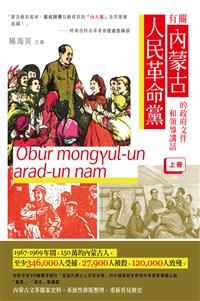
The attitude of the Chinese Communist Party (CCP) toward Inner Mongolia and the "Inner Mongolian People's Revolutionary Party" (IMPRP) underwent several critical shifts.
In October 1925, the IMPRP was established with the strong support of the Comintern and the Mongolian People's Revolutionary Party, the ruling party of the Mongolian People's Republic. At that time, the CCP expressed support for the right of self-determination for the Inner Mongolian people and encouraged the IMPRP to struggle for it. The "Declaration of the Central Government of the Chinese Soviet to the Inner Mongolian People," issued in 1935, even stated: "The Inner Mongolian nation may organize itself as it pleases; it has the right to organize its life according to its own principles, establish its own government, form federal relations with other nations, or separate completely." However, after coming to power and as the situation stabilized in the 1960s, the CCP's attitude changed drastically. It characterized the IMPRP as a "national separatist party," using this as a pretext to purge the Mongol elite and persecute Mongolian civilians. Between 1967 and 1969, nearly 500,000 Inner Mongolians were victimized, severely damaging the vitality of the Mongol nation.
In 1969, prior to the Ninth National Congress of the CCP, the number of persecuted Inner Mongolians petitioning in Beijing grew. To ensure the smooth opening of the Congress, the Central Committee issued the "May 22 Directive," demanding redress for "good people" wrongly injured during the "Incident of the Purge of the IMPRP." The political wind in Inner Mongolia shifted overnight. Additionally, the "August 28 Order" issued after the Ninth Congress required revolutionary committees in border regions to prepare against (US and Soviet) aggression. The previous propaganda advocating for "digging out the black line" and "cleansing the poison" against Mongols was replaced by calls for "Inner Mongolia as a frontline of war" and "uniting against foreign enemies."
Such shifts are particularly evident in CCP government documents and leadership speeches. The CCP's authoritarian regime bears the hallmark of the "rule of man," where speeches by high-ranking cadres—often presented as "opinions," "comments," or "instructions"—actually represent the will of the government and carry an irresistible nature. A shift in government documents and leadership speeches signifies a shift in overall national policy.
This book collects official Chinese government documents and speeches from numerous CCP leaders during the IMPRP incident. Divided into two volumes, the historical materials have been re-typed and formatted; Volume I covers the period from April 1967 to July 1969, documenting the process from advocating for the "purge" to the demand for "redress."
The "Inner Mongolia Cultural Revolution Archives" series consists of five titles, including "Collected Speeches of General Teng Haiqing Regarding the Inner Mongolian People's Revolutionary Party" (3 vols.), "Historical Evidence and Social Mobilization in Digging Out the Inner Mongolian People's Revolutionary Party" (2 vols.), "Report on the Victims in Tumd Right Banner, Inner Mongolia" (1 vol.), and "Records of Victims and Perpetrators in the Inner Mongolia Military Region" (1 vol.).
Miva: the next reading experience beyond audiobooks
Listen like an audiobook, then ask anything, anytime.
Start Miva's narrationMiva does not just narrate. It keeps explaining based on what you ask.