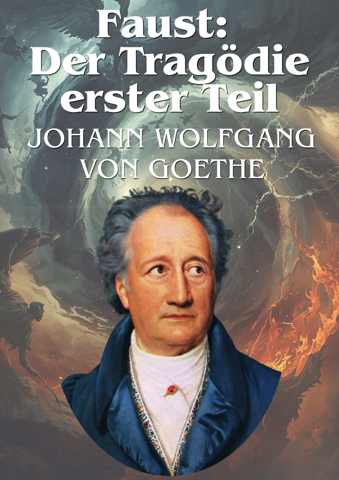
The National Epic of the German People • A Parable of All Humanity
Sixty Years in the Making • Completed Weeks Before the Author's Death
The Work That Gave the World the Concept of the "Faustian"
A scholar who knows everything decides it is not enough. He makes a deal with the devil. The devil, for once, may have underestimated his counterpart.
Johann Wolfgang von Goethe began writing Faust in his twenties and sealed the final manuscript weeks before his death at eighty-two. The project accompanied him for more than six decades—through his transformation from the rebellious young author of The Sorrows of Young Werther to the universal genius of Weimar Classicism, statesman, scientist, and the most towering figure in the history of the German language. Faust was, in his own words, his "main business." Everything else was preparation.
The premise is ancient—the scholar who bargains with the devil appears in medieval legend—but what Goethe made of it is entirely modern. Heinrich Faust is not a man who sells his soul for pleasure or power. He is a man who has mastered every field of human knowledge and found it insufficient. His bargain with Mephistopheles is a wager on the nature of satisfaction itself: Faust bets that no moment will ever be enough to make him say stay—you are so beautiful. Mephistopheles bets that it will. What unfolds across two vast dramatic parts is nothing less than the entire trajectory of Western ambition: the drive for boundless knowledge, the transgression of every limit, the destruction left in the wake of a restless, consuming intellect.
"Here Goethe has psychologically anticipated the whole future of Western Europe."
—Oswald Spengler
"The most precious statue ever to leave Goethe's workshop."
—Heinrich Heine
"Basically, it is the love story of an intellectual and a petit bourgeois woman. The devil must have been involved."
—Bertolt Brecht, on the Gretchen tragedy
The word Faustian exists because of this work—and it has never been more relevant. The bargain Goethe described: the exchange of moral accountability for the freedom to pursue knowledge and experience without limit, the belief that striving itself justifies every cost—is the bargain modernity has been making ever since. Oswald Spengler built an entire philosophy of Western civilization's rise and fall from its logic.
The Gretchen tragedy at the heart of Part One—the social destruction of an innocent girl by a man wielding intellect and supernatural power—has generated a century of analysis, from feminist readings to Brecht's characteristically dry dissection of class and seduction. It remains one of the most devastating portraits of collateral damage in all of literature.
F. W. Murnau brought Faust to expressionist silent cinema in 1926. Gustaf Gründgens's legendary stage interpretation of Mephistopheles shaped the visual image of the devil for generations. Peter Stein's monumental 21-hour theatrical production at EXPO 2000 staged the complete work as a cultural event of historic scale. The drama has since migrated into rock opera, feminist comics, and award-winning video games—each era finding in Faust's bargain a mirror for its own particular hungers.
Phrases from the work have become embedded in the German language itself: "Here I stand, poor fool that I am"; "Two souls, alas, dwell in my breast"—lines so thoroughly absorbed into everyday speech that most people who use them no longer know their source.
Goethe died in Weimar in 1832, having shaped the German language like no writer before or since. He left Faust sealed, complete, and not yet published in full. He had spent sixty years on the question of whether human striving could redeem itself.
He did not answer it simply. That was the point.
Miva: the next reading experience beyond audiobooks
Listen like an audiobook, then ask anything, anytime.
Start Miva's narrationMiva does not just narrate. It keeps explaining based on what you ask.