Story:
Independent Bathsheba Everdene inherits a farm and intends to manage it herself. Around her stand three very different men: steadfast shepherd Gabriel Oak, prosperous farmer William Boldwood, and dazzling soldier Frank Troy. A playful valentine, a reckless marriage, and the hard facts of rural work turn courtship into a test of judgment, responsibility, and the kind of love that can survive consequence.
Reading Highlights:
Hardy's countryside is never decorative. Sheep, storms, harvests, markets, and seasonal labour determine what the characters can risk, while the village chorus watches with humour and practical wisdom. Bathsheba's mistakes matter because her authority is real; the novel lets her learn without reducing independence to a flaw that must be punished.
Directed by Thomas Vinterberg; United Kingdom and United States; starring Carey Mulligan, Matthias Schoenaerts, Michael Sheen, Tom Sturridge, and Juno Temple. It is the leading recent feature-film adaptation.
How it differs from the book:
The film trims agricultural episodes and village commentary, accelerating the courtship plot and placing stronger visual emphasis on Bathsheba's choices and the three suitors.
How to choose a reader's edition:
Choose the complete 57-chapter text to retain the farming life and village voices that balance the romance. Notes help with sheep husbandry, harvest customs, military terms, and Wessex geography. In translation, beware editions marketed solely as a love story: the occupational detail is essential to Bathsheba's growth as an employer and landowner.
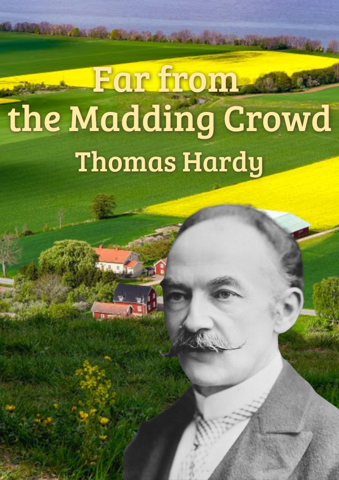
Far from the Madding Crowd appeared in 1874 and was Thomas Hardy's first major success. It also introduced the name Wessex for the partly real, partly imagined region that would organize much of his later fiction. By making Bathsheba a working landowner and placing courtship inside the risks of agriculture, Hardy joined romantic drama to the environment, labour, and communal observation that became signatures of his novels.
In the quiet countryside of Weatherbury, Gabriel Oak, an upright and sensible shepherd, falls deeply in love with the spirited Bathsheba Everdene. When he offers her his hand in marriage, she refuses, claiming she values her independence far too much to be bound to any man. Soon after, misfortune strikes Gabriel: his young shepherd dog chases his entire flock over a cliff, ruining him financially. Forced to look for employment, Gabriel happens upon a burning haystack on a grand estate and takes charge of putting out the fire. To his surprise, the estate’s newly appointed mistress is none other than Bathsheba, who has inherited her uncle’s prosperous farm. Recognizing his skill and loyalty, she hires him as her shepherd. While managing her farm, Bathsheba playfully sends an anonymous valentine marked "Marry Me" to her neighbor, William Boldwood, a solitary and dignified gentleman farmer. What begins as a harmless whim metastasizes into an obsession for Boldwood. Awakened from a life of quiet reserve, he becomes fixated on Bathsheba, begging for her hand in marriage. Intimidated and burdened by guilt for triggering his passion, Bathsheba hesitates, unsure of how to resolve the situation without breaking his heart. Before Bathsheba can make up her mind, a handsome and charismatic soldier, Sergeant Francis Troy, arrives in the village. Troy is dashing, flattered by attention, and skilled at seductive charm, captivating Bathsheba with a breathtaking display of swordsmanship in a secluded hollow. Overwhelmed by romance, Bathsheba impulsively marries him in secret, shattering Boldwood’s hopes and deeply saddening Gabriel. The marriage quickly sours. Troy is a reckless gambler who squanders Bathsheba’s hard-earned money on horse racing and shows little genuine care for her farm. Unknown to Bathsheba, Troy had previously abandoned a young village girl named Fanny Robin, whom he intended to marry until a tragic misunderstanding at the church ruined their wedding day. When Fanny dies in childbirth at a local workhouse, her body is brought back to Weatherbury. Bathsheba discovers the tragic truth and opens the coffin, finding Troy’s lost love and his deceased child inside. Devastated by grief and remorse, Troy kisses Fanny’s corpse, insults Bathsheba, and flees to the coast, where he is swept out to sea and presumed drowned. With Troy gone, a long period of quiet falls over the estate. Boldwood gradually resumes his suit, patiently waiting for the legal timeframe to pass so Bathsheba can be declared a widow. At a lavish Christmas party hosted by Boldwood, he presses her once more, and she reluctantly agrees to promise her hand in marriage in six years' time. However, the celebration is violently shattered when Troy, having survived his ordeal at sea, returns unexpectedly to claim his wife. As Troy grabs Bathsheba’s arm and she screams in distress, Boldwood loses all mental restraint. He seizes a gun from the wall and shoots Troy dead on the spot. Boldwood turns himself in, and his death sentence is later commuted to life imprisonment on grounds of insanity. In the aftermath of these harrowing tragedies, Gabriel announces his intention to emigrate to America, feeling his presence is no longer needed. Faced with the prospect of losing the one man who has stood by her through every trial, Bathsheba realizes the depth of her gratitude and true affection for him. She goes to his cottage to ask him to stay. Having learned life’s bitter lessons, Bathsheba and Gabriel are married in a quiet, unpretentious ceremony, their relationship built not on fleeting passion, but on an enduring bond of mutual trust, respect, and shared labor.
Had it been possible for the edge of the sword to leave in the air a permanent substance wherever it flew past, the space left untouched would have been almost a mould of Bathsheba’s figure.Far from the Madding Crowd Chapter 28. It uses vivid, dramatic imagery to highlight Troy's mesmerizing physical dexterity and martial charm, illustrating how his seductive skill disarms and captivates Bathsheba.
Bathsheba, you are the first woman of any shade or nature that I have ever looked at to love, and it is the having been so near claiming you for my own that makes this denial so hard to bear.Far from the Madding Crowd Chapter 19. This line conveys the raw, tragic vulnerability of Boldwood's obsessive devotion, demonstrating how Bathsheba's thoughtless action awakened a destructive passion in a previously reserved man.
Love is a possible strength in an actual weakness. Marriage transforms a distraction into a support, the power of which should be, and happily often is, in direct proportion to the degree of imbecility it supplants.Far from the Madding Crowd Chapter 4. It offers Hardy's characteristic philosophical commentary on the psychological impact of romance, framing love as an intoxicating vulnerability that can only be anchored through formal commitment.
Thomas Hardy's style presents a rich, rewarding reading experience, though modern readers may initially adjust to his elevated nineteenth-century prose and detailed descriptions of rural life. The language reflects Victorian literary traditions, featuring complex sentence structures, vast vocabulary, and occasionally local Dorset dialect spoken by the rustic farmhands. Hardy's immersive world-building pays meticulous attention to seasonal shifts, traditional farming methods, and the natural landscape of Wessex. Readers who appreciate vivid imagery, psychological depth, and atmospheric settings will find the prose profoundly engaging. The drama of the core romantic choices and the suspenseful plot turns keep the story moving forward at a compelling pace.
The work remains a classic because of its groundbreaking characterization, evocative setting, and timeless exploration of human relationships. Hardy broke away from conventional Victorian melodrama by creating Bathsheba Everdene, a complex, flawed, and fiercely independent female protagonist who insists on managing her own estate. Furthermore, Hardy's depiction of the Wessex countryside elevates nature to a central force in the narrative, mirroring the inner conflicts of his characters. The novel's enduring power lies in its realistic examination of love, distinguishing between destructive passion and the quiet, durable affection forged through shared hardship and labor.
What lies at the end of the narrative is not a simple resolution, but the quiet, solemn aftermath of passion brought to its absolute limit. Long-buried secrets return to demand an accounting, forcing every unspoken rivalry and hidden obsession into the light. A single, dramatic turning point shatters the precarious calm of Weatherbury, permanently altering the destinies of those involved and leaving no room for retreat. Yet, beyond the wreckage of impulsiveness and tragic obsession, the story reveals what remains when superficial romance burns away, bringing a rare, resilient bond forged through trial and shared labor into its rightful place.
The title is an ironical reference to Thomas Gray's famous poem, Elegy Written in a Country Churchyard, which speaks of living "far from the madding crowd's ignoble strife." Gray's verse idealizes rural existence as a peaceful retreat from the chaotic, stressful city world. Hardy chose this phrase to highlight the contrast between idyllic pastoral expectations and the reality of farm life. Far from being a serene sanctuary free of drama, Hardy's rural village of Weatherbury is filled with intense passions, destructive obsessions, tragic accidents, and profound emotional conflict.
The valentine sent by Bathsheba serves as the primary inciting incident for the tragic events surrounding William Boldwood. On a quiet afternoon, Bathsheba casually seals a valentine with the words "Marry Me" and sends it to Boldwood as an impulse, intending it as a lighthearted joke because he was the only man at the market who paid her no attention. For Boldwood, a deeply repressed man who has never pursued romantic love, the gesture is taken with absolute seriousness. It awakens a latent, obsessive passion that completely unbalances his mind, demonstrating how a momentary act of vanity can trigger catastrophic consequences.
Hardy portrays the countryside as a dynamic, living entity that intimately shapes the lives, work, and morality of its inhabitants. Rather than serving as mere background scenery, the landscape of Wessex participates in the drama, reflecting seasonal changes and echoing the characters' psychological states. The natural world presents both extreme beauty and harsh physical danger, requiring constant labor, vigilance, and respect from those who work the land. Through scenes of sheep shearing, storm protection, and late-night farm management, Hardy captures a traditional agricultural way of life that demands practical endurance and deep harmony with nature.
Miva: the next reading experience beyond audiobooks
Listen like an audiobook, then ask anything, anytime.
Start Miva's narrationMiva does not just narrate. It keeps explaining based on what you ask.