"The Mongols have rebelled!"
On April 18, 1967, Teng Haiqing followed the orders of CCP Premier Zhou Enlai to lead a military entry into the Inner Mongolia Autonomous Region. Under instructions from Kang Sheng that "bad elements of the Mongol ethnicity must be caught by the Mongols themselves," and carrying slogans like "dare to use bayonets; let the bayonets turn red," he openly called for "seizing power from the Mongols" in 1968, utilizing violence against the Mongol people.
After World War I, a wave of national self-determination rose across various countries. The "Inner Mongolian People's Revolutionary Party" (IMPRP), seeking the national liberation of the Mongol people, was established in Zhangjiakou accordingly. During the Second Sino-Japanese War, the party went underground, resumed activities after the war, but was disbanded again in 1947, with some members joining the Chinese Communist Party. Unexpectedly, when the CCP launched the Cultural Revolution in 1966, it triggered a bloody political movement in the grasslands known as the "Purge of the IMPRP." This movement investigated the history of Inner Mongolia's colonization by Japan, accusing people of "colluding with the enemy" and being "Mongol traitors," and labeled their pursuit of national liberation as advocating "national separatism."
In 1968, after the CCP officially designated the IMPRP as an "illegal counter-revolutionary organization," the Inner Mongolia Autonomous Region Revolutionary Committee, led by Teng Haiqing, launched the "IMPRP Purge Incident" under the banners of "striking at national separatism" and "class struggle." Former IMPRP members and ordinary Mongols were labeled as "IMPRP members," and Mongol elites were arrested and persecuted on a large scale, branded as "Soviet Revisionists," "Mongol Revisionists" (those in contact with Outer Mongolia), and "Japanese Spies." Specifically, supporters of the Mongol leader Ulanhu were targeted for "digging and purging": "digging up Ulanhu's black line and purging Ulanhu's poisonous influence." Out of the Inner Mongolian population of approximately 1.5 million at the time, 340,000 were arrested and over 20,000 died, an event nearing genocide and cultural extinction, comparable to the Katyn Massacre by Soviet Russia or the Khmer Rouge under Pol Pot.
From March 1969, the persecuted people of Inner Mongolia took various petitions, appeals, personal belongings of deceased relatives, and instruments of torture to Beijing to complain to the central government. This coincided with the eve of the "Ninth National Congress," and Mao Zedong decided to cool down the Cultural Revolution so the Congress could proceed smoothly. Under pressure from the petitions, the CCP Central Committee issued the "May 22 Directive," requiring the rehabilitation of innocent people who were mistakenly harmed. The political wind in Inner Mongolia shifted overnight. Teng Haiqing became a target of criticism, facing denunciation meetings where survivors and families of victims delivered tearful testimonies.
It was not until the CCP ceded eastern Inner Mongolia to the three northeastern provinces and western Inner Mongolia to Gansu and the Ningxia Hui Autonomous Region—restoring the traditional "divide and rule" method—that the incident finally quieted down. Teng Haiqing was transferred to Shandong in 1975 to serve as Deputy Commander of the Jinan Military Region. After the Cultural Revolution ended in 1976, although the "IMPRP Incident" was rehabilitated and classified as a historical error, Teng Haiqing never faced any criminal penalties throughout his life and died of illness in 1997.
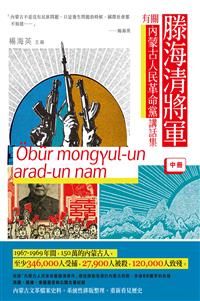
This book collects Teng Haiqing's speeches during his rule in Inner Mongolia and relevant documents from the late Cultural Revolution. The work is divided into three volumes, re-typed and formatted based on historical materials. Volume II covers March to December 1968, the consolidation phase of the "Purge" action of the "IMPRP Incident."
The "Inner Mongolia Cultural Revolution Archives" series consists of five titles, including Government Documents and Leadership Speeches Regarding the Inner Mongolian People's Revolutionary Party (2 vols.), Historical Evidence and Social Mobilization of the Purge of the Inner Mongolian People's Revolutionary Party (2 vols.), Report of Victims in Tumed Right Banner, Inner Mongolia (1 vol.), and Records of Victims and Perpetrators in the Inner Mongolia Military Region (1 vol.).
Miva: the next reading experience beyond audiobooks
Listen like an audiobook, then ask anything, anytime.
Start Miva's narrationMiva does not just narrate. It keeps explaining based on what you ask.