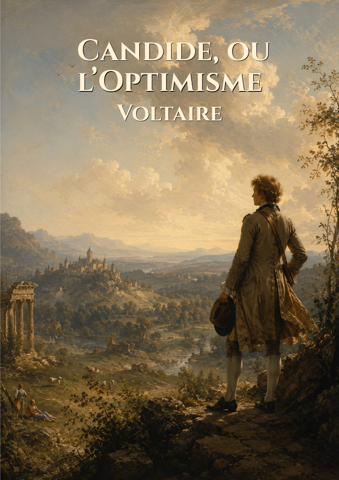
Published in 1759, Candide, or Optimism is one of the most famous philosophical tales.
The novel tells the story of Candide, a naive young man raised in the castle of Baron Thunder-ten-tronckh in Westphalia. His master, Pangloss, teaches him that "all is for the best in the best of all possible worlds," an idea inspired by the philosophy of Leibniz. But after being expelled from the castle for kissing Cunégonde, Candide discovers a world marked by violence, catastrophe, and human suffering. He travels across Europe and America, witnessing wars and earthquakes.
Through this journey of initiation, Voltaire denounces the philosophical illusions that prevent men from seeing reality. The famous Lisbon earthquake, religious persecutions, slavery, and political corruption become concrete examples of the world's cruelty. Even Eldorado, an ideal society based on peace and reason, appears as a place inaccessible to real humanity.
The style of the work is characterized by rapid, concise, and ironic writing. Voltaire blends black humor, exaggeration, and satire to make his critique more effective. Behind the apparent simplicity of the narrative lies a profound reflection on the human condition.
The conclusion of the tale, with the famous phrase "We must cultivate our garden," summarizes Voltaire's thought: instead of getting lost in abstract speculations, one must focus on practical work.
Even today, Candide remains a major work.
Miva: the next reading experience beyond audiobooks
Listen like an audiobook, then ask anything, anytime.
Start Miva's narrationMiva does not just narrate. It keeps explaining based on what you ask.