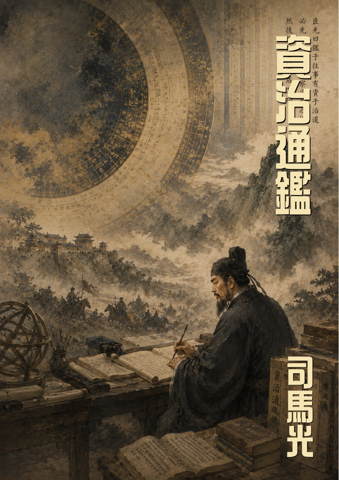
The Zizhi Tongjian (abbreviated as Tongjian) is a monumental and highly influential chronological history of China. It was compiled by the famous Northern Song dynasty historian Sima Guang, who led a team of assistants including Liu Shu, Liu Ban, Fan Zuyu, and Sima Kang over a period of 19 years. Along with Sima Qian's Shiji (Records of the Grand Historian), it is considered one of the two immortal masterpieces of Chinese historiography, leading to the phrase "The Two Simas of Historiography."
Below is a detailed introduction to the Zizhi Tongjian:
Meaning of the Title and Purpose of Compilation
The title Zizhi Tongjian was personally bestowed by Emperor Shenzong of Song, who also wrote the preface.
- Zi (資): To assist/help.
- Zhi (治): Governance (politics/ruling the country).
- Tong (通): A comprehensive history connecting past and present.
- Jian (鑑): A mirror (to take as a lesson).
Its core purpose, as stated by Sima Guang in his "Memorial on the Presentation of the Tongjian," was: "To focus on the rise and fall of states and the welfare of the people, so that the good may serve as a model and the evil as a warning." It was written specifically for emperors and the ruling class to provide historical lessons on governance through the causes and effects of order and chaos across dynasties.
Coverage and Scale
The Tongjian is the largest chronological history in Chinese history:
- Word Count and Volumes: It consists of 294 volumes (juan) and approximately 3 million characters.
- Time Span: It covers 1,362 years of detailed history, beginning with the "Partition of Jin" in the 23rd year of King Weilie of Zhou (403 BC) and ending with the conquest of Huainan by Emperor Shizong of the Later Zhou in the 5th year of Xiande (959 AD), spanning 16 dynasties.
- Emphasis on the Recent Past: The records are most detailed for the Sui, Tang, and Five Dynasties periods closer to the Song (112 volumes, accounting for nearly 40% of the work). This section is considered the most historically valuable.
Rigorous Compilation Team and Process
This masterpiece was not the work of Sima Guang alone; he assembled a top-tier "historiography studio" using a highly scientific and systematic workflow:
- Core Team Division of Labor
- Sima Guang (Editor-in-Chief): Responsible for planning the format, overseeing the entire project, and final editing to ensure a consistent style.
- Liu Ban: Responsible for Han Dynasty history.
- Liu Shu: Responsible for the Three Kingdoms, Jin, and Northern and Southern Dynasties (Sima Guang's most relied-upon assistant).
- Fan Zuyu: Responsible for the Tang and Five Dynasties.
- Sima Kang (Sima Guang’s son): Responsible for proofreading and checking texts.
- Liu Xisou (Astronomer): Responsible for ensuring the accuracy of the calendar system.
- Three-Step Compilation Process
- Step 1: Compiling "Concordances" and "Long Drafts" Assistants collected data from 17 official histories and 322 types of unofficial histories, miscellanies, collections, and inscriptions, arranging them chronologically. The draft was required to be exhaustive; for example, the draft for the Tang Dynasty alone exceeded 600 volumes.
- Step 2: Conducting "Examination of Discrepancies" (Kaoyi) When sources conflicted, Sima Guang and his assistants conducted rigorous textual research to distinguish truth from falsehood, writing the Zizhi Tongjian Kaoyi (30 volumes) to explain why specific accounts were chosen. This pioneered historical criticism in China.
- Step 3: Editing the "Final Text" Sima Guang personally trimmed the long drafts (e.g., condensing the 600-volume Tang record into 81 volumes) and hand-wrote the entire work in regular script.
Writing Style and Literary Features
- Concise and Fluent Language: Sima Guang avoided obscure words, using a clear, fluent style reminiscent of the Western Han. Even excerpts from official histories were edited for readability.
- Vivid Military Descriptions: The Tongjian emphasizes military history. Major battles like Maling, Guandu, Red Cliffs, and Feishui are depicted with vivid detail and dramatic tension.
- Emphasis on Causality: Sima Guang focused on identifying the "root causes and consequences" of events (e.g., tracing the regional military governorships of the late Tang to the court's earlier leniency).
- "Your Servant Guang Says" (Historical Commentary): The book includes 186 commentaries. 102 were written by Sima Guang himself, beginning with "Your Servant Guang Says," to systematically articulate his political, moral, and historical views.
Historical Limitations and Orthodox Stance
While a masterpiece, the work reflects its era and the author's biases:
- Strong Pro-Orthodoxy Stance: In divided eras, the Tongjian takes a subjective view. For example, it treats Cao Wei as the legitimate successor during the Three Kingdoms (giving it "Annals" while Shu Han and Wu have none, and calling Zhuge Liang’s campaigns "incursions"). This drew criticism from later Neo-Confucians like Zhu Xi.
- Conservative Political Bias: Sima Guang was a staunch conservative (opposing Wang Anshi's reforms). This is reflected in his harsh criticism of Shang Yang's reforms and his praise for conservative "rule by precedent."
- Inclusion of Unofficial Histories: By citing works like the Private Life of Zhao Feiyuan, some plots are considered overly mythical or unreliable by later scholars.
Influence and Legacy
- Model for Later Historians: It became the definitive model for chronological history. In the Southern Song, Yuan Shu created the Tongjian Jishi Benmo by rearranging the text by event, creating a new historical format. Zhu Xi wrote the Zizhi Tongjian Gangmu due to disagreements with Sima Guang's views on orthodoxy.
- Essential Reading for Rulers: Virtually every ruler and politician in Chinese history studied it. The scholar Wang Yinglin praised it, saying: "Since the beginning of writing, there has been nothing like the Tongjian." In modern times, Mao Zedong claimed to have read it 17 times.
- Modern Application: Today, its wisdom on political strategy and organizational management is even applied to business and corporate strategy.
Miva: the next reading experience beyond audiobooks
Listen like an audiobook, then ask anything, anytime.
Start Miva's narration
Miva does not just narrate. It keeps explaining based on what you ask.