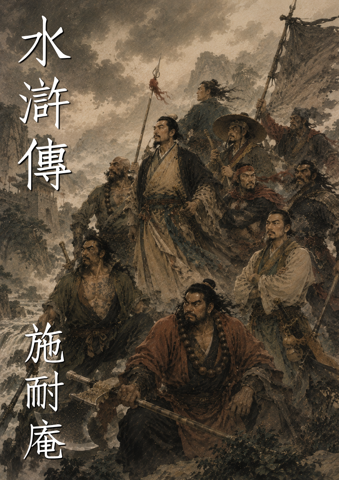
“Water Margin” (also known as “Outlaws of the Marsh,” “All Men Are Brothers,” or “The Loyalty and Righteousness of Water Margin”) is the first full-length chapter novel written in vernacular Mandarin in the history of Chinese literature. It is listed as one of the “Four Great Classical Novels of Chinese Literature,” and was selected by the late Ming dynasty man of letters Jin Shengtan as one of the “Six Works of Genius,” and evaluated by Li Yu as one of the “Four Great Extraordinary Books.”
This epic work primarily describes the grand journey of 108 heroes, led by Song Jiang, who gathered in Liangshan Marsh, Shandong, during the late Northern Song dynasty. It covers their transition from being forced into outlawry and growing in strength to eventually accepting the imperial court's amnesty, fighting in various campaigns, and ultimately meeting a tragic end.
I. Period of Writing and the Background of “Cumulative Creation”
There has long been debate in academic circles regarding the authorship and the exact period when “Water Margin” was written. Current consensus in history and literature circles is relatively clear:
Period of Writing (Ming Dynasty Jiajing Theory): The earliest extant complete version of “Water Margin” was printed in 1589. Mainstream modern scholarship supports the “Ming Dynasty Jiajing Theory,” speculating that the final text was finalized around 1524 (mid-Ming dynasty).
Cumulative Folk Creation: Song Jiang was a real historical figure (a leader of a peasant uprising during the Xuanhe era of the Northern Song). After the uprising failed, his stories spread wildly among the people:
Song Dynasty: Records already existed in the Southern Song work “Dongdu Shilu,” and standalone stories of figures like Wu Song, Lu Zhishen, and Yang Zhi began to appear in the “Huaben” (prompt books) of folk storytellers.
Yuan Dynasty: The prompt book “Old Incidents in the Xuanhe Period of the Great Song” contained the prototype of the Water Margin story; many Water Margin plays (such as “Li Kui Carries Thorns”) also appeared in Yuan Zaju drama.
Ming Dynasty: Finally, literati integrated and expanded these scattered folk materials, plays, and historical records with genius-level skill to create this long masterpiece.
II. The Mystery of Authorship: Shi Nai'an and Luo Guanzhong
There are several theories about who wrote “Water Margin,” but the most widely accepted is the “Shi Nai'an and Luo Guanzhong Collaboration Theory.”
Shi Nai'an (Primary Author): Lived during the late Yuan and early Ming dynasties. Legend has it he served as the magistrate of Qiantang County but resigned in indignation due to dissatisfaction with Mongol rule. He later briefly served as a military counselor for the separatist leader Zhang Shicheng. After retiring, he lived in seclusion to write, integrating the life prototypes of the salt-worker uprisings under Zhang Shicheng into the characterization of the Liangshan heroes.
Luo Guanzhong (Editor/Compiler): A student of Shi Nai'an (and the author of “Romance of the Three Kingdoms”). Ming dynasty documents record that “Water Margin” was “the draft by Shi Nai'an of Qiantang, edited by Luo Guanzhong.” It is generally believed that the first seventy chapters were written by Shi Nai'an, while the final thirty to fifty chapters (amnesty and campaign sections) were organized, edited, or continued by Luo Guanzhong.
Other Theories: Hu Shih once suspected that “Shi Nai'an” was merely a pseudonym used by a mid-Ming dynasty scholar, as writing vernacular novels carried the risk of being accused of “rebellion,” and scholar-officials dared not sign their real names. Another theory suggests Shi Nai'an was actually the late Yuan/early Ming Nanqu dramatist Shi Hui.
III. Complex Version System: Full and Abridged Editions
Over centuries of circulation, “Water Margin” evolved into an extremely complex system of versions, generally divided into “Full Editions” (refined prose, detailed text, high literary value) and “Abridged Editions” (simple prose, many plots but rough writing). The three most widely circulated full editions are:
100-Chapter Edition (Closest to the original): Narrates the gathering of heroes, amnesty, northern campaign against the Liao, and southern campaign against Fang La, ending with Song Jiang drinking poisoned wine and a tragic conclusion.
120-Chapter Edition (Most complete plot): Based on the 100-chapter version, it inserts plots where the court sends Liangshan to suppress Tian Hu in Hebei and Wang Qing in Huaixi.
70-Chapter Edition (Jin Shengtan’s truncated version): The late Ming/early Qing genius Jin Shengtan hated Song Jiang's surrender. He drastically “truncated” the 120-chapter version, deleting all plots after Chapter 71 regarding amnesty and campaigns. He rewrote the ending to be Lu Junyi having a nightmare where all the Liangshan heroes are executed. Due to its excellent literary commentary, this was the most widely circulated version during the Qing dynasty.
IV. Core Plot and Structure
The structure of “Water Margin” is unique, employing a chain-like structure of “from individual to collective, then from collective to dispersed.” The plot can be divided into three stages:
Forced into Liangshan (Chapters 1–40)
The story begins with Marshal Hong accidentally releasing the spirits of the 36 Heavenly Spirits and 72 Earthly Fiends. Subsequently, in an “anthology” format, the novel describes one by one how heroes were driven to desperation by corrupt officials (Gao Qiu, Cai Jing, Tong Guan) and local bullies, eventually fleeing to Liangshan Marsh. Classic episodes like “Lu Zhishen Pulls Up the Willow Tree,” “Lin Chong Flees to Liangshan on a Snowy Night,” “Wu Song Fights the Tiger,” and “The Wise Capture of the Birthday Gifts” are concentrated here.
The Great Gathering (Chapters 41–80)
After Song Jiang joins the mountain and succeeds the fallen Chao Gai as leader, Liangshan’s power reaches its peak. The heroes rob the rich to help the poor, flying the banner of “Acting on Behalf of Heaven.” They successively conquer Zhu Family Village, Gaotang Prefecture, and Daming Prefecture, and defeat several imperial armies sent by Gao Qiu and Tong Guan. This stage culminates in the grand ranking of the 108 heroes at the “Hall of Loyalty and Righteousness.”
Amnesty and Tragic Ending (Chapters 81–120)
Leaders Song Jiang and Wu Yong, unwilling to bear the stigma of “bandits” forever, strive for imperial amnesty. After surrendering to the Northern Song court, the heroes become tools of the state, fighting campaigns against the Liao, Tian Hu, and Wang Qing. In the final, brutal campaign against Fang La in the south, Liangshan encounters powerful enemies, and most of the 108 generals die in battle or from illness.
Upon returning to court, only about 20 heroes remain (Lu Zhishen passes away in meditation, Wu Song becomes a monk, Li Jun sails overseas). However, corrupt officials like Gao Qiu do not let them go and plot to poison Lu Junyi and Song Jiang. Before he dies, Song Jiang, fearing Li Kui would rebel and ruin Liangshan's name of “loyalty,” tricks Li Kui into drinking poisoned wine. Wu Yong and Hua Rong subsequently hang themselves at Song Jiang's grave. A magnificent peasant uprising ends in tragedy.
V. Multiple Interpretations of Themes
Over centuries, critics and politicians have offered starkly different interpretations of the core ideology of “Water Margin”:
“Loyalty and Righteousness” vs. “Opposing Corrupt Officials but Not the Emperor”: Ming dynasty scholars like Li Zhi believed the novel promotes the spirit of “Loyalty.” The heroes oppose “corrupt officials” like Cai Jing and Gao Qiu but remain loyal to Emperor Huizong. This was later criticized by Lu Xun: “Because they did not oppose the Emperor, they accepted amnesty as soon as the army arrived... eventually becoming slaves.”
A Rebellious Book Teaching Banditry: During the Ming and Qing dynasties (especially from the Chongzhen era to the Daoguang era), the court viewed it as a “seditious book” that incited rebellion. There was a folk saying, “The young should not read Water Margin” (fearing youth would blindly admire violence and gang-style chivalry). Consequently, it was banned for long periods.
An Ode to Peasant Uprising: After the 1950s, official Chinese views positioned it as a “realistic milestone successfully depicting peasant uprisings,” praising it for exposing the evils of the feudal ruling class and the social inevitability of “officials forcing the people to rebel.”
Mao Zedong’s “Negative Example of Capitulationism”: In 1975, Mao Zedong commented that the value of “Water Margin” lies in its depiction of “surrender,” serving as a negative example. He pointed out that Song Jiang practiced revisionism, changed the Hall of Assembly to the Hall of Loyalty and Righteousness, sidelined Chao Gai, and eventually surrendered, representing a line of capitulationism. This sparked a nationwide “Water Margin Criticism Movement.”
VI. Artistic Achievement and Far-reaching Influence
Pioneer of Vernacular Literature: As China's first mature vernacular novel, its language is vivid, sharp, and concise, establishing the national form of the Chinese classical novel.
Vivid Characterization: The characters are not clichéd. Although there are 108 of them, the main figures—such as Song Jiang's hypocrisy and generosity, Lin Chong's endurance and explosion, Lu Zhishen's boldness and meticulousness, and Wu Song's straightforward vengeance—all have distinct personalities and dialogue that fits their social status.
Global Cultural Derivatives:
Literary Sequels and Adaptations: The famous Ming dynasty novel “The Golden Lotus” (Jin Ping Mei) was created by extending the plot of Ximen Qing and Pan Jinlian from “Water Margin.” Later centuries saw numerous sequels like “The Later Story of Water Margin” and “Dang Kou Zhi.”
International Spread: It has been translated into many languages. Pearl S. Buck translated it as “All Men Are Brothers,” Sidney Shapiro as “Outlaws of the Marsh,” and the French translation is “Au bord de l'eau” (At the Water's Edge).
Modern Entertainment: Japan has been obsessed with “Water Margin” since the Edo period. In modern times, it has been adapted into countless manga (e.g., Mitsuteru Yokoyama's version), video games (e.g., Konami’s classic RPG “Suikoden” series, Koei’s “Bandit Kings of Ancient China”), and card games (e.g., the “Fire Fist” archetype in Yu-Gi-Oh!), demonstrating its powerful cultural vitality across time and space.
Miva: the next reading experience beyond audiobooks
Listen like an audiobook, then ask anything, anytime.
Start Miva's narrationMiva does not just narrate. It keeps explaining based on what you ask.