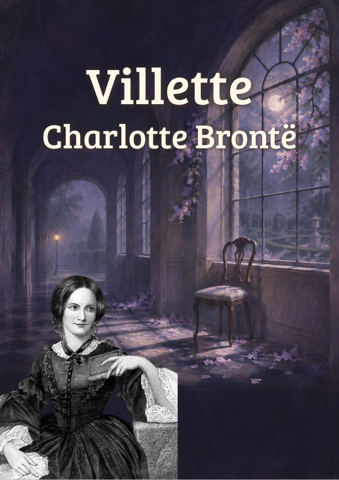
Background:
Published in 1853, the novel draws on Charlotte Brontë's experience in Brussels while transforming school work, religious difference, migration, solitude, and desire into a psychologically demanding first-person narrative.
The central tension:
Lucy Snowe travels alone to the fictional city of Villette and finds employment in a girls' school. Her account records work and attachment but also withholds motives and events, making the reader's relation to her uncertainty central.
How the writing works:
Retrospective first-person narration, gaps, dreamlike sequences, untranslated French dialogue, Gothic suggestion, and deliberate understatement create a narrator whose eloquence never guarantees full disclosure.
Lucy Snowe tells her own story but never offers herself for easy possession. She can describe a room, a face, or a theatrical performance with extraordinary intensity and then pass over a personal crisis in a sentence. That imbalance is the source of Villette's peculiar intimacy: readers are close to Lucy's intelligence yet continually reminded that she chooses what they may know. Her loneliness is therefore not merely a theme but a rule governing the narration.
The school in Villette is a workplace, a surveillance system, and a stage. French dialogue changes who has access to a conversation; religious difference shapes friendship and suspicion; amateur theatricals release impulses that ordinary school discipline contains. The Gothic nun may look like an intrusion from another genre, but it embodies the book's repeated uncertainty about whether desire, illness, memory, or an external plot is controlling the scene.
Readers who know Jane Eyre should not expect the same emotional contract. Villette is colder, stranger, more cosmopolitan, and less willing to convert suffering into a single triumphant meaning. Preserve the French rather than skipping it automatically: even partial comprehension lets the reader feel when Lucy is included, excluded, or strategically silent.
Lucy Snowe's reserve creates a special kind of suspense. She may tell us exactly how a face changes during a performance, then conceal the event that has most altered her own life. The reader becomes alert to gaps, sudden shifts of tone, and objects that acquire an intensity larger than their apparent role. This is not a puzzle with a final key. Lucy's omissions protect her, test us, and reproduce the loneliness of a person who has learned that disclosure does not guarantee care.
Around that guarded voice, Brontë builds a sensuous world of classrooms, dormitories, streets, gardens, confessionals, and stages. Work matters: Lucy's authority grows from competence, not rescue. So do language and religion, which decide who can participate fully in a conversation and who is treated as an outsider. The novel can be darkly funny, feverish, jealous, and severe within a few pages. Readers willing to surrender the emotional certainties of a conventional romance will find one of the nineteenth century's boldest portraits of consciousness.
The reward of Villette is the feeling that every sentence has a second temperature. Lucy's wit can conceal fury; a school celebration can become erotic theater; a supernatural sign can be both ridiculous and genuinely frightening. The ending does not cancel this ambiguity but perfects it. Readers who enjoy narrators they must actively interpret, atmospheres that shift without warning, and romances shaped as much by work and intellectual rivalry as by attraction may discover that this is Charlotte Brontë's most haunting book.
Director: Moira Armstrong
Production country: United Kingdom
Cast: Judy Parfitt, Bryan Marshall, Peter Jeffrey
Difference from the book: condenses Lucy's long retrospective account into a television serial and necessarily externalizes many of her omissions and private judgments.
French dialogue and Lucy's calculated omissions belong to the design. Useful notes should assist with language and context without explaining away the uncertainty.
Villette remains important for its representation of paid work, loneliness, religious and national difference, and a female narrator who resists the reader's demand for complete emotional access.
Miva: the next reading experience beyond audiobooks
Listen like an audiobook, then ask anything, anytime.
Start Miva's narrationMiva does not just narrate. It keeps explaining based on what you ask.