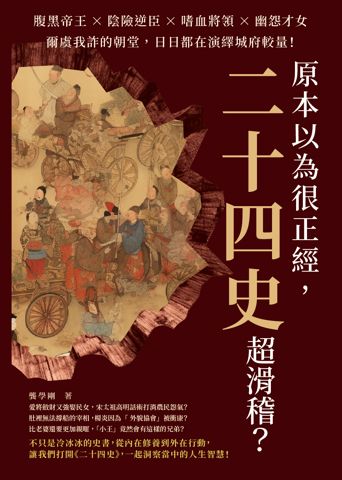
► A favorite general amasses wealth and forcibly marries a local woman—how did Emperor Taizu of Song use clever rhetoric to quell peasant resentment?
► A Prime Minister with no room in his heart—was Yang Yan sabotaged simply because of his appearance?
► More intimate than a wife—how could a "third wheel" have a brotherhood like this?
More than just cold history books, from inner cultivation to external actions,
let's open the Twenty-Four Histories and gain insight into the wisdom of life!
▎Bao Zheng, the God of Justice: Seeing through a case within a case with one remark
In the novel The Seven Heroes and Five Gallants, Bao Zheng's image as a mastermind is deeply rooted;
but setting aside artistic portrayals, was the real Bao Zheng in history... even more mysterious?
When Bao Zheng served as the magistrate of Tianchang, he encountered a bizarre case.
A farmer complained that his plow ox's tongue had been cut off by someone unknown.
People usually steal oxen, chickens, or ducks—what use is there in cutting an ox's tongue?
Suspecting a hidden motive, Bao Zheng pretended not to care and told the farmer to slaughter the ox for sale.
Soon after, another person came to the yamen to report the farmer for slaughtering a plow ox without permission. Bao Zheng immediately ordered his arrest.
It turns out that according to Song Dynasty law, farmers were not allowed to slaughter plow oxen privately.
This person had malicious intentions, aiming to cause the farmer to lose his ox and then report him to the authorities.
With his wisdom and precise judgment, Bao Zheng quickly caught the "culprit" behind the scenes.
▎Bai Qi, the God of War who terrified nations: Was he repaid with ingratitude by King Zhaoxiang of Qin?
Buried alive 400,000 Zhao troops using a ruse in the Battle of Changping—Bai Qi's cruelty and bloodlust were evident to all.
At the same time, he was fiercely loyal to the Qin State and never lost a battle. Why did he ultimately commit suicide?
After the Battle of Changping, Zhao's main forces were lost, the nation was on the brink of collapse, and the country was in panic.
Su Dai, a retainer of Lord Pingyuan, was unwilling to wait for death and volunteered to go to Qin to lobby.
At that time, the Prime Minister of Qin was Fan Ju. Su Dai used a strategy of sowing discord to make Fan Ju feel threatened,
who then quickly advised the King of Qin to withdraw troops. Soon, the order to retreat reached Bai Qi's hands.
A perfect opportunity to destroy Zhao was ruined. Fan Ju's behavior caused strong resentment in Bai Qi.
Thereafter, whenever Fan Ju visited, Bai Qi claimed illness and refused to lead troops to war.
After both soft and hard tactics failed, the King of Qin helplessly dismissed and exiled Bai Qi.
Fan Ju saw his chance and suggested King Zhaoxiang order Bai Qi's death to eliminate future trouble...
▎Loyal Ministers VS. Tyrant: "Anyone who dares to advise me can go die!"
After the fake eunuch Lao Ai and Queen Mother Zhao Ji attempted a coup, Qin Shi Huang quickly suppressed the rebellion.
Enraged, Ying Zheng ordered the house arrest of his biological mother, triggering a crisis of public opinion...
Legend has it that Zhao Ji was originally the concubine of Lu Buwei.
As Ying Zheng grew older, Lu Buwei arranged for Lao Ai to enter the palace to avoid trouble.
On the surface, he was a "eunuch" serving the Queen Mother, but in reality, he fathered two sons with her.
After the Lao Ai rebellion, Ying Zheng executed his two half-brothers and imprisoned his mother.
At that time, "filial impiety" was a supreme crime. Many officials advised the King of Qin to bring back the Queen Mother.
The King was furious and ordered the execution of all twenty-seven officials, their bodies piled into a small hill.
Mao Jiao of the Qi State, however, indifferently requested to give advice: "I am here to be the twenty-eighth!"
[Book Features]
From the Records of the Grand Historian to the History of Ming, the Twenty-Four Histories systematically record thousands of years of Chinese history, comprehensively showcasing the rise and fall of dynasties. Covering politics, economy, culture, and military affairs of various periods, it is an encyclopedia of Chinese civilization. This book selects stories and categorizes them into five aspects: self-cultivation, governance, personnel management, social conduct, and family. Through a relaxed and clear vernacular narrative and objective evaluation from a new perspective, it hopes to bring new inspiration to readers.
Miva: the next reading experience beyond audiobooks
Listen like an audiobook, then ask anything, anytime.
Start Miva's narrationMiva does not just narrate. It keeps explaining based on what you ask.