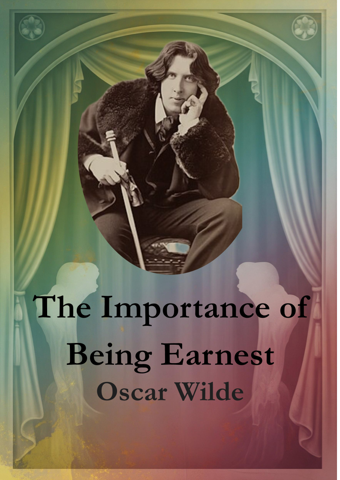
Oscar Wilde's "The Importance of Being Earnest: A Trivial Comedy for Serious People" is a brilliant farcical comedy first staged in 1895. The play centers on two bachelors, Jack Worthing and Algernon Moncrieff, who both invent a fictional invalid brother named 'Ernest' as an excuse to escape their social obligations and pursue their romantic interests. Jack uses 'Ernest' to woo Gwendolen Fairfax in the city, while Algernon uses 'Ernest' to visit Jack's ward, Cecily Cardew, in the country. Their elaborate deceptions lead to a series of hilarious misunderstandings and mistaken identities. Wilde's masterpiece is renowned for its sparkling wit, clever wordplay, and incisive satire of Victorian social conventions, particularly the institution of marriage, morality, and the upper class. Through its memorable characters, such as the formidable Lady Bracknell, the play masterfully explores themes of identity, superficiality, and the absurdities inherent in polite society, all while parodying the dramatic conventions of the era.
Reading ease score: 77.9 (7th grade). Fairly easy to read.
In London, Algernon Moncrieff receives a visit from his friend Jack Worthing, who goes by the name "Ernest" in the city. Jack announces his intention to propose to Algernon’s cousin, Gwendolen Fairfax. However, Algernon discovers an inscription in Jack’s cigarette case from a young woman named Cecily Cardew, addressing Jack as her "uncle." Jack is forced to confess his secret: he lives a double life. In the countryside, he is a respectable guardian named Jack to his young ward, Cecily. To escape his tedious country responsibilities and visit London, he invented a rebellious younger brother named "Ernest" who constantly gets into trouble. Algernon reveals that he practices a similar deception, having invented an invalid friend named "Bunbury" whose frequent relapses allow him to avoid unwanted social obligations. When Lady Bracknell and Gwendolen arrive, Jack takes the opportunity to propose to Gwendolen. She joyfully accepts, confessing that it has always been her absolute dream to love someone named Ernest, as the name inspires complete confidence. However, Lady Bracknell firmly interrupts the match and conducts a strict interrogation of Jack’s background, social standing, and finances. Though Jack meets her financial standards, the interview falls apart when he reveals that he does not know his parents; he was found as an abandoned baby in a leather handbag at Victoria Station. Horrified by his lack of family connections, Lady Bracknell forbids the marriage until he can produce respectable relatives. Meanwhile, Algernon overhears Jack giving Gwendolen his country address in Woolton and secretly decides to go "Bunburying" there to meet Cecily. At Jack’s country manor, Cecily studies under her governess, Miss Prism, alongside the local rector, Dr. Chasuble. Algernon unexpectedly arrives, pretending to be Jack’s wicked brother Ernest. Cecily is instantly fascinated by him, having already fallen in love with "Ernest" through romantic fantasies recorded in her diary. Shortly after, Jack returns dressed in full mourning clothes, intending to announce that his fictitious brother Ernest has died in Paris. He is stunned to find Algernon alive and well, posing as Ernest in his own home. Forced to keep up appearances, Jack demands that Algernon leave, but Algernon refuses as he courts Cecily. Both Jack and Algernon secretly arrange with Dr. Chasuble to be christened "Ernest" that afternoon to satisfy their lovers' fascination with the name. The plot thickens when Gwendolen arrives at the country house to visit Jack. She meets Cecily in the garden, and during a polite afternoon tea, both women discover they are engaged to "Ernest Worthing." A heated argument breaks out over who has the rightful claim. When Jack and Algernon join them, the truth is exposed: neither man is named Ernest, and both have concocted elaborate lies. Outraged and betrayed, Gwendolen and Cecily retreat into the house, leaving the two men to argue while eating muffins. The women soon forgive the men after they explain that their deceptions were conducted entirely out of devotion to win their hearts. Lady Bracknell then arrives in search of Gwendolen. Upon learning of Cecily’s massive fortune, she gives her consent for Algernon to marry Cecily, but Jack, as Cecily’s guardian, refuses to allow the union unless Lady Bracknell permits his marriage to Gwendolen. The impasse is resolved when Dr. Chasuble mentions Miss Prism. Lady Bracknell demands to see her and reveals that twenty-eight years earlier, Miss Prism was a nurse who disappeared with a baby boy. Under questioning, Miss Prism shamefully admits that she misplaced the baby in a black leather handbag at Victoria Station while placing her novel manuscript in the baby carriage. Jack realizes he was that baby and produces the handbag from his room, proving his identity. Lady Bracknell reveals that Jack is actually her nephew, the son of her late sister, making him Algernon’s elder brother. Upon consulting the military records of his father, Jack discovers his father’s name was indeed Ernest. He has been named Ernest all along without knowing it. With all obstacles cleared, the couples are united, and Jack embraces his new identity, declaring that he has finally realized the vital importance of being Ernest.
We live, as I hope you know, Mr. Worthing, in an age of ideals. The fact is constantly mentioned in the more expensive monthly magazines, and has reached the provincial pulpits, I am told; and my ideal has always been to love some one of the name of Ernest.The Importance of Being Earnest: A Trivial Comedy for Serious People Act I. It brilliantly satirizes Victorian superficiality and social absurdities by elevating a mere name to a profound moral ideal.
To lose one parent, Mr. Worthing, may be regarded as a misfortune; to lose both looks like carelessness.The Importance of Being Earnest: A Trivial Comedy for Serious People Act I. This famous line showcases Wilde's signature dark wit, inverted logic, and complete lack of empathy for conventional human tragedy.
All women become like their mothers. That is their tragedy. No man does. That's his.The Importance of Being Earnest: A Trivial Comedy for Serious People Act I. It succinctly captures the play's cynical view of gender relations and generational inevitability through a balanced, memorable epigram.
The play is remarkably accessible and widely considered one of the easiest 19th century literary works to read and enjoy. Because it is written as a theatrical play rather than a dense prose novel, the narrative moves at a rapid pace through dialogue rather than long descriptive passages. Oscar Wilde's humor relies heavily on clear, punchy epigrams and lively exchanges that feel surprisingly modern and fresh. While some of the Victorian vocabulary and social references require minor context, the underlying jokes about romance, social pressure, and hypocrisy are universal. Most readers find that the play's brevity and comedic timing make it an engaging experience rather than a difficult academic exercise.
Oscar Wilde's play stands as a masterpiece of satirical comedy because of its unmatched linguistic precision and incisive critique of Victorian society. It perfected the comedy of manners genre by using inverted logic, wordplay, and paradoxes to mock the superficial values of the late 19th century elite. Rather than delivering a heavy handed moral lesson, Wilde treats serious matters such as marriage, identity, and class with lighthearted triviality, while treating trivial matters with intense seriousness. This brilliant reversal creates a timeless humor that continues to influence modern comedic writing, political satire, and theatrical storytelling across the world.
At the climax, the mountain of absurdity and elaborate deceptions constructed by Jack and Algernon comes crashing down in a flurry of confronting truths. As both men race against time to alter their identities, Lady Bracknell arrives to reassert cold social order, threatening to tear apart every prospective match. Yet the ultimate unraveling does not come from a grand trial, but from the sudden entrance of an unsuspected past: a long-lost leather handbag, an old manuscript, and a forgotten nurse whose single confession upends decades of hidden history. What waits in the final moments is a brilliant string of revelations where every lie transforms into truth, delivering the most satisfying, ironic punchline in theatrical history.
"Bunburying" is a term coined by Algernon Moncrieff to describe the practice of creating a fictional person or responsibility to escape unwanted social obligations. Algernon invents an invalid friend named Bunbury who lives in the country and frequently suffers severe relapses, giving Algernon a convenient excuse to leave London whenever he wishes to avoid family dinners or boring parties. Jack practices a similar form of deception by inventing a troublesome brother named Ernest in London to escape his guardian duties in the country. The term has since become a famous literary symbol for living a double life or fabricating excuses to shirk social duties.
The title is a brilliant double entendre that lies at the heart of the play's central satire. It plays on the homophones "Earnest," the moral quality of being sincere and truthful, and "Ernest," the male given name that both Gwendolen and Cecily are obsessed with. Throughout the play, none of the main characters are actually earnest; they lie, invent fake relatives, and deceive their loved ones continuously. The title ironically highlights how society values the superficial appearance of being named Ernest far more than the actual moral virtue of being earnest in conduct and truth.
Lady Bracknell serves as the ultimate embodiment of Victorian aristocratic snobbery, materialism, and rigid social hierarchy. She evaluates potential suitors strictly based on their wealth, political affiliations, family connections, and street addresses rather than their character or moral standing. Her dialogue consistently treats human emotion with cold detachment while treating financial assets and social etiquette with absolute solemnity. Through her formidable presence and hilarious interrogations, Wilde creates a vivid caricature of a society that prioritizes property, status, and external reputation over genuine human affection and honesty.
Miva: the next reading experience beyond audiobooks
Listen like an audiobook, then ask anything, anytime.
Start Miva's narrationMiva does not just narrate. It keeps explaining based on what you ask.