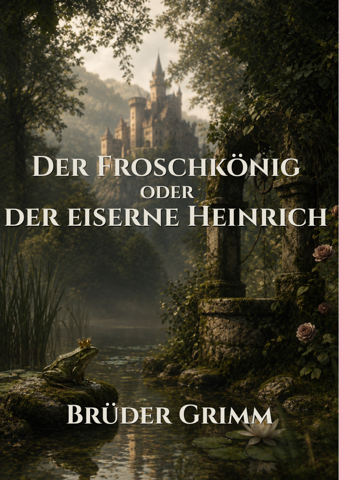
The Opening Tale of the Brothers Grimm Collection
First Published in 1812 — Known Across the World Ever Since
The Frog Was Never Kissed. That Came Later.
A Foundational Text of European Fairy-Tale Literature
She did not want to keep her promise. Her father made her. That is where the story really begins.
First published in 1812 as the opening tale of Kinder- und Hausmärchen ("Children's and Household Tales"), Der Froschkönig oder der eiserne Heinrich ("The Frog King, or Iron Henry") by the Brothers Grimm is one of the best-known folk tales in the European tradition — and one of the most quietly subversive.
The premise is familiar: a princess drops her golden ball into a well, a frog retrieves it, and in return asks for her friendship, her table, and her bed. She agrees, intending nothing by it. Her father, the king, holds her to her word. What follows is not a gentle story about kindness rewarded. It is a story about a promise made carelessly and honored only under compulsion — and what transformation that compulsion eventually produces.
"In the original Grimm version, the frog is not freed by a kiss. He is freed when the princess, in frustration and revulsion, throws him against the wall. The enchantment breaks on impact. The modern retelling remembered the frog. It forgot the wall."
The Tale Behind the Tale
The story's best-known detail is also its most frequently misremembered. The kiss does not appear in the Brothers Grimm. It entered popular imagination through later adaptations and modern retellings, softening a moment that Grimm left considerably rougher. In the original, it is an act of anger — not tenderness — that breaks the spell.
Equally overlooked is the figure who gives the tale its full title: Iron Henry, the prince's faithful servant, whose heart had been bound with three iron bands to keep it from breaking during his master's enchantment. When the prince is freed, the bands snap apart one by one — not from force, but from joy. Henry is a figure of absolute loyalty and emotional release, and his presence at the close reframes the story as something larger than a romance: a tale about what fidelity costs, and what it feels like when the cost is finally lifted.
Themes
At its core, The Frog King moves through the central preoccupations of the Grimm fairy-tale world: the weight of promises and the consequences of breaking them, transformation and redemption, the maturation of a young person into responsibility, and the relationship between outward appearance and inner worth. The princess who recoils from the frog becomes, by the story's end, someone capable of seeing past the surface — though the path there is neither gentle nor willing.
Like many Grimm tales, the story draws on older oral traditions and was linguistically revised across successive editions. It did not begin with the Brothers Grimm. It only found, in their hands, its most enduring form.
"The Frog King" is a fairy tale the whole world thinks it knows. Read the original. You may find it stranger, and more honest, than you remembered.
Miva: the next reading experience beyond audiobooks
Listen like an audiobook, then ask anything, anytime.
Start Miva's narrationMiva does not just narrate. It keeps explaining based on what you ask.