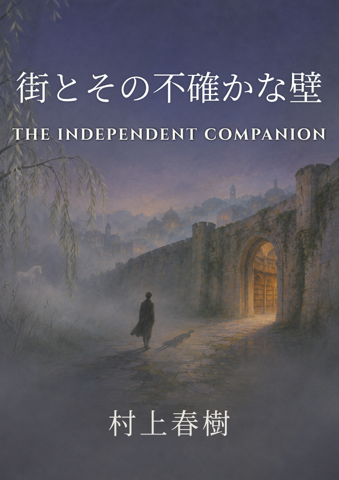
A seventeen-year-old “I” hears from his lover that her true self lives in a city surrounded by high walls. Decades later, having quit his job, “I” moves to a mountain library and draws closer once again to a city where shadows are lost, a job reading dreams, and the memories of a vanished girl.
This guide organizes parts one through three, covering two time periods—youth and middle age—as well as the walled city, the real world, and the roles of Mr. Koyasu and the boy in the Yellow Submarine parka. It serves as a guide to keep track of recurring locations and character correspondences without revealing how the real and otherworldly realms ultimately overlap. Please note that this is an independent chapter-by-chapter summary guide for organizing and reviewing your reading, not the original text.
Which is more real: the city you can enter only by surrendering your shadow, or the reality where one lives in solitude while keeping it? As the love of youth and the library life of middle age overlap, the walls come to represent protection, memory, and the loss of self. It is a story that asks readers which side they themselves wish to remain on.
It maps the timelines of the three parts, the walled city versus reality, Mr. Koyasu, the boy in the Yellow Submarine, and the library of dream reading. It also highlights echoes of the 1980 work of the same name and "Hard-Boiled Wonderland and the End of the World," without disclosing how the two worlds finally connect.
While the city provides order and tranquility, it demands that residents give up their shadows. Follow why gaining safety and losing a part of oneself happen simultaneously.
Three elements—books, old dreams, and the reader—create a circuit of memory different from ordinary records. Pay attention to how reading becomes an act of touching the inner lives of others.
The author returns to a work of the same name published in 1980 that was never released in book form. The act of retelling a lost possibility decades later resonates with the novel’s themes.
This guide is suitable for readers who enjoy Murakami’s recurring worlds, library fantasies, quiet romances, and parallel realities. It provides a map of imagery for first-time readers and a foundation for long-time readers to consider the meaning of rewriting past works.
Note on the Edition: This is not the original book, but an independent chapter guide and summary. It is intended for review and reading support and is recommended to be read alongside the original work.
Miva: the next reading experience beyond audiobooks
Listen like an audiobook, then ask anything, anytime.
Start Miva's narrationMiva does not just narrate. It keeps explaining based on what you ask.