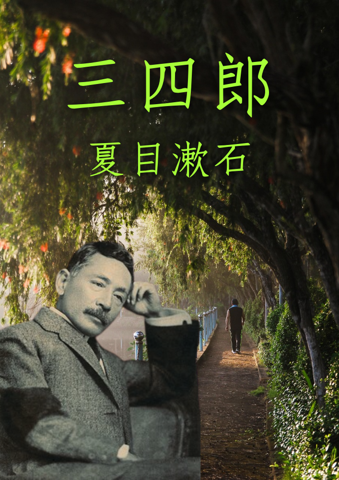
Background: Sanshiro depicts the journey of Ogawa Sanshiro, a young man from Kyushu, as he leaves his hometown and takes a train to Tokyo Imperial University for his studies. Along the way, he encounters a mysterious woman, and upon arriving in Tokyo, he is exposed to the campus, laboratories, intellectuals, art, and romance. Meiji-era Japan is modernizing rapidly; Tokyo is both the center of new knowledge and civilization, and a vast labyrinth that dazzles the youth. Sanshiro's story captures the excitement and anxiety many feel when leaving home for the first time to enter a major city.
Literary Features: Soseki captures the sense of estrangement in Tokyo through a youth's perspective. Sanshiro sees much but does not necessarily understand; he is drawn to Mineko but cannot read her ambiguity; he listens to Professor Hirota's profound talks yet remains unsure of how to act. The tone is brighter than Soseki's later works, carrying a sense of humor and youthful vigor, yet it already contains the bewilderment of the modern self. The train, the pond side, the atelier, the campus, and the streets are all places where Sanshiro learns to observe the world. The beauty of this book lies in the state of "not yet understanding."
Synopsis: Modern readers can easily see themselves in Sanshiro: entering university, moving to a new city, and meeting a group of seemingly more mature people, the world suddenly expands, yet one's identity remains unclear. It is not a coming-of-age novel rushed to provide answers, but one that gently preserves the shape of youthful confusion. After reading, one realizes that youth is not about finding a direction all at once, but about being constantly changed by new landscapes. Sanshiro enters a new world via a train journey; the strange woman on the train, the streetscapes of Tokyo, and the scholars and students at the university all make him feel fresh yet lost. Mineko is the most fascinating presence in the story; her words, smiles, and sense of distance constantly sway Sanshiro, yet leave him uncertain if he is truly understood. Professor Hirota, Nonomiya, and other characters represent different life paths. The novel details Sanshiro's transition from observer to infatuated, from admiration to confusion, serving as a psychological map of a youth arriving in a modern city. This story requires no deep literary knowledge to enter; simply following the characters' choices, hesitations, and silences allows the reader to feel the human condition slowly brought to light.
Encyclopedia
Author's Life: Natsume Soseki taught in the higher education system and was familiar with students, intellectuals, and Tokyo's cultural circles. His novels often start with light humor and gradually move into psychological and ethical depths.
Relationship Between Author and Work: Sanshiro is the starting point of Soseki's trilogy; the subsequent Sorekara (And Then) and Mon (The Gate) push the confusion here toward heavier choices and consequences.
Modern Analogy: It is like a college freshman's first year moving to Taipei or Tokyo: everyone seems like an answer, every heartbeat feels like a challenge, but no course teaches you how to become yourself."
Miva: the next reading experience beyond audiobooks
Listen like an audiobook, then ask anything, anytime.
Start Miva's narrationMiva does not just narrate. It keeps explaining based on what you ask.