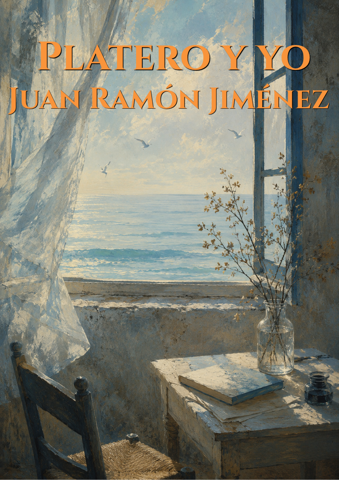
Published in 1914, Platero and I is one of the most beloved and universal works of Juan Ramón Jiménez, a central figure in 20th-century Spanish poetry and winner of the Nobel Prize in Literature in 1956. Although at first glance it appears to be a delicate book about a poet and his small silver donkey, the work eventually became one of the most influential texts of lyrical prose in the Spanish language. Jiménez transformed the daily life of Moguer—its white streets, poor children, orchards, distant bells, and Andalusian melancholy—into a poetic vision suspended between memory and dream.
Platero appears from the first pages as an almost unreal creature: "Platero is small, downy, smooth; so soft on the outside that one would say he were all cotton." This phrase, now one of the most famous images in Hispanic literature, summarizes the essence of the book: tenderness, innocence, and an extreme sensitivity to the passage of time. The little donkey is not merely a domestic animal; he is the narrator's silent confidant, the mirror of his solitude, and the last refuge of purity in a world marked by death and fleetingness. Through Platero, Jiménez constructed a meditation on lost childhood, humble beauty, and the fragility of existence.
The cultural influence of Platero and I quickly crossed Spain's borders. The work was adapted to music by the Italian composer Mario Castelnuovo-Tedesco, who in 1960 composed a suite for guitar and narrator inspired by episodes from the book. Later, the Spanish guitarist and composer Eduardo Sainz de la Maza also created a celebrated suite based on the work, consolidating Platero as a regular presence in the classical guitar repertoire. In 1968, director Alfredo Castellón brought the work to the cinema, demonstrating that Jiménez's intimate and poetic universe could also be translated into cinematic images. Decades later, playwright Josep-Antoni Garí presented a theatrical adaptation in Geneva to commemorate the centenary of its publication.
Jiménez's footprint even reached Anglo-Saxon and Latin American literature. The writer Ray Bradbury used a phrase by Jiménez as an epigraph for Fahrenheit 451: "If they give you ruled paper, write the other way." The quote became a symbol of intellectual rebellion and creative freedom. Puerto Rican novelist Giannina Braschi also evoked Jiménez's genius in Yo-Yo Boing!, where different artists passionately debate his place within the Spanish poetic tradition.
Many critics consider that the greatness of Platero and I resides in having elevated everyday simplicity to an almost sacred dimension. The poet Jorge Guillén stated: "Pure poetry found in him its most perfect consciousness." And even today, more than a century after its publication, the figure of Platero continues to be one of the most universal symbols of literary tenderness and the luminous nostalgia of Andalusia.
Miva: the next reading experience beyond audiobooks
Listen like an audiobook, then ask anything, anytime.
Start Miva's narrationMiva does not just narrate. It keeps explaining based on what you ask.