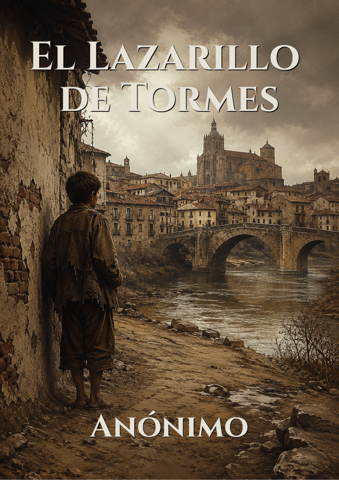
Published anonymously in 1554, The Life of Lazarillo de Tormes and of His Fortunes and Adversities is considered the founding work of the picaresque novel and one of the most revolutionary texts in Spanish literature. Written in an autobiographical and epistolary form, the work narrates the life of Lázaro de Tormes, a poor boy who survives by serving various masters in a society marked by hunger, hypocrisy, and moral inequality.
The novel breaks with the chivalric idealism of the Renaissance, replacing noble heroes with a marginal, hungry, and cunning protagonist. In contrast to heroic epics, Lazarillo presents an “epic of hunger,” where survival is worth more than honor. The story shows how Lázaro progressively loses his innocence as he learns that society functions through deception, appearance, and opportunism.
The structure of the work is organized into chapters (treatises), each associated with a different master. Notable among them are the cruel and cunning blind man, the miserly priest who starves Lázaro, and the impoverished squire obsessed with maintaining a false image of nobility. Each episode serves as a social and moral critique of 16th-century Spain.
One of the book's most innovative elements is its deep psychological realism. Lázaro is not an exemplary hero, but a character who evolves morally through necessity. The end of the novel, where he agrees to live ignoring rumors about the relationship between his wife and the archpriest, represents the definitive defeat of the ideal of honor. To survive, Lázaro must accept the corruption of the world and participate in it.
The work also constitutes a fierce critique of religious and clerical hypocrisy. Friars, priests, and pardoners are portrayed as greedy, corrupt, or morally empty figures. Due to this anticlericalism, the book was banned by the Inquisition and circulated for centuries in censored versions.
The literary impact of Lazarillo was immense. Its influence can be seen throughout the subsequent picaresque tradition, especially in works like Mateo Alemán's Guzmán de Alfarache and, more indirectly, Miguel de Cervantes' Don Quixote. The novel introduced a new type of protagonist: the social anti-hero, a figure that would later influence modern European literature.
In addition to its historical importance, Lazarillo de Tormes remains deeply relevant today for its disenchanted vision of power, poverty, and human morality. Its blend of irony, cruel humor, and social criticism makes it one of the great masterpieces of the Spanish Golden Age.
Miva: the next reading experience beyond audiobooks
Listen like an audiobook, then ask anything, anytime.
Start Miva's narrationMiva does not just narrate. It keeps explaining based on what you ask.