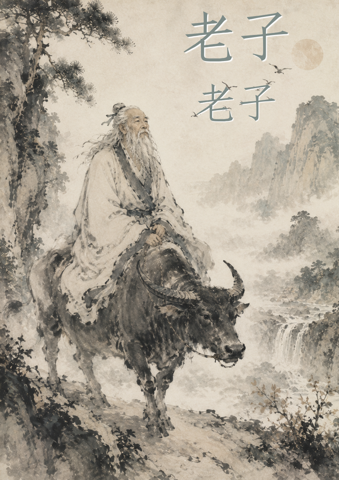
The Laozi, universally known in later generations as the Tao Te Ching, Te Tao Ching, or Sutra of the Way and Its Virtue, is the core founding classic of the Taoist school from China's Pre-Qin period.
Consisting of only about five thousand characters, this work holds a supreme position in Chinese philosophical history, political science, philosophical poetry, and cultural history. It is a monumental masterpiece written before the various schools of Pre-Qin thought branched out, and it is a rare speculative scroll regarding "cosmological ontology" in Eastern thought. Statistically, it is the most translated and widely circulated philosophical cultural classic in world history, second only to the Christian Bible.
I. Core Concepts: Non-being, Tao, and Te
The philosophical system of the Laozi is interwoven from three core concepts: "Tao" (The Way), "Wu" (Non-being), and "Te" (Virtue).
II. Philosophy of Life and Values: Yielding, Non-contention, and Few Desires
Laozi transformed his observations of cosmic laws into a methodology for human life in the world:
III. Political Views: Governing Through Non-action and Small States with Few People
Although the Laozi is full of profound philosophy, the ultimate goal of many of its discussions is actually politics—a "technique of the ruler" written for those in power:
IV. Literary Characteristics: A Paradigm of Philosophical and Poetic Prose
The Laozi stands unique among Pre-Qin prose:
V. Evolution of Versions and Circulation
Due to its antiquity, the Laozi has produced extremely complex versions through thousands of years of transcription and printing, which can be divided into excavated "bamboo and silk versions" and handed-down "received versions":
Excavated Ancient Versions (Restoring Historical Reality)
Received Versions (The 81-Chapter Structure)
The structure of 81 chapters we see today (37 chapters of the Tao Ching and 44 chapters of the Te Ching) first originated from Liu Xiang of the Western Han. There are two most widely circulated annotated versions:
VI. Legacy and International Evaluation
With its extremely refined five thousand words, the Laozi constructed a framework of wisdom that transcends time and space. Whether as political wisdom, a guide for physical and mental healing, or the supreme guidance for a philosophy of life, it is truly the "King of All Sutras" in Eastern civilization.
Laozi, also recognized through history as the Tao Te Ching or Daodejing, is a monumental pre-Qin philosophical classic and the foundational text of Taoism. Composed of roughly five thousand characters, this concise yet profound text presents a complete worldview centered on the supreme cosmic principle known as the "Tao" (the Way), its concrete manifestation "Te" (Virtue), and the fundamental reality of "Wu" (Non-being). The core narrative of the Tao Te Ching unfolds in three interconnected domains: cosmic ontology, personal cultivation, and political governance. At its cosmological foundation, the text establishes the Tao as the ultimate, indefinable source of the universe. Existing prior to heaven and earth, the Tao operates beyond sensory perception and speech, famously introduced with the opening declaration: "The Tao that can be told is not the eternal Tao." Out of non-being comes being, and through the Tao, the one gives birth to two, two to three, and three to all ten thousand things. The natural order functions through "Ziran" (self-so-ness or nature), urging humanity to align its actions with the seamless flow of the cosmos: "Man models himself on Earth, Earth models itself on Heaven, Heaven models itself on the Tao, and the Tao models itself on Nature." From this cosmic law emerges an approach to life defined by softness, yielding, and contentment. Laozi uses concrete imagery, most notably water and the newborn infant, to illustrate strength within apparent weakness. Water, the most yielding element, effortlessly breaks down the hardest obstacles. By maintaining humility, embracing a state of non-contention ("Bu Zheng"), and shedding excessive desires, an individual preserves life and achieves enduring peace. In terms of governance, the text translates these principles into "Wu Wei" (non-action or effortless action). Rather than advocating passive inaction, Laozi instructs rulers to eliminate personal desires, harsh laws, and meddlesome policies. Governing a nation is likened to "cooking a small fish", a delicate process requiring minimal handling to avoid ruin. The ultimate vision of society presented in the work is "Xiao Guo Gua Min" (a small country with few people), where citizens live simple, peaceful, and harmonious lives without entering into destructive conflicts with their neighbors. Beyond the text itself, the story of Laozi is inextricably bound to its legendary author, Li Er (Laozi), who served as the keeper of the archives for the Zhou court. According to historical records by Sima Qian, when Confucius visited Laozi to inquire about ancient rites, he emerged in awe, comparing Laozi's elusive depth to a formidable dragon soaring through the clouds. Seeing the decline of the Zhou Dynasty, Laozi departed westward riding a green ox. At the Hangu Pass, the gatekeeper Yin Xi foresaw his arrival through a favorable purple aura and begged the sage to record his wisdom. Laozi penned his five-thousand-word treatise before riding into the western wilderness, disappearing from history. In its historical aftermath, the work reshaped Chinese civilization, inspiring the Huang-Lao governance during the Han Dynasty's Wen-Jing era, giving rise to religious Taoism where Laozi was venerated as Taishang Laojun, and influencing the development of Zen Buddhism. In the modern era, the text has gained global resonance, celebrated by environmentalists for its ecological wisdom and by philosophers for its early insights into spontaneous order. The work concludes with timeless truisms on truth and selflessness, summarizing its perpetual wisdom: the truthful word is not ornate, the sage does not hoard, and by living for others, one achieves absolute abundance.
A tree that takes several arms to span grows from a tiny sprout. A tower nine stories high arises from a heap of earth. A height of a hundred units begins beneath one's feet.Original: 合抱之木 生於毫末 九成之臺 作於羸土 百仞之高 始於足下Laozi Chapter 64. This iconic passage encapsulates the Daoist principles of patience and organic growth, offering a timeless psychological insight into how immense endeavors are accomplished through incremental steps.
The Way that can be spoken of is not the constant Way; the name that can be named is not the constant name. Nameless, it is the origin of the ten thousand things; named, it is the mother of the ten thousand things.Original: 道可道也 非恆道也 名可名也 非恆名也 无名萬物之始也 有名萬物之母也Laozi Chapter 1. Serving as the foundational axiom of the entire philosophical system, it immediately challenges conventional conceptual thinking and invites the reader into metaphysical reflection.
Nothing in the world is more soft and weak than water, yet for attacking the hard and strong, nothing can surpass it, because nothing can replace it. That water overcomes the hard and the weak overcomes the strong—there is no one in the world who does not know this, yet no one is able to practice it.Original: 天下莫柔弱於水 而攻堅強者莫之能胜也 以亓无以易之 水之勝剛 弱之勝強 天下莫弗知 而莫能行也Laozi Chapter 78. It presents one of the text's most famous dialectical paradoxes, radically revaluating weakness as dynamic strength and challenging conventional views on power and conflict.
Highest goodness is like water. Water excels in benefiting the ten thousand things and stays still, dwelling in places that the multitude detest; thus it is near to the Way. In dwelling, value good ground; in heart, value depth; in giving, value heaven; in speech, value trustworthiness; in governing, value order; in affairs, value ability; in action, value timing. Indeed, because it does not contend, it is free from blame.Original: 上善治水 水善利萬物而有靜 居眾之所惡 故幾於道矣 居善地 心善淵 予善天 言善信 正善治 事善能 動善時 夫唯不爭 故无尤Laozi Chapter 8. It transforms abstract cosmic observation into practical ethics, illustrating how living harmoniously without self-assertion leads to peace and freedom from reproach.
While Laozi is written in concise, poetic classical Chinese of only five thousand words, its minimalist structure presents unique challenges and profound rewards for modern readers. The text avoids long narrative stories or formal philosophical debate, relying instead on rhythmic parallel phrasing, sharp paradoxes, and evocative natural metaphors. The primary difficulty stems from its deliberate ambiguity, as terms like "Tao" and "Wu Wei" resist single definitions and require thoughtful reflection rather than rote memorization. However, because the text grounds its abstract ideas in relatable physical imagery, such as flowing water, uncarved wood, hollow clay vessels, and newborn infants, the core concepts remain universally accessible across different cultures and eras. Readers who approach the work slowly, allowing its paradoxical statements to sit without immediate resolution, will find it immensely approachable.
Laozi is universally celebrated as a masterpiece because it provides an extraordinarily comprehensive cosmic ontology, personal ethic, and political theory within a brief manuscript. As one of the most widely translated texts in human history, it bridges ancient Eastern philosophy and modern Western thought. Its insights into "Wu Wei" (effortless action) offer a timeless counterweight to human anxiety, overwork, and aggressive ambition. Modern environmental scientists revere its concept of "Ziran" (natural spontaneity) as pioneering ecological wisdom, while economists find early models of spontaneous order within its critique of excessive government regulation. By offering profound psychological peace and flexible wisdom for leadership, the work continues to speak directly to the human condition regardless of time or location.
The concluding movement of the work brings together its cosmological principles and personal ethics into a final, undeniable synthesis. What takes shape in these ultimate lines is not a dramatic external narrative climax, but rather an absolute resolution of the paradoxes surrounding truth, generosity, and non-contention. The work brings its ultimate focus to the precise relationship between selflessness and true fulfillment, revealing how living entirely without competitive striving creates an unshakeable inner abundance. How the text summarizes the mark of genuine truth versus decorative speech, and how it defines the ultimate role of the sage in relation to others, are the exact revelations that make reaching the final chapter an unforgettable philosophical experience.
"Wu Wei" translates literally as "non-action" or "effortless action," but it does not advocate total passivity or lazy inertia. Within the framework of the text, it means acting without forced artificiality, selfish ambition, or resistance against the natural course of events. In political leadership, it requires removing excessive laws, high taxes, and aggressive wars so that society can organize itself naturally. For individuals, it means responding to circumstances with fluid adaptability rather than brute force, allowing challenges to dissolve through patience and alignment with natural timing.
In Laozi, the "Tao" represents the ultimate, formless, and eternal cosmic source of all existing matter, functioning as the foundational law of the universe. "Te" (Virtue or Power) represents the concrete manifestation of the Tao within specific physical beings and natural phenomena. While the Tao is the invisible path or principle, Te is the actualized character and inner vitality expressed when a person or object lives in complete accordance with that path.
The work presents humans as an integral component of a larger, self-balancing cosmic order rather than masters over the earth. This balance is expressed in the foundational formula stating that human beings model themselves after the Earth, the Earth models itself after Heaven, Heaven models itself after the Tao, and the Tao models itself after Nature. By practicing humility and curbing destructive desires, humans preserve the ecosystem and maintain long-term harmony.
Miva: the next reading experience beyond audiobooks
Listen like an audiobook, then ask anything, anytime.
Start Miva's narrationMiva does not just narrate. It keeps explaining based on what you ask.