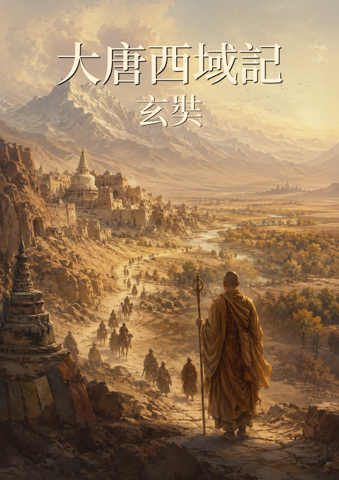
The Great Tang Records on the Western Regions (Da Tang Xiyu Ji), often shortened to Xiyu Ji, is a monumental work of geography and history dictated by the eminent Tang Dynasty monk Xuanzang and compiled by his disciple Bianji. Completed in the 20th year of the Zhenguan era (646 AD), this ambitious twelve-volume masterpiece is not a fictional tale of gods and demons, but a factual record of Xuanzang's seventeen years of travel through the Western Regions and India, measured by his own footsteps and life. With meticulous detail, it captures the boundaries, climate, products, politics, religions, and customs of over 140 countries from Xinjiang to Southern India, forming a grand tapestry of civilization with immense historical and geographical value.
This work holds an irreplaceable "lighthouse" status in global cultural history. Due to the lack of complete historical records in ancient India, this extraordinary book became the sole key for later generations to reconstruct ancient Indian history. Professor Athar Ali, an Indian historian, once praised it highly: "Without the works of Faxian, Xuanzang, and Ma Huan, the reconstruction of Indian history would be completely impossible." In the 19th century, British archaeologist Alexander Cunningham relied on the precise textual descriptions in the book to rediscover Buddhist holy sites buried in the desert sands, such as Sarnath, Nalanda Monastery, and the Great Ashoka Stupa at Bodh Gaya. Even the lion capital on the current National Emblem of India and the Dharma Wheel on the national flag can be traced back to the archaeological excavations guided by this book.
As a premier cultural IP spanning a millennium, the influence of the Great Tang Records on the Western Regions has long extended into modern creative industries, film, and gaming. It is the core realistic blueprint for the classical masterpiece Journey to the West, inspiring countless artistic creations about the pilgrimage to the West. The wonders and legendary history of the Western Regions it portrays have been adapted numerous times in recent years into historical documentaries and TV dramas. In contemporary digital games, it serves as a vital historical and visual source of inspiration for constructing Silk Road aesthetics and Buddhist fantasy worldviews. From the 1857 French translation by Stanislas Julien, which sparked a frenzy of Western research, to its unique charm in global cultural dissemination today, this authentic travelogue demonstrates a powerful vitality that transcends time and space.
Miva: the next reading experience beyond audiobooks
Listen like an audiobook, then ask anything, anytime.
Start Miva's narrationMiva does not just narrate. It keeps explaining based on what you ask.