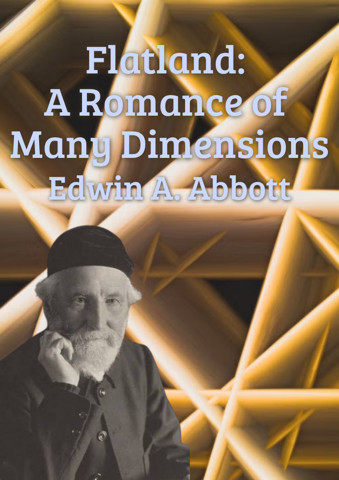
Background:
Abbott published Flatland anonymously in 1884, presenting geometry as both imaginative exercise and social satire. The rigid hierarchy of shapes reflects Victorian class and gender assumptions, but the narrator's encounters with other dimensions also expose the intellectual habits that make any world mistake its limits for universal truth.
What kind of book is it?
A Square describes life in a two-dimensional society before experiences with one, zero, and three dimensions overturn his understanding of reality. His attempt to communicate that discovery reveals how institutions defend a stable worldview.
Literary style:
Diagrams, mock ethnography, mathematical analogy, first-person testimony, nested worlds, and dramatic irony let readers understand more than the narrator. The book invites visualization while making every act of explanation politically charged.
Reading focus:
Geometry in Flatland is never only a neutral thought experiment. Shape determines rank, education trains citizens to recognize and obey rank, and supposedly objective rules protect those already authorized to define reality. A Square can describe this system with intelligence while remaining deeply shaped by its prejudices, which is why the satire depends on dramatic irony. Encounters with Lineland, Pointland, and Spaceland then repeat the problem of limited perception from different directions. Each world treats what it can experience as the boundary of what can exist. Readers should pay close attention to the methods used to teach a new dimension: analogy, movement, cross-section, and direct experience succeed or fail depending on what the learner is willing to imagine. The diagrams are therefore part of the narrative action. The book also refuses an easy story of enlightenment. A Square's discovery does not automatically make him generous toward every perspective, and institutions respond to disruptive knowledge through suppression. That combination lets the work support mathematical visualization while warning that intellectual breakthrough alone does not dissolve social hierarchy or personal blindness.
Director: Ladd Ehlinger Jr./Production: United States
Principal cast: Kristen Bell, Joe Estevez, Tony Hale
Why this adaptation:
Ladd Ehlinger's feature uses computer animation and a voice cast including Kristen Bell, Joe Estevez, and Tony Hale to make Abbott's dimensional argument visible.
One important difference:
visualizes the geometric society through computer animation and expands dialogue and characterization around the dimensional encounters.
Edition focus:
A reliable edition should retain both parts, all twenty-two sections, and Abbott's diagrams, which are part of the argument rather than optional decoration.
Reading recommendation:
Readers new to the book may prefer an annotated edition explaining Victorian social satire, while mathematical readers should still attend to the narrator's prejudices and institutional setting.
Cultural significance:
Flatland remains useful in mathematics education, philosophy, science fiction, and discussions of perspective. Its satire can open thought about dimensions and epistemic limits, while its misogynistic social scheme requires analysis rather than being excused as neutral geometry.
Relationship between author and work:
Abbott's experience as an educator shapes a book in which explanation is both method and conflict: A Square learns a new conceptual world but cannot persuade institutions invested in the old one.
Miva: the next reading experience beyond audiobooks
Listen like an audiobook, then ask anything, anytime.
Start Miva's narrationMiva does not just narrate. It keeps explaining based on what you ask.