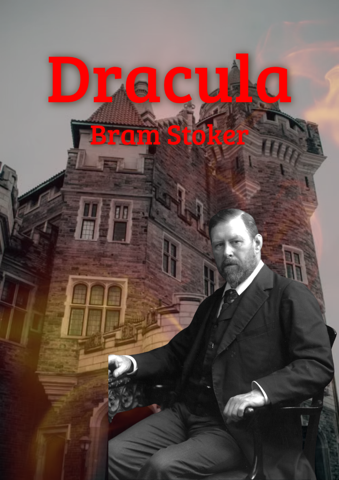
Background:
Published in 1897, Bram Stoker's Dracula brought older vampire traditions into the world of modern transport, journalism, medicine, business, and recorded information. The novel moves between Transylvania and England, but it is not presented by an all-knowing narrator. Instead, readers assemble the crisis from journals, letters, telegrams, newspaper cuttings, memoranda, and phonograph diaries. That documentary structure makes reading an act of investigation: dates, routes, gaps in knowledge, and contradictions matter because the characters survive by learning how to combine separate records.
Story overview:
Solicitor Jonathan Harker travels to Count Dracula's castle to assist with an English property transaction and gradually discovers that his host is not bound by ordinary human limits. In England, Mina Murray, Lucy Westenra, Dr John Seward, Professor Abraham Van Helsing, Arthur Holmwood, and Quincey Morris confront events that their ordinary professional and social categories cannot explain. Their response depends less on a single heroic figure than on cooperation, transcription, travel, and the difficult acceptance of evidence.
Literary form:
The epistolary design is more than decoration. Typewriters, shorthand, railway timetables, blood transfusions, telegrams, and the phonograph stand beside folklore, sacred objects, dreams, and inherited fears. Stoker repeatedly tests whether modern systems can recognize an old danger before it uses those same systems for its own movement. The book also changes pace through its documents: Harker's castle journal creates confinement and uncertainty; Whitby newspaper reports widen the public scale; Seward's recordings give clinical observation an unstable immediacy; Mina's typing turns scattered testimony into a searchable archive.
The novel belongs to Gothic fiction, invasion narrative, travel writing, and detective-like documentary fiction at once. Its anxieties concern boundaries: foreign and domestic, living and dead, scientific and supernatural, private body and public record. Modern readers also examine its treatment of gender, sexuality, disability, mental illness, religion, empire, and xenophobia. Those questions should not be reduced to a claim that Dracula is simply based on one historical ruler. Stoker drew on several bodies of reading and transformed them freely; the fictional Count is a literary construction rather than a biography of Vlad III.
Director: Tod Browning / Production country: United States
Cast: Bela Lugosi, Helen Chandler, David Manners, Edward Van Sloan
Why it matters:The Universal production fixed Lugosi's formal speech, evening dress, and controlled gestures in popular screen memory. The Library of Congress records the film as a 1931 Universal release, while BFI identifies Browning and the principal cast.
Difference from the book:The film draws heavily on the stage adaptation as well as the novel. It reduces the documentary network and travel structure, places greater weight on drawing-room encounters, and concentrates authority in a smaller group of characters.
Director: Terence Fisher / Production country: United Kingdom
Cast: Christopher Lee, Peter Cushing, Michael Gough, Melissa Stribling
Why it matters:Hammer's colour production launched a major cycle and paired Lee's physically threatening Count with Cushing's forceful Van Helsing. BFI describes it as a decisive reinvention of Gothic horror in colour.
Difference from the book:Jimmy Sangster's screenplay radically compresses geography and relationships. Harker becomes a vampire hunter posing as a librarian, Renfield disappears, and the journeys among Transylvania, Whitby, and London are replaced by a faster and more localized pursuit.
Director: Francis Ford Coppola / Production country: United States
Cast: Gary Oldman, Winona Ryder, Anthony Hopkins, Keanu Reeves
Why it matters:The film combines elaborate practical effects, costume design, theatrical staging, and references to early cinema while restoring many names and episodes absent from earlier versions.
Difference from the book:Its central reincarnation romance between Dracula and Mina is an invention of the film, not the organising relationship of Stoker's novel. The adaptation also connects the Count much more explicitly to Vlad the Impaler.
Principal editions:
The novel was first published in London by Archibald Constable and Company in 1897. Readers should distinguish the 1897 text from later annotated editions, abridgements, retellings, illustrated books, and editions that add “Dracula's Guest.” The selected Project Gutenberg #345 EPUB contains the English text in 27 chapters followed by a note. Its package metadata identifies Bram Stoker, English, and a United States public-domain status; the present intake separately applies the United Kingdom rule requested for the original work. Because Stoker died in 1912, the original literary text is out of copyright in the United Kingdom, although modern introductions, notes, translations, artwork, and editorial matter can remain protected.
Translation choices:
Dracula has many competing translations. Taiwan's ISBN records include Hung Hsia-tien; Japan's National Diet Library lists editions translated by Teiichi Hirai and a complete annotated version by Akihiko Niizuma and Ai Tanji; the Bibliothèque nationale de France records Ève and Lucie Paul-Margueritte and Lucienne Molitor; Spain's national bibliography records Francisco Torres Oliver; Italian and Korean catalogues show further named versions. These records demonstrate variety, not interchangeability. Readers should check whether a book is complete, abridged, adapted for younger readers, newly annotated, or bundled with related stories.
Form creates a special translation problem. Each diary keeper needs a recognizable register, while Van Helsing's deliberately marked English, newspaper prose, shorthand, telegrams, and phonograph entries must remain distinct without turning accent into caricature. Place names and personal names also vary across markets. For study, an unabridged edition that identifies translator and editorial additions is preferable; for comparison, chapter count and the presence of the final Note provide quick but not sufficient checks.
Cultural significance:
Dracula did not invent the vampire, yet it became one of the principal works through which twentieth- and twenty-first-century culture imagined the figure. Its influence extends across fiction, theatre, film, television, radio, comics, games, tourism, and advertising. Adaptations often detach the Count from the book's documentary form, give him a tragic romance, or make him the central consciousness. Returning to the novel reveals a different balance: Dracula is powerful partly because others cannot initially assemble what they know, while Mina's organisation of documents becomes essential to collective action.
The author and the work:
Bram Stoker was born in Dublin in 1847 and died in 1912. He worked for many years with actor-manager Henry Irving and managed London's Lyceum Theatre, experience that sharpened his sense of timing, entrances, spectacle, publicity, and collaborative production. Dracula emerged from sustained reading and note-taking, but its achievement lies in arrangement rather than simple source copying. The book coordinates multiple voices and technologies so that information itself becomes dramatic material.
That structure explains why the novel continues to reward rereading even after its broad premise has become familiar. A reader may know the Count's name and still be surprised by how much of the book concerns work: collecting evidence, typing copies, comparing dates, arranging trains, caring for the ill, and deciding whom to trust. The supernatural contest is carried by ordinary acts of documentation. In this sense, Dracula is not only a story about an ancient intruder; it is also a story about whether a group can build a reliable shared record quickly enough to act.
Miva: the next reading experience beyond audiobooks
Listen like an audiobook, then ask anything, anytime.
Start Miva's narrationMiva does not just narrate. It keeps explaining based on what you ask.