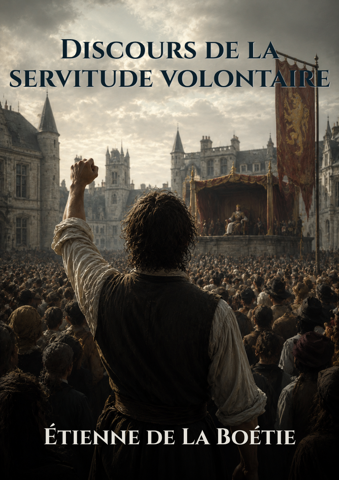
Discourse on Voluntary Servitude, also known as the Anti-Dictator (Le Contr’un), is a political treatise written around 1548 by Étienne de La Boétie when he was likely only between sixteen and eighteen years old. The work was partially published in Latin in 1574, then in its entirety in French in 1576, after the author's death. Despite its brevity, this text is considered one of the great founding works of modern political philosophy.
The treatise seeks to answer an essential question: why do entire populations accept obedience to a single man, even when he is tyrannical? La Boétie is astonished that "one tyrant alone" can dominate thousands of individuals when he actually possesses only the power granted to him by those who obey him. According to him, tyranny does not rest solely on force or violence, but above all on the consent of the dominated. It is this revolutionary idea that he summarizes in his famous phrase: "Resolve to serve no more, and you are at once free."
The originality of the text lies in the paradoxical expression of "voluntary servitude." La Boétie asserts that men end up loving their servitude because they grow accustomed to it from birth. Habit then becomes the primary cause of obedience. Individuals raised in a hierarchical society consider submission to be natural and progressively forget the very desire for freedom. This loss of collective memory constitutes what the author calls the "misfortune" (malencontre), a historical rupture that shifted humanity from a natural state of freedom to a state of domination.
La Boétie also explains that tyrants maintain their power through several means: entertainment, spectacles, material rewards, religion, or even superstitions. These distractions serve to divert the people from political reflection. But the true secret of domination lies, according to him, in the complicity of a portion of the population. The tyrant relies on a hierarchy of men interested in privileges and honors; each dominates others while remaining himself subject to a superior. Thus, a social pyramid is formed where everyone participates in the preservation of power.
The text does not propose a violent revolution. La Boétie believes more in a form of internal and intellectual resistance: freedom can be reborn as soon as men voluntarily cease to obey. This idea foreshadows the modern theories of civil disobedience later developed by Henry David Thoreau or Mahatma Gandhi.
Although deeply marked by Renaissance humanism, the Discourse on Voluntary Servitude remains surprisingly modern. It has influenced a wide variety of thinkers, including Jean-Jacques Rousseau, Simone Weil, Gilles Deleuze, and Pierre Clastres. Even today, the work fuels reflections on political power, social alienation, propaganda, and even our dependence on digital technologies.
Through its oratory style, its philosophical depth, and the power of its critique of power, the Discourse on Voluntary Servitude remains a major text of Western political thought and one of the first great manifestos in favor of individual liberty.
Miva: the next reading experience beyond audiobooks
Listen like an audiobook, then ask anything, anytime.
Start Miva's narrationMiva does not just narrate. It keeps explaining based on what you ask.