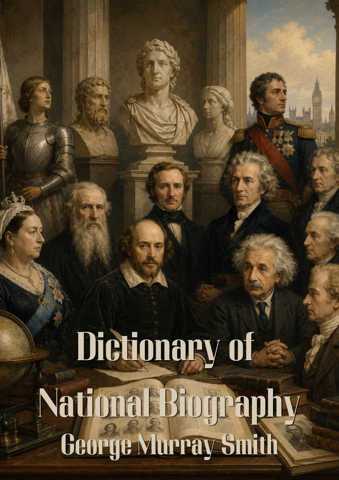
Dictionary of National Biography
Few reference works have shaped the historical imagination of Britain as profoundly as the Dictionary of National Biography. First published in 1885, the DNB was more than an encyclopedia of famous lives — it was an attempt to construct a literary and moral architecture for the British nation itself. Across sixty-three monumental volumes, the project gathered monarchs, pirates, poets, scientists, traitors, bishops, murderers, explorers, radicals, actors, colonial administrators, and forgotten eccentrics into a single continuous narrative of British civilization.
The ambition behind the work bordered on imperial in scale. Inspired by continental projects such as Germany’s Allgemeine Deutsche Biographie, publisher George Murray Smith envisioned a biographical cathedral that would define Britain’s intellectual memory for generations. Under the editorship of Leslie Stephen — father of Virginia Woolf — and later Sidney Lee, the Dictionary became one of the greatest collaborative enterprises in Victorian scholarship.
What made the DNB extraordinary was not simply its scale, but its tone. Victorian Britain believed biography was a moral force. To write a life was to define character, national identity, and historical virtue. The Dictionary therefore became a mirror of how the British Empire understood itself: industrious, literary, expansionist, contradictory, brilliant, and haunted by its own ambitions. Within its pages, Shakespeare stood beside Cromwell, Isaac Newton beside Horatio Nelson, Florence Nightingale beside colonial governors and executed rebels. It transformed history into a gallery of lives.
The DNB quickly became indispensable to writers, historians, journalists, genealogists, and political thinkers. Before the internet age, it functioned as the nervous system of British historical scholarship. Countless biographies, historical novels, BBC documentaries, television dramas, and academic works drew foundational material from its entries. The influence of the DNB quietly permeates modern portrayals of Britain itself — from prestige dramas like The Crown and Wolf Hall to university scholarship, literary criticism, and historical filmmaking.
Its cultural reach also extended into literature. Virginia Woolf grew up in the shadow of the project because her father Leslie Stephen spent years editing it, and many scholars believe the obsessive labor, emotional exhaustion, and intellectual atmosphere surrounding the DNB echoed through Woolf’s later meditations on memory, history, and biography. The Dictionary was not merely a scholarly enterprise; it became part of the emotional machinery of British literary modernism.
The work earned immense scholarly reverence. The Encyclopædia Britannica described it as having “proved of inestimable service,” while later historians praised its unparalleled source citations at a time when archives remained largely uncatalogued. Even now, despite the transformation of historiography, original DNB entries remain widely consulted because many were written by leading scholars astonishingly close to the eras they described.
Yet the Dictionary also preserves the ideological fingerprints of Victorian Britain. Early editors prioritized imperial statesmen, Anglican clergy, aristocrats, military officers, and literary elites, while women, colonized peoples, laborers, and marginalized voices often received minimal attention or exclusion entirely. The later Oxford Dictionary of National Biography would radically expand this vision, adding thousands of overlooked figures and reframing British history as a far broader and more conflicted human tapestry.
When the ODNB finally appeared in 2004 — spanning 60 volumes and over 50,000 articles — it represented not merely an update, but the continuation of a century-long attempt to answer an impossible question: who deserves to be remembered by history?
The DNB endures because biography itself remains irresistible. Nations understand themselves through stories of lives, and few works have attempted to gather an entire civilization’s memory with such relentless ambition.
Miva: the next reading experience beyond audiobooks
Listen like an audiobook, then ask anything, anytime.
Start Miva's narrationMiva does not just narrate. It keeps explaining based on what you ask.