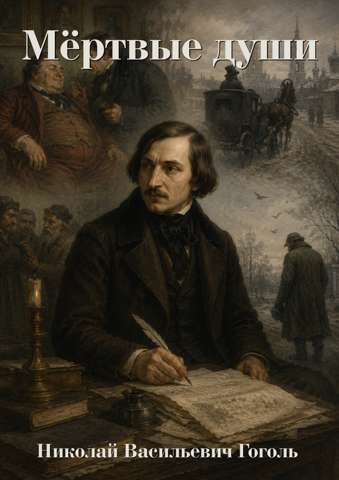
Dead Souls —
Nikolai Vasilievich Gogol’s own Divine Comedy: the first volume
At the center of the plot is Pavel Ivanovich Chichikov — a fraudster.
Chichikov's journey: Manilov symbolizes empty daydreaming; Korobochka — narrow-mindedness and petty stinginess; Nozdryov — chaos, lies, and lack of control; Sobakevich — crude practicality and spiritual heaviness; Plyushkin becomes the extreme form of human decay and pathological avarice. Through them, Gogol shows the gradual "dying of the soul" of a human being.
In the second volume, which survived only partially, the author attempted to shift the focus from satire to the theme of moral reformation. New characters appear: the idealist Tentetnikov, the wealthy tax-farmer and moralist Murazov, a stern Governor-General, and various officials, landowners, and businessmen. Here, Gogol ridicules society less and reflects more on the possibility of Russia's spiritual salvation, though the surviving chapters remain contradictory and unfinished.
One of the central themes of the poem is the image of Russia. Gogol simultaneously depicts a country plunged into corruption, bureaucracy, and moral decline, but at the same time endows it with enormous internal strength. The symbol of this idea became the famous "bird-troika" — a rapidly rushing Russia to which other nations give way. The finale of the first volume combines satire, anxiety, and an almost mystical faith in the historical destiny of Russia.
The work is distinguished by its unusual genre. Although "Dead Souls" is often called a novel, Gogol himself defined it as a poem. The text combines realism, grotesque, philosophical reflections, lyrical digressions, and a satirical portrayal of society. Researchers have compared the structure of the work to Dante's "Divine Comedy," and some critics to the wanderings of Odysseus in the Odyssey.
"Dead Souls" had a huge influence on Russian culture. The poem has been translated into foreign languages many times, adapted for screen and stage. Illustrations for it were created by artists Alexander Agin, Pyotr Boklevsky, and Marc Chagall. Among the famous adaptations are the stage versions by Mikhail Bulgakov, the film Dead Souls, and modern theatrical productions.
Today, "Dead Souls" remains one of the most important works of Russian literature — not only as a satire on Gogol's era but also as a philosophical reflection on human nature, the power of money, spiritual emptiness, and the fate of Russia.
Miva: the next reading experience beyond audiobooks
Listen like an audiobook, then ask anything, anytime.
Start Miva's narrationMiva does not just narrate. It keeps explaining based on what you ask.