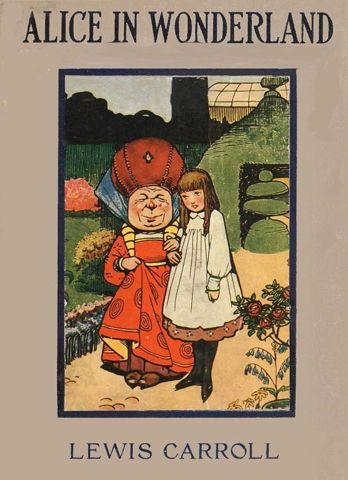
Work Background:
Alice's Adventures in Wonderland, by Lewis Carroll, first appeared in 1865. Carroll's mathematical habits, interest in games and language, and storytelling for Alice Liddell were reshaped into a carefully structured published book with John Tenniel's illustrations. Carroll's fantasy changed children's literature by trusting nonsense, parody, dream logic, and linguistic instability instead of reducing wonder to direct moral instruction. Carroll builds Wonderland from abrupt changes of scale, parody, games, riddles, recitation, and unstable rules of language. Readers should distinguish this book from its sequel, Through the Looking-Glass, which many adaptations combine with it. This context explains the work's choice of voice, structure, and genre, while helping readers recognize the literary setting and social institutions surrounding its first publication or performance. Readers may notice how public rules enter private judgment, how repeated images change meaning, and how form controls what can be known at each stage.
Story Overview:
Alice follows a White Rabbit underground and enters a world of changing size, unstable rules, strange conversations, games, recitations, and trials. Her attempts to ask sensible questions expose how language and authority repeatedly change their terms. This summary identifies only the central situation and direction without revealing the ending. As speakers, settings, scale, or social positions change, earlier events take on new meanings; the work's effect lies not only in its incidents but also in pacing, point of view, silence, and the distance between what characters understand and what readers can infer.
Director: Clyde Geronimi, Wilfred Jackson, and Hamilton Luske
Production country: United States
Principal cast: Kathryn Beaumont, Ed Wynn, Richard Haydn, and Sterling Holloway
Difference from the book: Disney compresses and rearranges episodes, turns poems and encounters into songs, and imports some characters and motifs associated with Through the Looking-Glass.
Director: Tim Burton
Production country: United States
Principal cast: Mia Wasikowska, Johnny Depp, Helena Bonham Carter, and Anne Hathaway
Difference from the book: Alice returns as a young adult to an Underland with a quest plot; the film combines names and imagery from both Alice books rather than retelling the 1865 sequence.
The selected full text is the verified digital edition numbered 11. Market titles include: Alice's Adventures in Wonderland; Alice in Wonderland; Alice au pays des merveilles; Alicia en el país de las maravillas; 愛麗絲夢遊仙境. When choosing an edition, distinguish complete, abridged, annotated, modernized, and collected versions, and verify the translator, publisher, and year for each.
Carroll's fantasy changed children's literature by trusting nonsense, parody, dream logic, and linguistic instability instead of reducing wonder to direct moral instruction. Carroll's mathematical habits, interest in games and language, and storytelling for Alice Liddell were reshaped into a carefully structured published book with John Tenniel's illustrations. These qualities place the book at a specific point in the author's career and in the development of its genre. Its influence rests on recognizable questions of language, structure, history, and judgment rather than on a vague label of “classic.” Reading the full text beside another translation, stage production, or film reveals what later editors, translators, actors, and directors preserve, explain, compress, or rearrange, and brings out formal effects that summaries often conceal.
Reading another work from the same author's career also shows which concerns persist and which methods change. The book remains open to interpretation, disagreement, and rereading because readers can return to its actual language and arrangement instead of allowing later reputation to replace the experience of reading.
Bored while sitting on a riverbank with her sister, young Alice spots a White Rabbit in a waistcoat checking his pocket watch. Curious, she pursues him down a deep rabbit hole, landing in a hall surrounded by locked doors. Finding a small golden key, she discovers a glass table and a tiny door opening into a lovely garden. By drinking a mysterious liquid that shrinks her and eating a cake that causes her to grow enormous, Alice begins a chaotic journey where her physical size and sense of identity constantly shift. Her sudden massive growth fills the room, and her tears form a great pool. After shrinking again, she falls into her own pool of tears, swimming ashore alongside an assortment of unusual animals. On the bank, a Dodo organizes a nonsensical "Caucus-race" where everyone runs in circles to get dry, and every participant is declared a winner. The White Rabbit, mistaking Alice for his housemaid, sends her to his home to fetch his gloves. Inside, she drinks from another bottle, growing so vast that she becomes trapped in the house. After defending herself against the Rabbit's attempts to remove her, she eats small cakes that turn into pebbles, shrinking herself enough to escape into the woods. There, she encounters a wise Caterpillar resting on a mushroom and smoking a hookah. During their strange, philosophical conversation about who she is, the Caterpillar reveals that different sides of the mushroom can make her grow taller or shorter, allowing her to control her size. Continuing through the forest, Alice visits the house of the Duchess, where a smoky kitchen, a pepper-heavy soup, and a violent lullaby create chaos. Leaving with the Duchess’s baby, Alice watches in amazement as the infant transforms into a pig, which she sets free. She then meets the grinning Cheshire Cat, who explains that everyone in Wonderland is mad before vanishing piece by piece until only his floating smile remains. Guided by the Cat, Alice joins the March Hare, the Hatter, and a sleepy Dormouse for a surreal, endless tea party where Time stands still at six o'clock. Frustrated by their non sequiturs, unanswerable riddles, and rude remarks, Alice leaves and finally gains entry to the beautiful garden. Inside, she meets three card-gardeners frantically painting white roses red to avoid the wrath of the terrifying Queen of Hearts. The Queen invites Alice to participate in a bizarre croquet game played with live flamingos as mallets and hedgehogs as balls, while constantly shouting orders for executions. Alice then spends time with the Mock Turtle and the Gryphon, who entertain her with tales of their underwater school and demonstrate the lively Lobster Quadrille. Suddenly, the Gryphon whisks Alice away to attend a grand trial in the royal court, where the Knave of Hearts is accused of stealing the Queen's tarts. As the trial progresses under the King's erratic legal rulings, Alice finds herself growing back to her normal height. When called to testify, she boldly challenges the nonsensical courtroom procedures, arguing against the King's invented regulations and the absurd demand for "sentence first, verdict afterwards." Reclaiming her voice and size, Alice confronts the royal court, exclaiming that they are "nothing but a pack of cards!" At her declaration, the entire deck flies into the air and swarms down upon her. Alice wakes up on the peaceful riverbank in her sister's lap, brushing away falling leaves and realizing that her extraordinary adventures in Wonderland were a dream.
Curiouser and curiouser!” cried Alice (she was so much surprised, that for the moment she quite forgot how to speak good English); “now I’m opening out like the largest telescope that ever was! Good-bye, feet!”Alice's Adventures in Wonderland Chapter 2. It captures Alice's childlike wonder and surreal sense of detachment as her body dramatically transforms, introducing the book's core motif of physical and identity instability.
“Oh, you can’t help that,” said the Cat: “we’re all mad here. I’m mad. You’re mad.”Alice's Adventures in Wonderland Chapter 6. This iconic declaration serves as the central philosophical thesis of Wonderland, challenging traditional notions of sanity and logic.
“Stuff and nonsense!” said Alice loudly. “The idea of having the sentence first!”Alice's Adventures in Wonderland Chapter 12. It marks a crucial turning point where Alice openly rejects the absurd legal procedural logic of Wonderland, asserting her own critical thinking.
“Who cares for you?” said Alice, (she had grown to her full size by this time). “You’re nothing but a pack of cards!”Alice's Adventures in Wonderland Chapter 12. It represents the climax of Alice's developmental arc, as she reclaims her agency, shatters the illusion of authority held by the inhabitants of Wonderland, and triggers her return to the real world.
While the book was written for young readers in the Victorian era, modern readers might initially find its Victorian phrasing, wordplay, and formal sentence structure slightly distinct from contemporary prose. However, the narrative itself remains exceptionally light, fast-paced, and engaging. Rather than relying on dense world-building or difficult vocabulary, Carroll relies on playful dialogue, mathematical humor, and dreamlike scenarios that move rapidly from one encounter to the next. Readers who approach the text as an imaginative comedy filled with satire and nonsensical arguments will find it easily accessible and deeply entertaining across all reading levels.
Lewis Carroll's 1865 masterpiece fundamentally changed the trajectory of children's literature by abandoning heavy-handed moralizing in favor of pure imagination, linguistic play, and dream logic. Before its publication, stories written for young readers focused primarily on moral instruction and proper behavior. Carroll trusted nonsense, parody, and clever wordplay, creating a carefully structured narrative supported by John Tenniel's iconic illustrations. Its sharp satire of adult authority, mathematical logic, and Victorian social customs allows it to function simultaneously as an entertaining tale for children and a rich text for scholarly analysis.
What awaits at the climax is not a quiet resolution, but an explosive clash between rigid, unyielding logic and absolute absurdity. As the royal trial descends into total chaos, every surreal thread of this dreamscape pulls together into a single, high-stakes confrontation. The arbitrary authority that has dictated every rule, trial, and execution in Wonderland finally demands its ultimate sacrifice: total compliance. What makes this conclusion unforgettable is the sudden, electrifying moment when a voice dares to shatter the entire illusion. Standing at the threshold of absolute madness, one final choice must be made, a single, defiant realization that tears through the fabric of Wonderland itself and forever alters the boundary between reality and imagination.
Film adaptations frequently compress, rearrange, or combine Carroll's original text with its 1871 sequel, Through the Looking-Glass. For instance, the 1951 animated Disney film converts Carroll's poems into musical songs and imports characters such as Tweedledum and Tweedledee from the second book into Alice's initial journey. Similarly, Tim Burton's 2010 film reimagines Alice as a young adult returning to an Underland setting with a traditional fantasy quest plot. Reading the original 1865 book restores Carroll's specific episodic pacing, original character interactions, and focus on pure linguistic play.
Alice's physical growth and shrinking serve as a central thematic driver for her personal journey and identity crisis in Wonderland. Each physical transformation alters how she interacts with her environment, from being too large to fit through the door into the garden to being so small that she almost drowns in her own tears. These sudden changes mirror the awkwardness and disorientation of growing up. They force Alice to continually re-evaluate who she is, adapt to shifting physical perspectives, and eventually learn how to manage her growth using the Caterpillar's mushroom.
Lewis Carroll was the pen name of Charles Lutwidge Dodgson, an English author, mathematician, photographer, and Anglican deacon. His deep interest in logic, games, and wordplay heavily influenced the nonsensical logic found throughout Wonderland. The story originally began as an improvised tale told during a boat trip to entertain Alice Liddell, the young daughter of the Dean of Christ Church, Oxford, and her sisters. Encouraged by the children, Dodgson expanded and structured his storytelling into the published book that became a cornerstone of world fantasy literature.
Miva: the next reading experience beyond audiobooks
Listen like an audiobook, then ask anything, anytime.
Start Miva's narrationMiva does not just narrate. It keeps explaining based on what you ask.