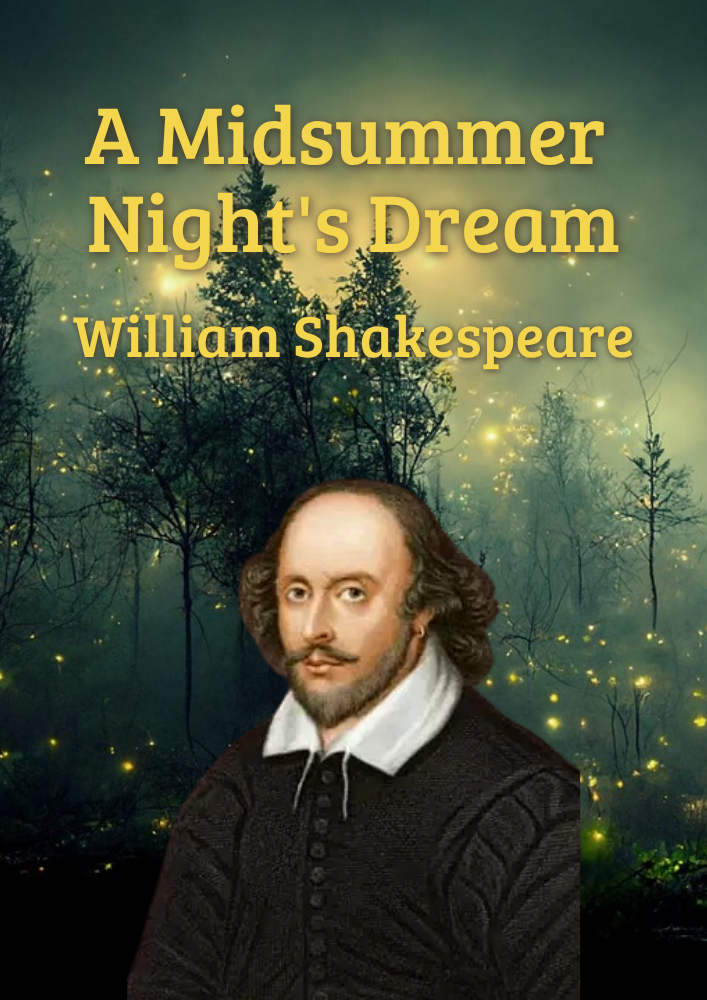
Work Background:
A Midsummer Night's Dream, by William Shakespeare, first appeared in c. 1595–1596. Written during Shakespeare's early-to-middle comic period, the play brings together courtly romance, classical story, English folklore, and amateur theatre in a design made for ensemble performance. The play has remained central to repertory theatre, school performance, ballet, opera, and film because its multiple worlds can be staged in radically different visual languages. Its interlocking court, woodland, fairy, and mechanicals plots make performance itself a subject: desire is redirected by acting, watching, rehearsal, and enchantment. This context explains the work's choice of voice, structure, and genre, while helping readers recognize the literary setting and social institutions surrounding its first publication or performance. Readers may notice how public rules enter private judgment, how repeated images change meaning, and how form controls what can be known at each stage.
Story Overview:
Four young Athenians enter a forest where Oberon and Puck's enchanted flower redirects desire, while a group of artisans rehearses a play for a royal wedding. The crossed affections, fairy quarrel, and comic rehearsal converge in a final sequence of recognition and performance. This summary identifies only the central situation and direction without revealing the ending. As speakers, settings, scale, or social positions change, earlier events take on new meanings; the work's effect lies not only in its incidents but also in pacing, point of view, silence, and the distance between what characters understand and what readers can infer.
Director: Max Reinhardt and William Dieterle
Production country: United States
Principal cast: James Cagney, Mickey Rooney, Olivia de Havilland, and Ian Hunter
Difference from the book: The Warner Bros. production enlarges the fairy spectacle with ballet, Mendelssohn's music, and studio effects while cutting and rearranging Shakespeare's text.
Director: Michael Hoffman
Production country: United States, Italy, and the United Kingdom
Principal cast: Kevin Kline, Michelle Pfeiffer, Rupert Everett, and Calista Flockhart
Difference from the book: The setting moves to a turn-of-the-twentieth-century Tuscan world; bicycles, villas, and period social rules replace an unspecified ancient Athens.
The selected full text is the verified digital edition numbered 1514. Market titles include: A Midsummer Night's Dream; Ein Sommernachtstraum; Le Songe d'une nuit d'été; El sueño de una noche de verano; 真夏の夜の夢; 仲夏夜之夢. When choosing an edition, distinguish complete, abridged, annotated, modernized, and collected versions, and verify the translator, publisher, and year for each.
The play has remained central to repertory theatre, school performance, ballet, opera, and film because its multiple worlds can be staged in radically different visual languages. Written during Shakespeare's early-to-middle comic period, the play brings together courtly romance, classical story, English folklore, and amateur theatre in a design made for ensemble performance. These qualities place the book at a specific point in the author's career and in the development of its genre. Its influence rests on recognizable questions of language, structure, history, and judgment rather than on a vague label of “classic.” Reading the full text beside another translation, stage production, or film reveals what later editors, translators, actors, and directors preserve, explain, compress, or rearrange, and brings out formal effects that summaries often conceal.
Reading another work from the same author's career also shows which concerns persist and which methods change. The book remains open to interpretation, disagreement, and rereading because readers can return to its actual language and arrangement instead of allowing later reputation to replace the experience of reading.
Miva: the next reading experience beyond audiobooks
Listen like an audiobook, then ask anything, anytime.
Start Miva's narrationMiva does not just narrate. It keeps explaining based on what you ask.