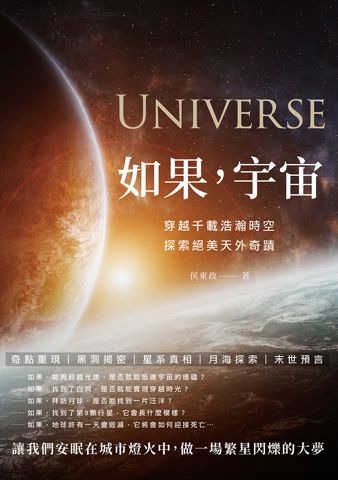
───Lull yourself to sleep in the city lights and dream a grand dream of twinkling stars───
Singularity Reappearance | Black Hole Secrets | Galactic Truths | Lunar Sea Exploration | Doomsday Prophecies
──What if we could exceed the speed of light? Could we reach the boundaries of the universe?
The question of whether the universe is finite or infinite actually involves the shape of the universe. If the birth of the universe was indeed caused by the Big Bang, then the distance light could have reached since the Big Bang is finite. Since light propagates spherically in all directions, the universe is likely spherical; and if the universe is spherical, it is finite but unbounded.
This "finite but unbounded" shape is the one most widely accepted by the mainstream scientific community.
──What if we found a white hole? Could we achieve time travel?
Scientists believe that if time flows backward, everything should be identical. So if at some point in the future, light only enters and never leaves (a black hole), there must have been a point in the past where light only left and never entered—this is a "white hole." There is a specific term for the passage between a black hole and a white hole called a "grey hole." Although white holes have not yet been discovered, the ability to continuously discover or confirm new things during the process of scientific exploration is one of the most beautiful things.
──What if we traveled to other planets? Could we still see magnificent auroras?
Using NASA's Hubble Space Telescope, scientists have captured images of Jupiter's auroras. By using the infrared telescopes of the Southern European Observatory, scientists can more clearly observe the smog and auroras above Jupiter's north pole. Scientists point out that the auroras surround Jupiter's magnetic axis, while the smog revolves around Jupiter's rotational axis below the auroral ring; the smog is influenced by zonal winds on Jupiter, which move along the same latitude.
──What if we visited the Moon? Could we find a vast ocean?
In the 17th century, the Italian scientist Galileo used his self-made telescope to discover that the Moon was pitted and uneven. Galileo believed the raised bright parts were land and the recessed dark parts were oceans, called "Lunar Seas" (Maria). With the development of space exploration technology, it was further discovered that the bright parts are indeed highlands, peaks, and impact craters, while the dark parts are not oceans but low-lying, vast plains. Nevertheless, the inaccurate name "Lunar Sea" is still in use today.
──What if we found a ninth planet? What would it look like?
Opinions among experts regarding the existence of a ninth planet are inconsistent, with the views of Takafumi Matsui from the University of Tokyo being most representative. Matsui believes that based on current theories of the origin of the solar system and planets, it is difficult to consider the existence of an unknown planet several times the mass of Earth. Beyond Saturn, especially as far as Pluto, the density of planet-forming material is very low, and it takes a long time to form a planet—at most, it could only form small bodies with a radius of several hundred kilometers. If a planet several times the mass of Earth truly exists, existing theories must be revised.
──What if our Earth eventually faces destruction? How will it meet its end?
Scientists believe that in the final cycle of the Sun's life, it will evolve into a red giant and scorch all the inner planets of the solar system, including Earth. Astronomers Klaus-Peter Schröder and Robert Cannon Smith have proposed a detailed timeline for Earth's destruction. Smith calls this latest prediction "depressing," but adds that "from another perspective, it is a motivation to find ways to leave our Earth and settle in other regions of the galaxy." He said: "I would be very surprised if someone finds a way to save the Earth in a future paper."
Using this book as your spacecraft,
Embark on a colorful journey of astronomical dreams.
This book covers several levels including the universe, the solar system, the Moon, the Earth, and the starry sky, transforming the distant universe into intimate words. Through a complete and unified knowledge structure, it allows readers to fully witness the wonders of the universe and unlock various cosmic mysteries.
Miva: the next reading experience beyond audiobooks
Listen like an audiobook, then ask anything, anytime.
Start Miva's narrationMiva does not just narrate. It keeps explaining based on what you ask.