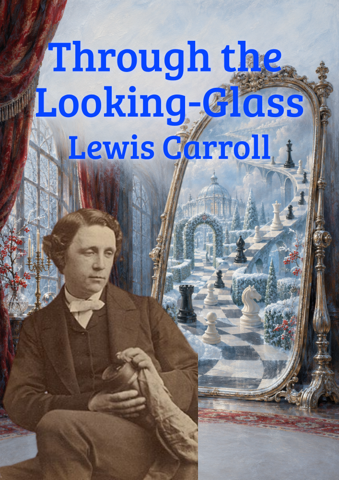
Background:
Published in 1871, the sequel to Alice's Adventures in Wonderland organizes dream, language, identity, time, and social rules around a journey through a looking-glass world structured like a chess problem.
The central tension:
Alice crosses the mirror and moves across a landscape where pieces, squares, nursery rhymes, and arguments follow rules that are precise but continually unstable. The guide preserves the pleasure of discovery rather than converting the book into a list of symbols.
How the writing works:
Chess movement, mirrored language, poems, logical reversals, abrupt scale and identity changes, episodic encounters, and a framing dream make typography and sequence part of the narrative.
The mirror opens not onto random fantasy but onto a board with rules. Alice moves through the landscape like a chess piece seeking promotion, yet every encounter changes the meaning of language, time, identity, or sequence. The pleasure comes from feeling a structure operate even when its local logic becomes absurd.
Poems are part of that structure. Jabberwocky asks readers to understand grammar before vocabulary; Humpty Dumpty claims ownership over meaning; the White Queen treats memory as something that can run in both directions. Nonsense here is not the absence of sense but an experiment in how much form can survive when ordinary reference is removed.
The 2016 film borrows names and visual motifs but invents a time-travel rescue story unrelated to the novel's chess journey. Readers expecting the film will therefore discover a stranger, more compact book whose episodes continually test who has authority to make a rule. Preserve the poems, typography, and chapter order: they are not ornaments but the mechanism of the game.
The chess design gives Alice a destination, but it does not give her mastery. Every square introduces a local authority who treats an arbitrary rule as obvious: flowers judge, queens remember backward, and Humpty Dumpty claims the power to make words obey him. Alice's practical questions keep colliding with systems that are internally confident and mutually incompatible. Her progress becomes a comic education in the politics of definition.
The poems deepen that game. Jabberwocky proves that grammar, sound, and narrative expectation can produce meaning before the vocabulary is known; The Walrus and the Carpenter turns rhythm and charm into moral unease. Tenniel's images and the typography participate in the jokes rather than merely illustrating them. The book is short enough to race through, but its best pleasures appear when read aloud and revisited. It makes nonsense feel not like an escape from thought, but like thought caught inventing its own rules.
This is a book children can follow as an adventure and adults can reopen as a comedy of systems. Its creatures are funny because their logic is rigorous enough to trap Alice inside it. Reading aloud reveals rhythms and sounds that silent summary cannot preserve, while the chess pattern rewards anyone who wants to trace the hidden architecture. The book offers the rare pleasure of feeling clever and confused at once. Every confident explanation creates another question about language, authority, memory, or identity—and then the story moves briskly to the next square.
Director: James Bobin
Production country: United States
Cast: Mia Wasikowska, Johnny Depp, Helena Bonham Carter
Difference from the book: borrows characters and motifs but invents a time-travel rescue plot that is not the novel's chessboard journey.
All 12 chapters, poems, typography, and chess design matter. A text that drops Jabberwocky or flattens its layout removes part of the reading experience.
Jabberwocky, Tweedledum and Tweedledee, Humpty Dumpty, the Red Queen, and the chessboard design have entered global culture, often detached from the book's sustained play with rules and interpretation.
Miva: the next reading experience beyond audiobooks
Listen like an audiobook, then ask anything, anytime.
Start Miva's narrationMiva does not just narrate. It keeps explaining based on what you ask.