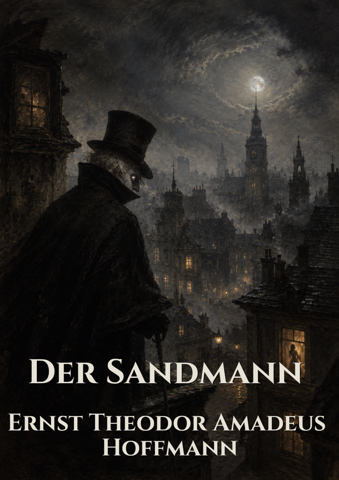
The Sandman is one of the most famous tales of German Romanticism and was published in 1816 in the collection Night Pieces (Nachtstücke). Today, the novella is considered a key work of fantasy literature as well as an early precursor to psychological horror and the literature of the uncanny. At the center of the story is the question of how precarious the boundary between reality, imagination, and madness can be.
The plot follows the student Nathanael, who has been haunted since childhood by the figure of the "Sandman." Originally a bogeyman from children's fairy tales intended to steal the eyes of disobedient children, for Nathanael, this figure is linked to the mysterious lawyer Coppelius, a dark acquaintance of his father associated with alchemical experiments and his father's death. Years later, Nathanael meets the barometer salesman Coppola and believes he recognizes the same sinister man. From this moment on, his perception of reality begins to shatter.
Particularly important to the narrative is Nathanael's relationship with Olimpia, the daughter of Professor Spalanzani. Nathanael falls passionately in love with her, despite her being unusually quiet, rigid, and mechanical. It is later revealed that Olimpia is not human, but an artificial automaton. This discovery finally destroys Nathanael's mental stability, leading him to madness and death.
In The Sandman, Hoffmann combines Romantic fantasy with psychological uncertainty. The novella explores themes of the fear of losing one's identity, the threat of technology and artificial humans, and the power of repressed childhood memories. The eye motifs, in particular, play a central role, symbolizing perception, insight, and psychological vulnerability.
The story gained significant influence through Sigmund Freud's 1919 essay The Uncanny. Freud interpreted The Sandman as a literary archetype for the "uncanny"—that feeling of dread that arises when something seems simultaneously familiar and foreign. As a result, the novella became one of the most discussed works in European literary history.
To this day, The Sandman continues to influence literature, opera, film, and horror aesthetics. The story inspired, among others, Léo Delibes' ballet Coppélia, Jacques Offenbach's opera The Tales of Hoffmann, and numerous modern works concerning artificial humans, madness, and psychological anxiety.
Miva: the next reading experience beyond audiobooks
Listen like an audiobook, then ask anything, anytime.
Start Miva's narrationMiva does not just narrate. It keeps explaining based on what you ask.