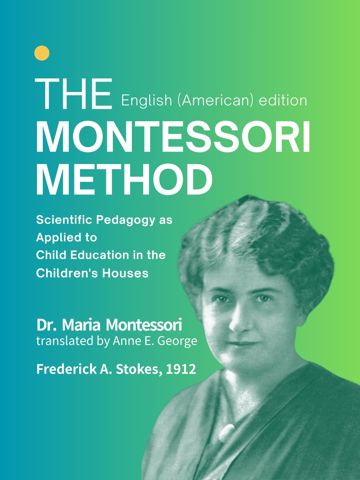
Dr. Maria Montessori ---
The Montessori Method by Maria Montessori is a scientific publication and an all-encompassing introduction to the Italian physician's popular alternative approach to educating and nurturing children as they develop. First published in the early 20th century (1912) and featuring original illustrations, this influential work introduces an innovative approach to child education and pedagogy, articulating the principles underlying Montessori's educational philosophy, particularly as applied in "The Children's Houses."
The Montessori teaching method focuses on a child’s natural abilities and interests, and encourages hands-on learning. At the start of the book, Montessori reflects on the state of education and the need for a new pedagogy rooted in scientific principles. She critiques traditional schooling for its rigid structures and the application of discipline that stifles a child's natural inclinations. Removing the formality of traditional elements of education, such as examinations, Dr. Montessori’s approach to teaching gives children the opportunity to learn from their mistakes and develop at their own pace.
By advocating for an environment where children can learn through observation and hands-on experiences, she emphasizes the significance of freedom and spontaneity in a child’s development. Montessori argues that true education must respect and nurture the individual child's spirit, preparing the teacher to observe and understand the child’s unique path to knowledge.
Clear and simple, this introduction explores the importance of fostering independence and allowing natural learning processes, which have become foundational concepts in modern educational practices, making it an ideal read for teachers and parents alike.
This volume features the following chapters:
The Montessori Method; Scientific Pedagogy as Applied to Child Education in 'The Children’s Houses' with Additions and Revisions by the Author, a classical book, has been considered essential throughout human history. So that this work is never forgotten, efforts have been made in its preservation by republication in a modern format for present and future generations. The whole book has been reformatted, retyped, and designed. These books are not made of scanned copies of their original work, ensuring the text remains clear and readable.
An audience already thoroughly interested awaits this translation of a remarkable book. For years no educational document has been so eagerly expected by so large a public, and not many have better merited general anticipation.
It is wholly within the bounds of safe judgment to call Dr. Montessori's work remarkable, novel, and important. It is remarkable, if for no other reason, because it represents the constructive effort of a woman. We have no other example of an educational system—original at least in its systematic wholeness and in its practical application—worked out and inaugurated by the feminine mind and hand. It springs from a combination of womanly sympathy and intuition, broad social outlook, scientific training, intensive and long-continued study of educational problems, and varied and unusual experience as a teacher and educational leader. No other woman who has dealt with Dr. Montessori's problem—the education of young children—has brought to it personal resources so richly diverse as hers.
A system which embodies such a capital of human effort could not be unimportant. Certain aspects of the system are in themselves striking and significant: it adapts to the education of normal children methods and apparatus originally used for deficients; it is based on a radical conception of liberty for the pupil; it entails a highly formal training of separate sensory, motor, and mental capacities; and it leads to rapid, easy, and substantial mastery of the elements of reading, writing, and arithmetic.
The Montessori System vs. The Kindergarten
The system is not original in the sense in which Froebel's system was original; but as a system it is the novel product of a single woman's creative genius. Dr. Montessori's views of childhood are in some respects identical with those of Froebel, although in general decidedly more radical. Both defend the child's right to be active, to explore his environment and develop his own inner resources through every form of investigation and creative effort. Education is to guide activity, not repress it. Environment cannot create human power, but only give it scope and material, direct it, or at most but call it forth; and the teacher's task is first to nourish and assist, to watch, encourage, guide, induce, rather than to interfere, prescribe, or restrict.
Compared with the kindergarten, the Montessori system presents these main points of interest:
The broad contrast between a Montessori school and a kindergarten appears on actual observation to be this: whereas the Montessori children spend almost all their time handling things largely according to their individual inclination and under individual guidance, kindergarten children are generally engaged in group work and games with an imaginative background and appeal.
Social Aspect and Liberty
Dr. Montessori believes in liberty for the pupil because she thinks of life "as a superb goddess, ever advancing to new conquests." She holds that sense perception forms the sole basis for the mental and hence for the moral life; that "sense training will prepare the ordered foundation upon which the child may build up a clear and strong mentality." The Montessori apparatus satisfies sense hunger when it is keen for new material, and it has besides a puzzle-interest which children eagerly respond to.
In any discussion of the availability of the Montessori system, two general conditions under which Dr. Montessori did her early work in Rome should be borne in mind: she had her pupils almost all day long, practically controlling their lives in their waking hours; and her pupils came for the most part from families of the laboring class. We must welcome Dr. Montessori's large conception of the social function of her "Houses of Childhood" as a new gospel for the schools which serve the city poor. No matter what didactic apparatus such schools may use, they should learn of Dr. Montessori the need of longer hours, completer care of the children, closer co-operation with the home, and larger aims.
Implementation in the Home and School
In the school arts, the programme used to such good effect in the Italian schools and the programme which has been so well worked out in English and American schools may be profitably combined. We can learn much about writing and reading from Dr. Montessori—especially from the freedom her children have in the process of learning to write and in the use of their newly acquired power, as well as from her device for teaching them to read connected prose.
As to the use of the Montessori system in the home, parents should not expect that the mere presence of the material in the nursery will be enough to work an educational miracle. A Montessori directress does no common "teaching," but she is called upon for very skillful and very tiring effort. She must watch, assist, inspire, suggest, guide, explain, correct, inhibit. The best use of the Montessori system in the home will come through the reading of this book. If parents shall learn from Dr. Montessori something of the value of child life, of its need for activity, of its characteristic modes of expression, and of its possibilities, and shall apply this knowledge wisely, the work of the great Italian educator will be successful enough.
To all educators this book should prove most interesting. All who are fair-minded will admit the genius that shines from the pages which follow, and the remarkable suggestiveness of Dr. Montessori's labors, honoring in the Dottoressa Maria Montessori the enthusiasm, the patience, and the constructive insight of the scientist and the friend of humanity.
Miva: the next reading experience beyond audiobooks
Listen like an audiobook, then ask anything, anytime.
Start Miva's narrationMiva does not just narrate. It keeps explaining based on what you ask.