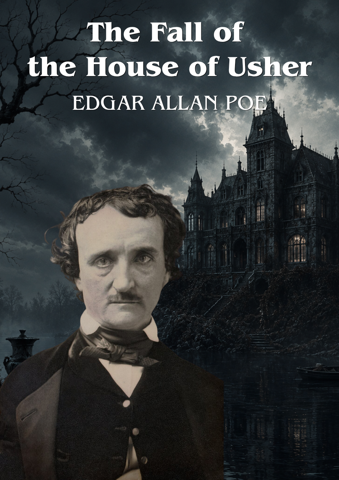
Edgar Allan Poe's classic Gothic short story, "The Fall of the House of Usher," first published in 1839, delves into themes of madness, family, and the supernatural. The narrative follows an unnamed protagonist who receives an urgent letter from his childhood friend, Roderick Usher, requesting his presence at the ancestral Usher mansion. Upon arrival, the narrator finds Roderick in a state of extreme nervous agitation, convinced that his decaying house is sentient and exerting a malevolent influence over him. He also encounters Roderick's mysterious and sickly twin sister, Madeline, who appears to be wasting away from a cataleptic illness. As Madeline's condition worsens, she is prematurely entombed in a vault beneath the house. However, her return from the grave, amidst a terrifying storm and the house's own collapse, culminates in a horrifying climax that inextricably links the fate of the Usher twins to their cursed ancestral home.
Reading ease score: 49.7 (College-level). Difficult to read.
An unnamed narrator arrives on a dark autumn day at the House of Usher, the gloomy, isolated estate of his childhood friend, Roderick Usher. The narrator has traveled there after receiving an urgent, despairing letter from Roderick pleading for his company. Roderick explains that he is suffering from an acute physical and mental illness, a debilitating nervous affection marked by a morbid hypersensitivity of the senses. Upon approaching the mansion, the narrator experiences an inexplicable sense of dread, noting the building’s decaying appearance, blank eye-like windows, and a barely perceptible zigzag crack running from the roof down into the adjacent dark tarn. Inside, the atmosphere is equally oppressive, filled with somber tapestries, antique furnishings, and shadowy vaults. The narrator finds Roderick severely altered, exhibiting cadaverous paleness and erratic behavior that alternates between intense agitation and deep melancholy. Roderick believes that the ancient mansion itself, along with the surrounding moat and vegetation, possesses a sinister sentience that has bound itself to his family line and shaped his tragic destiny. Adding to his distress is the terminal condition of his beloved twin sister, Lady Madeline, who suffers from a mysterious, wasting illness characterized by cataleptic trances. Shortly after the narrator's arrival, Madeline succumbs to her disease and appears to die. To prevent medical researchers from exhuming her body due to the unusual nature of her illness, Roderick decides to preserve her corpse temporarily in a vault situated directly beneath the mansion. The narrator assists Roderick in carrying Madeline to the copper-lined, iron-doored tomb. While placing her inside, the narrator notices the striking physical resemblance between the twins and observes a faint blush lingering on Madeline's cheeks and chest before the heavy vault door is sealed shut. In the days following Madeline's entombment, Roderick's mental health rapidly deteriorates. He wanders aimlessly through the house, his skin growing even paler and his eyes wildly vacant. He abandons his artistic pursuits and constantly stares into space as if listening to faint, imagined sounds. His terror infects the narrator, who begins to experience an overwhelming sense of foreboding and insomnia. One week later, during a furious tempest, the narrator finds Roderick wandering into his bedchamber in an extreme state of panic. To calm his friend, the narrator reads aloud from a medieval romance titled the "Mad Trist." As the story progresses, the sounds described in the narrative, such as the splintering of wooden doors, the death-shriek of a dragon, and the clanging of metal armor, are terrifyingly echoed by real, muffled noises resonating from deep within the house. Roderick finally snaps and reveals his horrific secret in a screaming outburst: he has been hearing movements from inside the vault for days and realizes they buried Madeline alive. As he declares that she is standing outside the door, the heavy antique doors burst open. The shrouded, bloodied figure of Lady Madeline stands on the threshold. With a low moaning cry, she sways and collapses upon her brother. In her final death-agonies, she drags Roderick to the floor, where he dies instantly from sheer terror. Horrified, the narrator flees the mansion into the howling storm. As he crosses the causeway, he looks back under a blood-red moon to see the subtle fissure in the front wall rapidly widening. The entire House of Usher splits apart and collapses into the dark, silent waters of the tarn, swallowing all remnants of the estate and the Usher bloodline forever.
Feeble gleams of encrimsoned light made their way through the trellised panes, and served to render sufficiently distinct the more prominent objects around; the eye, however, struggled in vain to reach the remoter angles of the chamber, or the recesses of the vaulted and fretted ceiling.Interior Description. The passage captures the uncanny, claustrophobic atmosphere inside the mansion, mirroring the psychological decay and isolation of its inhabitant.
We have put her living in the tomb! Said I not that my senses were acute? I now tell you that I heard her first feeble movements in the hollow coffin.Interior Description Climax. This unhinged outburst represents the emotional crescendo of the story, exposing Roderick's agonizing guilt, heightened sensitivity, and impending mental collapse.
For a moment she remained trembling and reeling to and fro upon the threshold—then, with a low moaning cry, fell heavily inward upon the person of her brother, and in her violent and now final death-agonies, bore him to the floor a corpse, and a victim to the terrors he had anticipated.Interior Description Climax. This horrifying moment delivers the physical culmination of the Usher curse, uniting the twins in death and completing the horrific destiny foreshadowed throughout the narrative.
DURING the whole of a dull, dark, and soundless day in the autumn of the year, when the clouds hung oppressively low in the heavens, I had been passing alone, on horseback, through a singularly dreary tract of country, and at length found myself, as the shades of the evening drew on, within view of the melancholy House of Usher.Interior Description Opening Paragraph. This famous opening sentence establishes the gothic atmosphere of the entire tale through rhythmic prose, vivid imagery, and an overwhelming sense of foreboding.
Edgar Allan Poe’s prose style in this work is complex, formal, and dense, making it moderately challenging for modern readers. The language relies heavily on elevated nineteenth-century vocabulary, elaborate sentence structures, and rich atmospheric descriptions intended to build a feeling of claustrophobic dread. Sentences often feature layered clauses that slow down the reading pace, reflecting the narrator's methodical, lingering observation of his gloomy surroundings. Readers who are unfamiliar with classic Gothic literature may initially find the vocabulary demanding, as terms like cataleptical, cadaverousness, and ideality appear frequently to establish the story's psychological depth. However, the narrative is quite short, and its emotional intensity and clear narrative arc make it accessible once the reader adapts to Poe's rhythmic cadence. The intricate language serves a specific purpose, wrapping the reader in the same heavy, oppressive atmosphere that affects the narrator inside the Usher estate.
This short story is celebrated as a masterpiece because it perfects the fundamental tropes of Gothic fiction while pioneering psychological horror. Poe expertly fuses setting, character, and theme so that the physical environment becomes an extension of the human mind. The mansion itself, with its blank eye-like windows, somber interior draperies, and structural crack, acts as a living character that embodies the decay of the Usher lineage. Furthermore, the tale moves beyond simple ghost stories by exploring complex psychological phenomena such as acute sensory distress, hereditary madness, and the terrifying guilt of buried secrets. Poe’s meticulous control over tone, imagery, and pacing creates an unbroken unity of effect, ensuring that every sentence contributes directly to an overarching feeling of dread. Its profound influence on subsequent horror writers and its exploration of the uncanny keep it centrally positioned in the literary canon.
What happens at the end is the convergence of every quiet horror carefully built from the very first page. The mounting storm outside, the uncanny echoes throughout the decaying halls, and the fragile sanity of Roderick Usher all collapse into a single, terrifying revelation. Rather than offering a neat resolution, the final sequence demands that the reader confront the ultimate consequence of secrets buried too deep and a family line bound to its own destruction. When the heavy doors finally open, the boundary between physical decay and psychological ruin entirely dissolves, delivering a climax so atmospheric and unyielding that it reshapes everything that came before it, leaving only the silent, dark waters to close over the truth.
The subtle fissure running down the front of the mansion symbolizes the fundamental rupture in the Usher family line and Roderick's fracturing mind. It serves as a visual marker of hidden instability beneath a seemingly intact structure. As the story progresses, the crack represents the split between reality and madness, gradually widening as psychological tension reaches its breaking point. Ultimately, the expanding fissure demonstrates how structural decay and human mortality are inextricably linked in Poe's Gothic universe.
The Haunted Palace is a ballad composed by Roderick Usher that functions as an allegory for mental decline. It describes a once beautiful and radiant palace governed by Thought, which is eventually invaded and ruined by evil forces, leaving its windows glowing red and haunted by phantom shapes. This poetic insertion mirrors Roderick’s personal transformation from a brilliant artist to a man consumed by madness, showing how horror originates from within the human intellect.
Roderick chooses to place Lady Madeline in a vault temporarily due to his anxiety regarding her unusual cataleptic illness. He expresses fear that medical doctors might exhume her body to conduct examinations on her mysterious medical condition. By securing her behind a heavy iron door within the ancestral vaults, Roderick seeks to protect her remains, though this action directly triggers the terrifying sequence of events that follows.
Miva: the next reading experience beyond audiobooks
Listen like an audiobook, then ask anything, anytime.
Start Miva's narrationMiva does not just narrate. It keeps explaining based on what you ask.