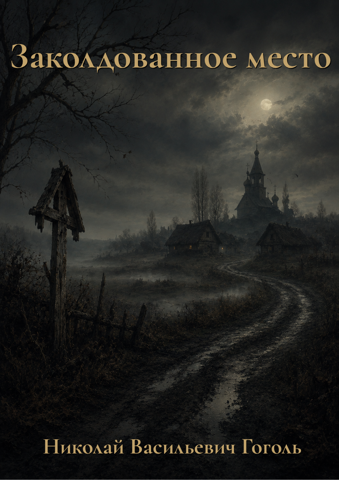
"The Enchanted Place" is one of the most famous short stories by Nikolai Vasilievich Gogol from the cycle Evenings on a Farm Near Dikanka. The work was first published in 1832 and combines folk humor, mysticism, folklore, and the atmosphere of a Ukrainian village.
The plot centers on the narrator's grandfather, who one day during a dance notices a strange spot in a field: as soon as he approaches it, space seems to shift. Later, the grandfather finds a treasure there; however, the "enchanted place" begins to toy with the man—confusing his paths, frightening him with visions, and mocking human greed. In the end, the discovered treasure turns out to be a deception, and the story itself transforms into an ironic parable about human weaknesses.
The story reflects Gogol's early style: vivid colloquial speech, the grotesque, a blend of the funny and the terrifying, and a deep connection to Ukrainian folklore. Here, the unclean force is not so much an absolute evil as it is a part of the folk worldview, where the miraculous constantly exists alongside the everyday.
"The Enchanted Place" influenced the development of Russian and Ukrainian mystical prose. Later, Gogolian motifs—the combination of satire, the absurd, and the supernatural—inspired writers such as Mikhail Bulgakov and Franz Kafka. The atmosphere of the work has been repeatedly utilized in film, theater, and video games based on Gogol's plots.
Critics have often noted Gogol's unique perspective on folk fantasy. Literary critic Andrei Bely wrote that in Gogol's work "laughter suddenly turns into horror," and a mundane scene is capable of instantly transforming into a mystical revelation.
Miva: the next reading experience beyond audiobooks
Listen like an audiobook, then ask anything, anytime.
Start Miva's narrationMiva does not just narrate. It keeps explaining based on what you ask.