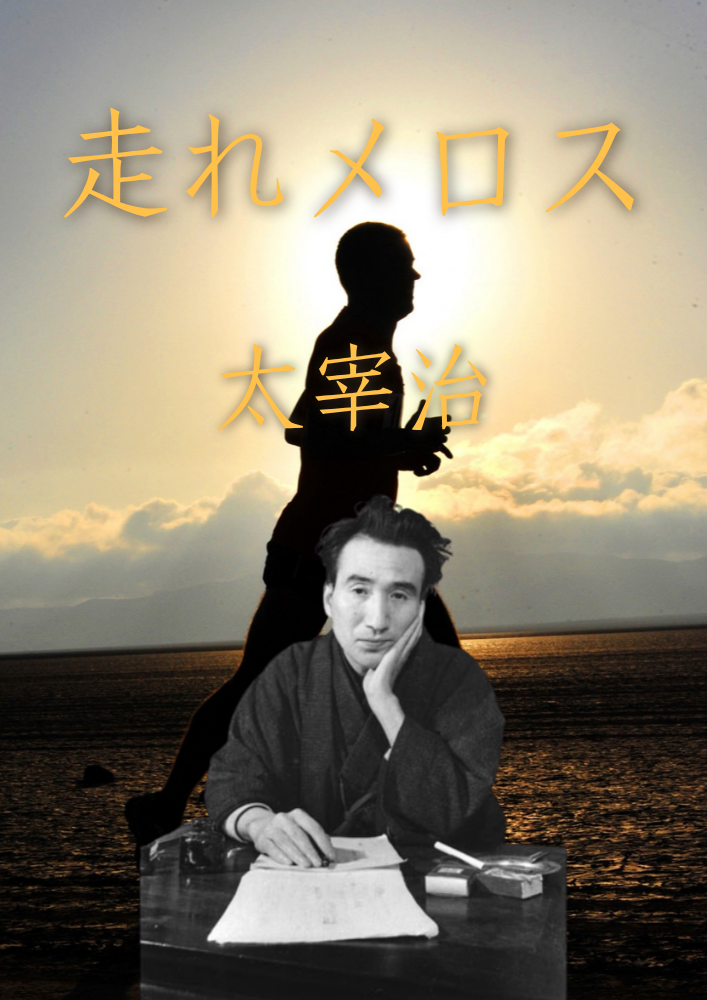
Work Guide
Background:"Run, Melos!" is a short story published in 1940, based on Friedrich Schiller's ballad "Die Bürgschaft" and other sources. Set in a stage reminiscent of ancient Syracuse, it places the characters in extreme situations testing friendship and trust, reconstructed with a powerful Japanese rhythm. It has been widely read as a staple of school curriculum. It is significant for replacing classical materials with a colloquial style and dramatic pace that resonated with readers of its time. Rather than discussing ideals abstractly, it demonstrates the weight of trust through the physical exhaustion of a running body.
Synopsis:Melos, a shepherd ordered to be executed due to the tyrant's anger, gains a three-day reprieve to complete his younger sister's wedding by leaving his best friend, Selinuntius, as a hostage. On his journey back to return by the appointed time, natural obstacles, fatigue, and doubt strike him one after another. The events hindering Melos's return include not only external obstacles but also the internal temptation to abandon his promise. It is revealed that doubt also arose on his best friend's side, portraying friendship not as a relationship between perfect individuals.
Literary Characteristics:Starting from a definitive opening sentence, the story uses short sentences, repetition, apostrophes, and monologues to simultaneously express the speed of running and the fluctuations of the psyche. By depicting not only heroic ideals but also resignation and self-justification, trust is shown not as a virtue perfected from the start, but as an act that must be chosen repeatedly. The dialogue at the end links friendship to mutual weakness rather than making it a one-sided heroic tale. While the narrator praises Melos, they do not hide his weakness or exaggerated self-justification. The mixture of high tone and mundane emotions creates a depth that prevents the fable from being confined to a simple moral teaching tool.
Film and Television Adaptations
There are multiple adaptations including movies, television, stage, and anime, but only those whose production information and differences from the original can be confirmed through independent documentation should be adopted. Based on the current text information alone, specific video versions satisfying the four essential criteria cannot be determined, so no titles have been inferred or listed.
When adding adaptations, it is necessary to distinguish between storytelling films and reading programs or stage recordings of the same name. Titles where production credits and content differences cannot be verified are not adopted based on search results alone.
Editions and Translations
The text is in the original Japanese and is not a translation. Treatment of old characters, new characters, kana usage, and ruby characters may vary depending on the base text or public edition. The sources cited at the end of the work indicate creative starting points, and Dazai's work itself should not be regarded as a literal translation of Schiller's work.
For research purposes, editions that allow for verification of wording and annotations in the first magazine appearance, hardcover, and current paperback editions are suitable. New character/new kana editions with word glossaries are convenient for first-time readers, but for readings, one should also pay attention to the speed created by punctuation and repetition.
Author and Work
Relationship between Author and Work:While borrowing from preceding Western tales, Dazai transferred the physical pain of keeping a promise and the doubt arising in the believer into a dramatic Japanese narrative. Though it leaves a different impression from his semi-autobiographical works, the key qualities of Dazai's literature—narrative exaggeration, shame, and self-doubt—are clearly evident. Because it has become established in education as a story of friendship and trust, it has acquired a public reading style distinct from Dazai's other works. Therefore, it is important not to overlook the complexity of the original text, which includes doubt and shame, rather than focusing solely on the moral conclusion.