Background:
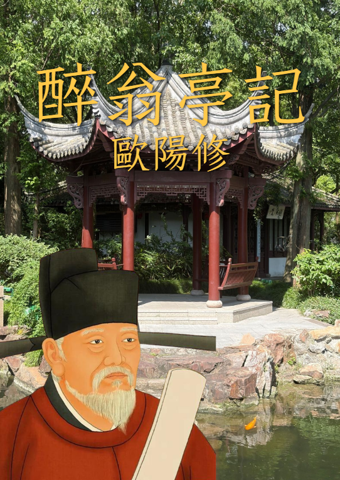
While Ouyang Xiu was exiled to Chuzhou, he wrote this record for the Old Drunkard's Pavilion on Mount Langya. The essay moves from mountain paths, springs, and the pavilion's name to seasonal scenery, the prefect's banquet, and the joy of the people. The so-called "intent of the old drunkard" lies not just in drinking, but in finding joy in the landscape and in the company of the people.
Synopsis:
The opening follows sounds and sights to find Niang Spring and the Old Drunkard's Pavilion, followed by an explanation of the prefect's self-given moniker. The middle section describes the scenery according to the morning, evening, and four seasons, while the latter part depicts the Chuzhou people's excursions, the prefect's banquet, the guests' merriment, and the return after the feast.
Literary Features:
The text makes extensive use of the particle "ye" (也) for declarative sentences and "er" (而) for transitions, creating a circular and flowing rhythm. It shifts from scenery to people, then returns to the author's identity through the joy of others. Vernacular annotations should preserve the layers of tone rather than simply deleting every grammatical particle.
Currently, no adaptations are recorded.
Main Edition:
This edition uses "Record of the Old Drunkard's Pavilion" (Zuiweng Ting Ji) as the standard title, with Ouyang Xiu listed as the author, editor, or traditional signatory. The scope of the text is the complete single essay. Common search titles include: Zuiweng Ting Ji; Record of the Old Drunkard's Pavilion.
Reading Suggestions:
The focus of this guide is on the acquisition of the full text and vernacular annotations. When reading this classical prose, the original text, historical commentaries, modern vernacular translations, and textbook excerpts should be distinguished; for citations, one should refer back to the full text and specific chapters.
Ouyang Xiu concludes by arranging the multiple perspectives of prefect, traveler, and writer, thereby bringing political circumstances and local governance into the landscape essay. This piece is a representative of Northern Song ancient prose; later calligraphy and site inscriptions have formed a separate history of reception.
Miva: the next reading experience beyond audiobooks
Listen like an audiobook, then ask anything, anytime.
Start Miva's narrationMiva does not just narrate. It keeps explaining based on what you ask.