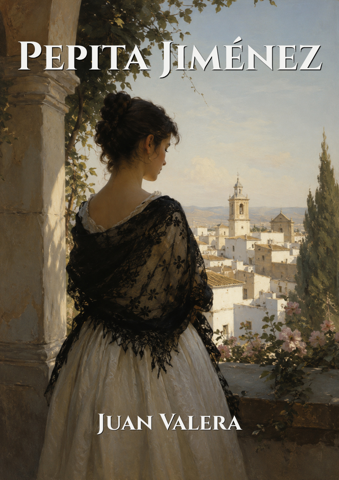
Published in 1874, Pepita Jiménez is the most famous work by Juan Valera and one of the fundamental novels of late Spanish Realism. Although it begins with a moral and religious conflict—the love between a young seminarian and his own father's fiancée—the work avoids tragic drama and becomes a refined exploration of desire, vocation, and human nature.
Valera constructs the novel following a Cervantine artifice: the supposed discovery of an Andalusian manuscript whose names have been altered to protect the real protagonists. The first part adopts an epistolary form through the letters that Luis de Vargas writes to his uncle, the Dean, while the second part abandons correspondence to transform into a more open and manners-based narrative. This structure allows for an internal observation of the protagonist's slow psychological transformation.
Don Luis returns to his hometown before taking his priestly vows and discovers that his father, Don Pedro, plans to marry Pepita Jiménez, a young widow barely twenty years old. Educated almost his entire life in the seminary, Luis comes into contact with a sensual and natural world he does not know: walks through the Andalusian countryside, domestic gatherings, Pepita's serene beauty, and human closeness eventually weaken his religious vocation. What begins as spiritual unrest ends up becoming a passion he considers sinful, further aggravated by a secret feeling of rivalry toward his own father.
The greatness of the novel lies in the fact that Valera does not present the conflict as a struggle between good and evil, but between two different forms of human fulfillment: spiritual life and natural life. Against artificial asceticism, the work defends vital spontaneity, earthly love, and harmony with nature. The resolution avoids traditional moral punishment and leads toward an unexpectedly human and understanding reconciliation.
Far from the somber realism or crude naturalism that dominated part of European literature at the time, Valera opts for an elegant, luminous, and harmonic prose. Andalusia appears idealized as a warm and sensual space, where even moral conflicts maintain a gentle irony and a constant aesthetic delicacy. The author himself argued that the novel should seek beauty and artistic delight above all, rather than demonstrating ideological theses.
The influence of Pepita Jiménez was enormous in its time. The novel was quickly translated into numerous languages and surpassed one hundred thousand copies sold, an extraordinary figure for the era. Furthermore, it inspired theatrical, cinematic, and musical adaptations. The composer Isaac Albéniz transformed it into an opera premiered at the end of the 19th century, while cinema revisited it in different eras, from the 1927 silent version to later Mexican and Spanish adaptations.
More than a century later, Pepita Jiménez remains one of the most admired Spanish novels for its psychological subtlety, the perfection of its style, and its ability to turn an intimate conflict into a universal reflection on love, desire, and the authenticity of human life.
Miva: the next reading experience beyond audiobooks
Listen like an audiobook, then ask anything, anytime.
Start Miva's narrationMiva does not just narrate. It keeps explaining based on what you ask.