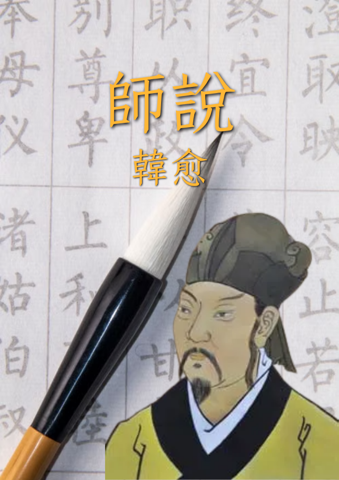
Background:
Han Yu wrote "On Teachers" during the Tang Dynasty when scholars were reluctant to learn from teachers. Using Li Pan's pursuit of learning as a specific context, he redefined the function of a teacher. The work discusses the transmission of the Way, the teaching of skills, and the resolution of doubts, which is not equivalent to a complete discourse on the modern school teaching system.
Synopsis:
The article first explains the necessity of seeking a teacher, then criticizes scholar-officials who choose teachers for their sons but consider it a shame to follow a teacher themselves. It then contrasts shamans, doctors, musicians, and craftsmen with scholar-officials, finally using Confucius's example of seeking teachers to conclude and state the reason for writing the piece.
Literary Features:
The text progresses through definitions, rhetorical questions, contrasts, and examples, with transitional phrases like "shiguh" (therefore) clearly marking the arguments. Vernacular annotations should clarify the syntax of terms like "the way of the teacher," "learning the small while losing the large," and "not being ashamed to learn from one another," rather than just picking out famous quotes.
There are currently no recorded film or television adaptations.
Main Version:
This version uses "On Teachers" (Shi Shuo) as the standard title, with the author, editor, or traditional signature recorded as "Han Yu." The scope of the text is: the complete single chapter. Common search titles include: Shi Shuo; On Teachers.
Reading Suggestions:
The focus for guiding the reading of "On Teachers" is obtaining the full text and vernacular annotations. When reading this classical argumentative essay, one should separate the original text, later commentaries, modern vernacular translations, and textbook excerpts; for citations, one should return to the complete text and specific chapters for verification.
"On Teachers" is related to Han Yu's practice of advocating the Classical Prose Movement. The article itself uses clear prose to oppose the empty vanity of the noble family system. It has had a profound influence on later educational discourse, but the social context of the Tang Dynasty should be separated from modern slogans about respecting teachers.
Miva: the next reading experience beyond audiobooks
Listen like an audiobook, then ask anything, anytime.
Start Miva's narrationMiva does not just narrate. It keeps explaining based on what you ask.