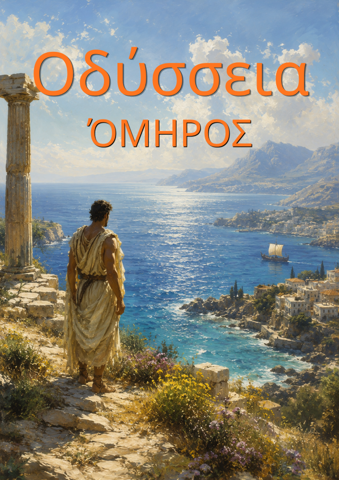
After Ten Years of Wandering, a Hero Must Become a Husband, Father, and King Again
Monsters, Witches, Gods, and a Home Overrun by Suitors
The Ancient Blueprint for Every Homecoming Adventure
The end of war is not the same as coming home. Sometimes the harder journey is returning to your own life.
────────────────────────
The Odyssey stands beside the Iliad, but its spirit is different. If the Iliad belongs to the battlefield, the Odyssey belongs to the sea, memory, temptation, disguise, and return. Odysseus, king of Ithaca, spends ten years wandering after the fall of Troy, facing the Cyclops, the Lotus-Eaters, Circe, the Sirens, Scylla, Charybdis, and the long delay on Calypso's island.
Meanwhile Ithaca is occupied by suitors. Penelope delays remarriage through cunning, and Telemachus begins his own search for his father. The second half becomes a drama of disguise, loyalty, recognition, revenge, and restored order.
────────────────────────
Author and Tradition
Ancient readers attributed both great epics to Homer, but modern scholarship treats their composition as part of a larger oral and textual tradition. The Odyssey uses Homeric Greek, hexameter, and formulaic diction, yet its narrative art is especially rich in flashback, delayed revelation, and interwoven plots.
────────────────────────
Odysseus is not the strongest hero. He is the hero who survives by speech, patience, disguise, and intelligence.
This is the ancestor of homecoming stories and long-journey adventures: from survival-at-sea novels to space odysseys, from veteran homecoming narratives to O Brother, Where Art Thou?
The Odyssey tells the grand tale of Odysseus, the king of Ithaca, and his arduous journey home after the Trojan War. As the story opens, ten years have passed since the fall of Troy, yet Odysseus remains trapped on the remote island of Ogygia by the nymph Calypso. In his absence, his kingdom has descended into chaos. Dozens of insolent suitors have overrun his palace, greedily devouring his estate and pressuring his faithful wife, Penelope, to marry one of them. Meanwhile, his young son, Telemachus, feels powerless to defend his home and his father's honor. Seeing Odysseus's plight, the goddess Athena intervenes during an assembly of the gods on Mount Olympus while Poseidon, the sea god who bears a grudge against Odysseus, is absent. With Zeus's approval, Athena descends to Ithaca disguised as Mentes. She fills Telemachus with newfound courage, urging him to call a council of local leaders, stand up to the suitors, and set sail for Pylos and Sparta to gather news of his father. Though the suitors mock him, Telemachus asserts his authority as lord of the house and embarks on his journey, taking his first steps toward manhood. Meanwhile, the messenger god Hermes travels to Ogygia to order Calypso to release Odysseus. Building a raft, Odysseus sets sail, but Poseidon stirs up a violent storm that destroys his craft. Washing ashore naked and exhausted on the island of Phaeacia, Odysseus is rescued by Princess Nausicaa. Welcomed warmly by King Alcinous and Queen Arete, Odysseus reveals his true identity and recounts his legendary, tragic misadventures. He tells of his encounters across treacherous seas: battling the monstrous Cyclops Polyphemus, whom he blinded, provoking Poseidon's rage, escaping the enchantments of the sorceress Circe, resisting the alluring song of the Sirens, navigating the deadly passage between Scylla and Charybdis, and losing his entire crew after they ate the sacred cattle of the sun god Helios. Deeply moved by his harrowing tale, the Phaeacians offer him rich gifts and passage home on one of their swift ships. Odysseus finally lands in Ithaca, but to protect him, Athena disguises him as an old beggar. He takes refuge in the hut of his loyal swineherd Eumaeus, where he meets Telemachus, who has safely returned from his quest. Odysseus reveals his true self to his emotional son, and together they devise a plan to reclaim their home and slaughter the suitors. Returning to the palace in his disguise, Odysseus endures abuse and insult from the arrogant suitors, as well as from corrupt servants. Penelope, remaining steadfast, devises a final test for her court: she promises to marry whoever can string Odysseus's great bow and shoot an arrow through the sockets of twelve axe heads. Suitor after suitor fails even to bend the bow. Stepping forward, the disguised beggar easily strings the weapon and shoots the arrow cleanly through the targets. Dropping his rags, Odysseus reveals his true identity and attacks. Joined by Telemachus, Eumaeus, and a few faithful servants, and aided by Athena, Odysseus slays every suitor and purges the palace of betrayal. After convincing Penelope of his identity by revealing the secret of their immovable bed, built around a living olive tree, the couple is joyfully reunited. In the poem's final turn, Hermes guides the souls of the fallen suitors to the underworld, where Agamemnon praises Penelope's legendary virtue. Odysseus travels into the countryside to find his grieving father, Laertes. After proving his identity by showing a childhood scar and reminding Laertes of the trees they planted together, the family shares a tearful reunion. When the angry relatives of the dead suitors march out seeking bloody revenge, Athena intervenes, halting the clash and establishing lasting peace across Ithaca.
For no other Odysseus will ever come back to you here; I am the man, just as I am, who has borne many sorrows and wandered far, returning at last in the twentieth year to my native land.Original: οὐ μὲν γάρ τοι ἔτ' ἄλλος ἐλεύσεται ἐνθάδ' Ὀδυσσεύς, ἀλλ' ὅδ' ἐγὼ τοιόσδε, παθὼν κακά, πολλὰ δ' ἀληθείς, ἤλυθον εἰκοστῷ ἔτεϊ ἐς πατρίδα γαῖαν.The Odyssey Book 16, lines 202–205. It captures the emotional core of Odysseus's epic trial and his long-awaited reunion with his son after two decades of suffering and wandering.
Show me the city, and give me some rag to wrap around myself, if you had any wrapping for the clothes when you came here.Original: ἄστυ δέ μοι δεῖξον, δὸς δὲ ῥάκος ἀμφιβαλέσθαι, εἴ τί που εἴλυμα σπείρων ἔχες ἐνθάδ' ἰοῦσα.The Odyssey Book 6, lines 177–178. It illustrates Odysseus's resourcefulness and diplomatic tact in begging for assistance while maintaining dignity despite total vulnerability.
May the gods grant you all that your heart desires, a husband and a home, and may they bestow upon you noble harmony in spirit.Original: σοὶ δὲ θεοὶ τόσα δοῖεν, ὅσα φρεσὶ σῇσι μενοινᾷς, ἄνδρα τε καὶ οἶκον, καὶ ὁμοφροσύνην ὀπάσειαν ἐσθλήν·The Odyssey Book 6, lines 179–181. It presents Homer's profound ancient ideal of marital harmony (homophrosyne) and demonstrates Odysseus's mastery of persuasion through heartfelt, courtly speech.
Reading this ancient epic can feel challenging at first due to its poetic structure, unusual epithets, and complex narrative timeline that starts in media res. Because the plot jumps between Telemachus's travels, Mount Olympus, and Odysseus's flashbacks, first-time readers often find the structural shifts unexpected. However, the underlying core of the story is driven by deeply human motivations including love, survival, revenge, and family reunion. Modern prose translations translate the poetic hexameter into clear, accessible storytelling that allows the narrative tension to shine through naturally. Focusing on the character dynamics rather than trying to memorize every obscure Greek name helps readers build a smooth rhythm and fully appreciate the dramatic momentum.
This work is considered a masterpiece because it established the structural and thematic blueprint for narrative storytelling across Western literature. It pioneered complex narrative techniques that are still widely used today, including non-linear plotting, embedded flashbacks, and parallel storylines. Beyond its technical innovation, the poem explores universal human experiences: the pain of exile, the challenge of maintaining faith against long odds, and the struggle to rebuild a life after trauma. Its archetypal journey has inspired countless adaptations, from classic sea-faring tales to modern novels and films exploring veteran re-entry into civilian society.
Everything the poem has been holding back lands in a single, high-stakes sequence once the hero steps inside the gates of his occupied palace. Who is recognized first, which impossible physical test finally reveals his true strength, and how he cleanses his ancestral hall are the exact payoffs worth experiencing in the original text. Rather than ending with immediate victory, the narrative extends into deeply emotional reunions with his faithful wife and aging father. The final moments bring a divine resolution that settles generations of bloodshed, offering a complete and satisfying restoration of domestic order and lasting peace.
Penelope relies on her exceptional intellect and diplomatic skill to maintain control over her household without provoking an immediate armed conflict. Her most famous tactic involves pretending to weave a burial shroud for Odysseus's elderly father, promising she will choose a husband only when the garment is finished. Each day she weaves the fabric in plain sight, but every night she secretly unpicks her work by torchlight, fooling the suitors for nearly four years. When her trick is eventually betrayed by a disloyal maid, she continues to use her sharp wits to stall for time until her husband returns.
The Olympian gods act as active forces that shape human fate, working through both direct physical intervention and subtle divine inspiration. Poseidon serves as the primary antagonist, driving violent sea storms to punish Odysseus for blinding his son, the Cyclops Polyphemus. Conversely, Athena acts as a dedicated guardian, shielding Odysseus, transforming his appearance, and instilling confidence in his young son Telemachus. While the gods provide assistance or set up obstacles, human beings are still held accountable for their own choices, moral failings, and disrespect of sacred customs.
While both epics emerge from the same heroic tradition surrounding the Trojan War, they focus on very different aspects of human experience. The Iliad takes place entirely on the battlefield over a short period, exploring tragic rage, glory in combat, and the violent mortality of heroes. In contrast, this poem takes place across uncharted seas and intimate domestic settings, spanning a full decade of travel and survival. Its primary hero succeeds through intelligence, adaptability, and emotional endurance rather than sheer physical dominance, shifting the focus from battlefield glory to the quiet victory of coming home.
Miva: the next reading experience beyond audiobooks
Listen like an audiobook, then ask anything, anytime.
Start Miva's narrationMiva does not just narrate. It keeps explaining based on what you ask.