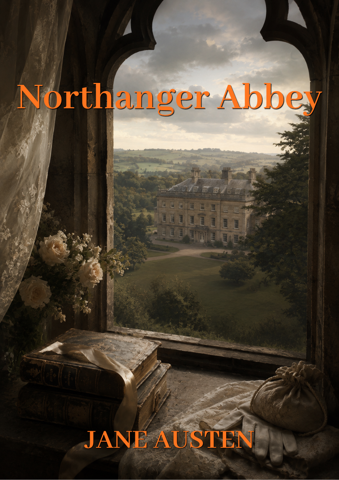
The Gothic Castle That Exists in the Reader's Imagination
Jane Austen's First Completed Novel
A Coming-of-Age Story That Teaches How to Read
The Satire Published Only After Austen's Death
Before the celebrated masterpieces came Northanger Abbey: a first book in which Jane Austen's defining concerns were already taking shape.
Northanger Abbey (/ˈnɔːrθæŋər/ NOR-thang-ər), written by the English author Jane Austen, is a coming-of-age novel and a satire of Gothic novels. Although the title page is dated 1818 and the novel was published posthumously in 1817 with Persuasion, Northanger Abbey was completed in 1799. From a fondness of Gothic novels and an active imagination distorting her worldview, the story follows Catherine Morland, the naïve young protagonist, as she develops a better understanding of herself and the world around her. Based on the different styles and different references to Gothic novels, it is apparent that Austen wrote Northanger Abbey over the span of many years. Not until after her death was her brother finally able to obtain publication for the book. Once published, it received a mix of reviews. The novel covers a wide array of topics such as high society, Gothic fiction, bildungsroman, the value of reading, and the importance of time. This novel is considered to be more juvenile than her others.
Catherine Morland enters society with a mind trained by Gothic fiction. At Northanger Abbey she interprets locked rooms and family silences as evidence of melodramatic crime, only to discover that imagination can misread reality even while ordinary reality contains its own forms of cruelty, money, and control.
Austen's satire therefore does not simply mock readers or dismiss popular novels. It defends the pleasure of fiction while teaching a more alert kind of reading—one able to distinguish fantasy from evidence and romantic convention from the economic motives shaping courtship and social behaviour.
Why Northanger Abbey Still Matters
Read today, Northanger Abbey offers more than the curiosity of a famous writer's beginning. It preserves the risks, experiments, and unresolved tensions of a literary voice before later success made that voice familiar.
Return to the beginning, and discover how Northanger Abbey first opened the path ahead.
Catherine Morland, a young and imaginative woman, travels back to her family home at Fullerton in a state of profound distress following her abrupt and humiliating expulsion from Northanger Abbey by General Tilney. Throughout the solitary eleven-hour journey, she is consumed by grief, utterly confused about how she could have offended her host, and filled with deep anxiety regarding how the General's son, Henry Tilney, will react to her sudden departure. Upon her arrival, Catherine is warmly embraced by her family. Though she eventually explains the humiliating circumstances of her return, leading her parents to view the General's behavior as exceptionally rude and ungentlemanly, her pragmatic parents dismiss her visible agitation as mere travel fatigue, remaining entirely unaware of her growing heartbreak and true feelings for Henry. Meanwhile, the mystery behind General Tilney’s sudden hostility stems from the deceitful boasts of John Thorpe. When Thorpe first encountered the General in London, his vanity led him to falsely portray the Morlands as an exceptionally wealthy family, even inflating Mr. Morland’s estate and hinting that Catherine was the prospective heiress to the wealthy, childless Allens. Relying completely on these false calculations, the General had encouraged Henry to pursue Catherine, hoping for a lucrative union. However, after Catherine rejected Thorpe's advances, and after his sister Isabella's engagement to Catherine's brother failed, a bitter Thorpe encountered the General once more. In a fit of spite, he recanted his previous claims, painting the Morlands as a destitute, scheming, and socially ambitious family. Enraged by the realization that Catherine possessed only modest means, the General instantly ordered her dismissal from Northanger Abbey and commanded Henry to sever all ties with her. Refusing to obey his father’s unjust demands, Henry is driven by honor and sincere affection. Following a severe disagreement with the General, Henry travels directly to Fullerton to explain the misunderstandings, express his deep regret for his father’s rudeness, and declare his love to Catherine. During a walk together, Henry proposes marriage, and Catherine joyfully accepts. When Mr. and Mrs. Morland are approached by Henry for their consent, they are initially surprised, having never suspected a romance. However, recognizing Henry's good sense, pleasing manners, and excellent character, they readily grant their approval, with Mrs. Morland offering only a gentle foreboding that Catherine might start out as a heedless young housekeeper. Following the marriage of his daughter Eleanor, General Tilney eventually relents, permitting Henry to return to Northanger Abbey and sending a courteously worded consent to Mr. Morland. Within a year of their very first meeting, Henry and Catherine are happily united in marriage as the village bells ring, embarking on their life together at the ages of twenty-six and eighteen.
No one who had ever seen Catherine Morland in her infancy would have supposed her born to be an heroine.Northanger Abbey Chapter 1. This famous opening sentence establishes the novel's satirical tone by immediately subverting traditional 18th-century romantic conventions and setting expectations for an ordinary, unheroic heroine.
Consult your own understanding, your own sense of the probable, your own observation of what is passing around you. Does our education prepare us for such atrocities?Northanger Abbey Chapter 24. This speech marks the climax of Catherine's gothic delusions, dramatically forcing her to confront the boundary between romantic fiction and the rational realities of modern English society.
Readers approaching Jane Austen for the first time often find Northanger Abbey to be one of her most accessible and playful works. Written early in her career, the language is lighthearted, energetic, and filled with sharp irony. While the eighteenth-century prose style features longer sentence structures and formal dialogue, the pacing remains lively due to the frequent satire and romantic misunderstandings. Austen's playful narrator frequently addresses the reader directly, mocking the dramatic tropes of popular fiction of her era. Understanding every historical reference to Gothic literature is not required to enjoy the story, as the central conflicts involving social awkwardness, friendship, and romance are timeless. New readers quickly adapt to the conversational rhythm and ironic humor, making it an ideal starting point for exploring classic literature.
Northanger Abbey holds a vital place in literary history as a pioneering satire of the Gothic novel genre and an early masterpiece of literary realism. Austen brilliantly subverts the expectations of typical romantic heroines by creating Catherine Morland, an ordinary girl who lacks traditional heroic qualities. By contrasting Catherine's dramatic fears with the quiet, everyday cruelties of social ambition and economic mercenary behavior, Austen demonstrates that real life holds far greater dangers than fictional ghosts or haunted castles. The novel remains celebrated for its sharp social commentary on female dependence, marriage, and class structure. Scholars and general readers alike admire its brilliant use of ironical narrative voice, making it an enduring contribution to the coming-of-age tradition.
What awaits at the narrative's resolution is not merely the unraveling of a father's tyrannical greed, but the ultimate test of two lovers willing to risk fortune and family approval for genuine affection. As the misunderstandings constructed by malicious vanity collapse, the story turns toward a dramatic reconciliation between pride and propriety. Readers will witness the ultimate triumph of quiet integrity over calculated mercenary ambition, culminating in a poignant transformation where past humiliations yield to enduring devotion. Every conflict built through deception finds its lingering answer, leaving a profound sense of justice and fulfilled affection. Read these closing pages for yourself to experience the unforgettable resolution firsthand.
Austen parodies Gothic tropes by placing an ordinary, impressionable young heroine into situations that mimic sensational novels, only to reveal mundane explanations. When Catherine visits Northanger Abbey, she expects hidden rooms, mysterious manuscripts, and dark family secrets. She interprets a standard laundry list as a mysterious document and suspects her host of terrible crimes. By contrasting these romantic delusions with the practical realities of polite society, Austen exposes the absurdity of sensational fiction while affirming the value of common sense.
Bath serves as the initial testing ground where Catherine transitions from her quiet country home into the complex world of public entertainment and social posturing. In Bath, she encounters unfamiliar social dynamics, fake friendships, and competing romantic interests. Navigating the ballrooms and assembly rooms forces her to distinguish between genuine kindness, represented by the Tilneys, and self-serving manipulation, represented by the Thorpes. This urban setting prepares her for the psychological challenges she later faces at Northanger Abbey.
The Thorpe siblings act as the primary catalysts for the novel's external conflicts through their dishonesty and shallow behavior. Isabella's insincere friendship teaches Catherine that emotional professions are not always authentic, particularly when Isabella abandons Catherine's brother for a wealthier prospect. Meanwhile, John Thorpe's arrogance and false claims regarding Catherine's inheritance directly cause General Tilney's initial interest and subsequent outrage. Their manipulative actions contrast sharply with the genuine integrity of the Tilney family.
Miva: the next reading experience beyond audiobooks
Listen like an audiobook, then ask anything, anytime.
Start Miva's narrationMiva does not just narrate. It keeps explaining based on what you ask.