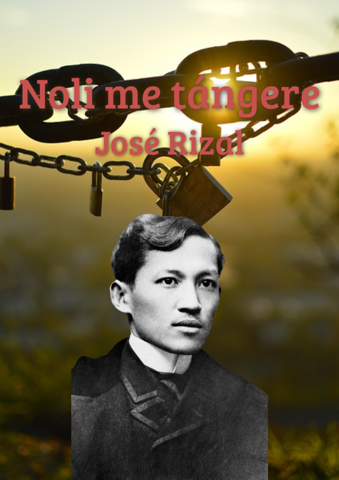
Context:
José Rizal published Noli me tángere in Berlin in 1887, within the framework of the debate on political reform, education, and the representation of the Philippines under Spanish colonial rule. The novel does not present colonial society as a conflict between two individuals, but as a network of religious authorities, officials, landowners, families, and communities. The selected edition is the 1902 Spanish text published by Casa Editorial Maucci with notes by Ramón Sempau; therefore, its preliminaries are also part of the history of this version.
Summary without revealing the ending:
Crisóstomo Ibarra returns to the Philippines after studying in Europe and wishes to promote an educational project. He soon discovers that his father's memory, his family ties, and his plans are conditioned by powers acting within the church, the administration, and local life. Social gatherings, the projected school, private conversations, and public events gradually broaden the conflict. This orientation avoids anticipating the characters' final fate.
Literary Form:
Rizal combines social satire, sentimental novel, political discussion, costumbrista scenes, and an extensive choral narrative. The narrator can shift from irony to indignation and from a domestic interior to a public ceremony, showing that institutional violence does not depend on a single antagonist. Names, titles, forms of address, and religious terms preserve the hierarchical relationships of the era. Therefore, the reader must observe who can speak, who interprets the law, and who is reduced to rumor or silence.
Central Themes:
The novel studies how colonial power enters education, religion, family, and public reputation. Ibarra's reformist project does not only encounter individual adversaries, but institutions that protect one another. Love, faith, and kinship are conditioned by class and colonial identity, so that private tragedies appear as consequences of a social structure.
Direction: Gerardo de León
Country of production: Philippines
Main cast: Eduardo del Mar, Edita Vital, Johnny Monteiro
Why it is included: Gerardo de León's film is an identifiable and award-winning Philippine adaptation that occupies a prominent place in the audiovisual reception of the novel.
Difference from the book: The cinematic duration necessitates condensing the extensive social panorama, the debates, and numerous secondary episodes, concentrating the conflict around Ibarra and the central relationships. This reduction modifies the balance between institutional analysis, melodrama, and action.
Cinematic Interpretation:
Cinema must convert narration, commentary, and documents into images, dialogues, and performances. When comparing, it is useful to review Ibarra's return, the presentation of the school project, the treatment of religious authorities, and the ending, without assuming that a visible scene replaces all the nuances of the corresponding chapter. One must also observe which characters are merged or disappear. The film constitutes its own historical interpretation and not an authorized abridged edition of the text.
Editorial History:
The selected archive is the public-domain edition, in Spanish, based on the complete 1902 edition by Casa Editorial Maucci and annotated by Ramón Sempau. It includes preliminary materials, sixty-three chapters, and an epilogue. The date 1902 identifies the source printing of this digitalization; the novel originally appeared in 1887. Ramón Sempau appears as the annotator, not the translator. The translator field should remain empty because the collected text is in the original language of the work.
Translations:
The Social Cancer by Charles E. Derbyshire is a historical, public-domain English translation, but it no longer controls this entry. There are also versions in Tagalog and other languages. Each translation must be identified by translator, publisher, year, source language, integrity, and system of notes. A well-known local title helps discover an edition but does not prove which text it uses. Modern translations may offer more current solutions and remain protected even if the original novel is in the public domain.
Cultural Importance:
Noli me tángere occupies a central place in the education, national history, and anti-colonial discussion of the Philippines. Its influence does not stem solely from a summarizable political message. The novel turns institutions into related scenes and shows how authority is reproduced through ceremonies, language, kinship, property, and reputation. Its characters and situations passed into Philippine cultural memory, while translations and adaptations brought the debate to different audiences.
Place in Rizal's Trajectory:
Rizal wrote from an experience of Philippine and European training, medical activity, linguistic study, and participation in reformist networks. These biographical data are developed in the separate field dedicated to the author; here they matter because they explain the precision with which the novel confronts education, knowledge, and colonial power. Fiction allows incompatible perspectives to be brought together without turning it into a treatise. The next book, El Filibusterismo, continues part of this world, but it should not be used to complete the metadata for Noli me tángere.
Legacy:
After reading, one can compare how the beginning and the epilogue distribute responsibility, follow the school project, or study who has the capacity to name, confess, judge, and punish. Then, the same passage can be compared with a translation and with the 1961 film. This procedure separates the Spanish text, the annotator's decisions, the translation, and the adaptation, allowing for an understanding of why a historically situated work continues to generate new readings.
Miva: the next reading experience beyond audiobooks
Listen like an audiobook, then ask anything, anytime.
Start Miva's narrationMiva does not just narrate. It keeps explaining based on what you ask.