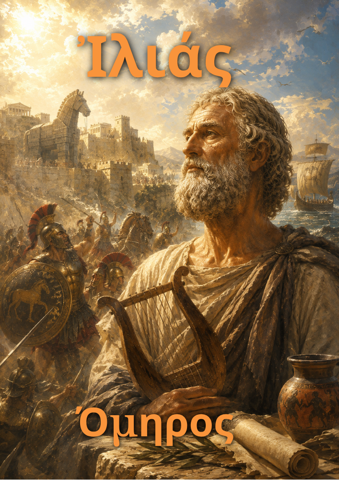
Achilles' Rage and the First Great War Story of the West
Not the Whole Trojan War, but the Final Weeks When Everything Breaks
Glory, Fate, Grief, and the Terrible Price of Heroism
One hero refuses to fight, and an army begins to collapse. One friend dies, and the world catches fire again.
────────────────────────
The Iliad is one of the earliest and most influential long poems in Western literature. Its title means a poem about Ilion, or Troy, yet it does not narrate the entire Trojan War. Instead, it focuses on the final weeks of the war's tenth year: the quarrel between Agamemnon and Achilles, Achilles' withdrawal, the Greek crisis, Patroclus' death, Achilles' return, Hector's fall, and Priam's heartbreaking appeal for his son's body.
────────────────────────
Homer, Oral Poetry, and the Homeric Question
Homer's life remains legendary. Ancient tradition imagined him as an Ionian, perhaps blind, wandering poet, often placed around the ninth or eighth century BCE. Modern scholarship treats the question more carefully: the Iliad is likely the product of a long oral tradition shaped by performance, formulaic language, dactylic hexameter, and later textual stabilization.
────────────────────────
Achilles is not choosing victory. He is choosing how he will be remembered.
In modern terms, the Iliad has the civilizational scale of The Lord of the Rings, the honor politics of A Song of Ice and Fire, and the psychological force of modern war literature. It does not simply praise heroism; it exposes its glory and its cost at the same time.
The epic saga of Homer’s Iliad does not encompass the entirety of the decade-long Trojan War, but rather zeroes in on a crucial, intense period during its final year. The narrative centers on the catastrophic wrath (mênis) of Achilles, the greatest warrior of the Achaean (Greek) forces, and the profound, fateful consequences of his emotions. The conflict ignites when Agamemnon, the king and supreme commander of the Greek forces, dishonors Chryses, a priest of Apollo, by refusing to return his captive daughter. In retaliation, Apollo sends a deadly plague upon the Greek camp. To appease the god and save his army, Agamemnon agrees to release the girl, but arrogantly demands Briseis, Achilles’ prized war trophy, as compensation. Enraged by this public humiliation and abuse of power, Achilles withdraws himself and his formidable Myrmidon warriors from the fighting. He retreats to his tent on the shore and begs his divine mother, the sea-nymph Thetis, to intercede with Zeus. Zeus agrees to grant victory to the Trojans until the Greeks recognize Achilles’ true worth and honor. Without Achilles on the battlefield, the tide of war shifts dramatically. Led by the fierce Trojan prince Hector, the Trojan forces drive the Greeks back to their camp, trapping them against their own ships and setting fire to the fleet. Desperate, Achilles’ beloved companion, Patroclus, begs Achilles to re-enter the fight. While Achilles still refuses out of pride, he allows Patroclus to wear his divine armor and lead the Myrmidons into battle to save the ships, strictly instructing him to push the Trojans back but not to storm Troy itself. Patroclus successfully repels the enemy and slays the Lycian hero Sarpedon, a son of Zeus. However, swept up in the glory of combat, Patroclus disobey’s Achilles' command and pursues the retreating Trojans to the city walls. Apollo intervenes, striking Patroclus from behind and stripping him of his armor. Vulnerable and stunned, Patroclus is mortally wounded by Euphorbus and ultimately slain by Hector, who strips the body of Achilles’ armor. Devastated and consumed by unbearable grief and rage over Patroclus’ death, Achilles abandons his feud with Agamemnon. Thetis secures magnificent new armor for her son, forged by the god Hephaestus, including an intricately detailed shield depicting the entire cosmos and human society. Re-entering the fray, Achilles unleashes a terrifying, murderous rampage, slaughtering countless Trojans and driving their forces back into the city walls. Achilles confronts Hector outside the gates of Troy. Driven by duty and honor, Hector stands his ground, but after a fierce battle, Achilles strikes him down with a spear to the throat. As Hector dies, he foretells Achilles' own impending death. Refusing to grant Hector a proper burial, Achilles desecrates the corpse, dragging it behind his chariot around the tomb of Patroclus for days. The epic reaches its emotional resolution when King Priam of Troy, guided by Hermes, bravely enters the Greek camp at night to visit Achilles’ tent. Priam humbly kneels before Achilles, kissing the hands that slew his sons, and begs for the return of Hector’s body. Moved by the elderly king’s grief and reminded of his own aged father, Achilles overcomes his rage. The two men share a moment of shared human grief and mutual respect, arriving at a quiet, tragedy-laden reconciliation. Achilles returns Hector’s body, granting the Trojans a twelve-day truce so they can mourn and hold proper funeral rites for their champion.
Sing, O goddess, of the wrath of Peleus' son Achilles, that accursed wrath which brought upon the Achaeans countless woes.Original: Μῆνιν ἄειδε, θεά, Πηληϊάδεω Ἀχιλῆος / οὐλομένην, ἣ μυρί' Ἀχαιοῖς ἄλγε' ἔθηκεIliad Book 1, lines 1–2. This iconic opening line introduces the supreme theme of the entire epic, Achilles' destructive rage, establishing the tragic scale and emotional intensity of the narrative right from its first breath.
Thus he spoke in prayer, and Phoebus Apollo heard him, and strode down from the peaks of Olympus, enraged at heart.Original: ὣς ἔφατ', εὐχόμενος, τοῦ δ' ἔκλυε Φοῖβος Ἀπόλλων, / βῆ δὲ κατ' Οὐλύμποιο καρήνων χωόμενος κῆρIliad Book 1, lines 43–44. It visually and dramatically conveys the sudden, terrifying intervention of divine power into human conflict, setting off the plague that paralyzes the Achaean camp.
Hector, thus you are to me father and revered mother and brother, and you are my blooming husband.Original: Ἕκτορ, ἀτὰρ σύ μοί ἐσσι πατὴρ καὶ πότνια μήτηρ / ἠδὲ κασίγνητος, σὺ δέ μοι θαλερὸς παρακοίτηςIliad Book 6, lines 429–430. It captures the deep emotional core and tragic human cost of war, showing how Hector embodies the entire world and security of his family before his inevitable doom.
Reading an ancient epic can feel intimidating due to its poetic structure, extensive formal speeches, and lengthy lists of combatants and lineages. However, the core narrative is driven by timeless, immediate human emotions like pride, grief, jealousy, and loyalty. Modern translations translate the original hexameter verse into clear, compelling prose or accessible poetic lines, making the narrative flow like a high-stakes dramatic war novel. Understanding the main conflict between Agamemnon and Achilles beforehand allows readers to easily follow the character arcs without getting lost in historical detail.
The work established fundamental narrative conventions, character archetypes, and thematic explorations that defined European literature for thousands of years. Rather than presenting a simplistic propaganda tale of good versus evil, it treats both the Greek invaders and the Trojan defenders with remarkable empathy and complexity. By focusing on the internal psychological struggles of its characters alongside physical battles, the epic moved literature beyond simple mythology into profound psychological realism and moral inquiry.
What lies at the end of this ancient epic is not a glorious declaration of victory or the grand fall of a city, but a quiet, agonizing encounter in the dark that redefines the true nature of heroism. When the final chapters arrive, the crushing weight of grief brings together two enemies who have lost everything, stripping away their rage to reveal their shared, fragile humanity. They must sit together in the shadow of irreparable loss, facing the cruel price that war extracts from mortal men. It is an unexpectedly tender, profoundly tragic reconciliation that echoes across millennia. Turn to these closing pages and read this devastating final chapter for yourself.
Achilles withdraws from combat because Agamemnon publicly dishonors him by taking away his captive prize, Briseis. In ancient Greek heroic culture, a warrior's physical rewards represented his social standing and honor (timê). By stripping Achilles of his prize, Agamemnon disrespects his supreme contributions to the war effort. Achilles chooses to withhold his military power to prove that the Greek army cannot survive without his strength, forcing Agamemnon to recognize his value.
No, the narrative does not include the famous story of the wooden Trojan Horse or the ultimate destruction of Troy. The story takes place entirely across a span of several weeks during the tenth year of the conflict. It begins with the quarrel between Agamemnon and Achilles and concludes with the funeral rites of Hector. The fall of the city and the strategy of the wooden horse were detailed in other ancient works within the broader epic cycle.
The Olympian deities are active participants in the war, taking distinct sides based on personal grievances and loyalties. Hera, Athena, and Poseidon actively aid the Greek forces, while Apollo, Aphrodite, and Ares support the Trojans. Zeus acts as an arbiter, balancing divine favors while ensuring that fate is ultimately fulfilled. The gods descend directly to the battlefield, shielding favored mortals, deflecting weapons, and manipulating human emotions to alter the course of battle.
Miva: the next reading experience beyond audiobooks
Listen like an audiobook, then ask anything, anytime.
Start Miva's narrationMiva does not just narrate. It keeps explaining based on what you ask.