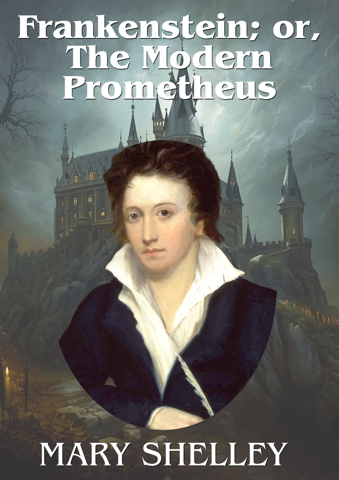
The Novel That Ignited the Science Fiction Genre
Written at Eighteen • The Foundational Myth of the Modern Age
From Boris Karloff to Guillermo del Toro • Two Centuries of the Most Famous Monster in Literature
A young scientist creates life. He is immediately horrified by what he has made. He abandons it. The creature, left alone in a world that will not accept it, begins to wonder what it owes its creator—and what its creator owes it.
In the summer of 1816, Mary Shelley was eighteen years old, stranded in Switzerland by the volcanic winter that had blotted out the sun across the Northern Hemisphere. Lord Byron proposed a ghost story competition. Shelley had a waking dream—of a pale student of unhallowed arts kneeling beside the thing he had assembled—and Frankenstein was born.
Published anonymously in 1818, it was assumed by many reviewers to have been written by a man. It had been written by a teenager. And it had invented a genre.
What Mary Shelley understood—at eighteen, which remains almost incomprehensible—is that the true horror was not the creature. It was the creator. Victor Frankenstein is not a madman in the Gothic sense. He is a recognizable modern type: brilliant, ambitious, consumed by the desire to transgress the final boundary of natural philosophy. He succeeds. And then, confronted with the reality of what he has made, he runs. He abandons his creation without a name, without a purpose, without any of the love that might have made the difference.
The creature does not begin as a monster. The novel is insistent on this. He is made a monster—by rejection, by isolation, by the discovery that his existence is an experiment its author refuses to stand behind.
"Remember, that I am thy creature; I ought to be thy Adam; but I am rather the fallen angel, whom thou drivest from joy for no misdeed."
—The Creature, Frankenstein
"It's the idea of asking your maker what your purpose is. Why are we here, what can we do?"
—Professor Patricia MacCormack
"The quintessential teenage book. A song of the human experience."
—Guillermo del Toro
Frankenstein moved the source of terror from the supernatural to the laboratory—replacing ghosts with the instruments of natural philosophy, replacing divine punishment with the consequences of human choice. Every science fiction story that asks what we owe what we create, every bioethics debate about genetic engineering and artificial intelligence, every anxious conversation about the responsibilities of the scientist—traces its lineage directly here.
The cultural Frankenstein we carry in our heads today is a composite of Shelley's prose and over a century of reinterpretation. Boris Karloff's flat-topped, bolt-necked portrayal in James Whale's 1931 film became so definitive that it permanently displaced the novel's own creature in the popular imagination—a being Shelley had described as eloquent, philosophical, and devastatingly lonely. Junji Ito reimagined it in manga. Hammer Horror rebuilt it in Technicolor. Guillermo del Toro's 2025 adaptation brings it to yet another generation.
The word "Franken-" has entered the language as a prefix for anything assembled wrongly, animated dangerously, or created without sufficient thought for the consequences. Frankenstein is no longer just a novel. It is a warning label.
Two hundred years later, we are still building things we are not prepared to be responsible for. Mary Shelley was eighteen when she noticed.
There is no story content available for the requested position or topic.
Remember that I am thy creature; I ought to be thy Adam, but I am rather the fallen angel, whom thou drivest from joy for no misdeed.Frankenstein; or, The Modern Prometheus Chapter 10. This line encapsulates the novel's core thematic subversion of John Milton's *Paradise Lost*, highlighting the Creature's tragic longing for parental care and his forced transformation from an innocent creation into an alienated outcast.
Like Adam, I was apparently united by no link to any other being in existence; but his state was far different from mine in every other respect.Frankenstein; or, The Modern Prometheus Chapter 15. It captures the profound existential crisis at the heart of the monster's narrative, illustrating how self-awareness and education deepen his agony by revealing his utter lack of companions.
Am I not shunned and hated by all mankind? You, my creator, would tear me to pieces and triumph; remember that, and tell me why I should pity man more than he pities me?Frankenstein; or, The Modern Prometheus Chapter 16. This passage articulates the psychological shift from suffering to vengeance, demonstrating how societal rejection and parental abandonment turn a benevolent entity into a vengeful force.
You are my creator, but I am your master; obey!Frankenstein; or, The Modern Prometheus Chapter 20. This chilling declaration marks the total reversal of the power dynamic between creator and creation, serving as one of the most iconic turning points in gothic literature.
Readers approaching the novel for the first time often express concern regarding its 19th-century prose style and framed narrative structure. Frankenstein is written in the formal, elevated language typical of Romantic literature, utilizing rich vocabulary, complex sentence structures, and philosophical speeches. The novel is structured as a series of letters from Captain Robert Walton, which enclose Victor Frankenstein's personal narrative, which in turn encloses the Creature's own detailed life story. While this layered storytelling requires attentive reading, the dramatic pace and intense emotional core keep the narrative accessible and deeply compelling.
Mary Shelley's masterpiece pioneered the science fiction genre by placing the origin of terror inside a scientific laboratory rather than the supernatural realm. The novel transcends simple horror by engaging with profound bioethical questions regarding human ambition, parental duty, and social alienation. Its enduring fame relies on its complex characterization, as both creator and creation possess valid arguments, transforming a monster story into a timeless tragedy regarding the necessity of human sympathy.
At the journey’s absolute horizon, beyond the shattered vows and desolate landscapes, lies a final encounter across the polar ice where creator and creation must ultimately answer for the existence they shared. What awaits the reader is not merely a resolution of violence, but a heartbreaking reckoning over remorse, responsibility, and the tragic price of total isolation. As the cold darkness closes in, the creature utters his final, sorrowful defense, offering a philosophical self-portrait of a soul driven from innocence into monsterhood. To stand at the edge of the freezing sea and hear that last, desperate confession is to experience one of the most haunting and emotionally devastating climaxes in all of world literature.
Shelley deliberately blurs the boundary between human and monster throughout the work. While the Creature commits terrible acts of violence, his crimes stem directly from societal rejection and Victor's complete failure to provide care or guidance. Conversely, Victor displays emotional coldness and reckless pride by creating life without considering the moral obligations of parenthood. The novel suggests that true monstrosity lies in the rejection of empathy and moral responsibility.
In classical mythology, Prometheus stole fire from the gods to give to humanity and was condemned to eternal torment for his hubris. Victor Frankenstein acts as a modern Prometheus by stealing the secret of life from nature, only to suffer severe punishment through the destruction of everything he loves. The subtitle emphasizes the novel's warning against crossing natural and ethical boundaries in pursuit of personal glory.
Victor never gives his creation a proper name, referring to him throughout the text as a fiend, monster, daemon, or wretch. This lack of a name underscores the Creature's complete lack of identity, family, and legal standing in the human world. The Creature himself notes this loss, comparing his situation to Adam while lamenting that he has been denied even a place in human society.
Miva: the next reading experience beyond audiobooks
Listen like an audiobook, then ask anything, anytime.
Start Miva's narrationMiva does not just narrate. It keeps explaining based on what you ask.