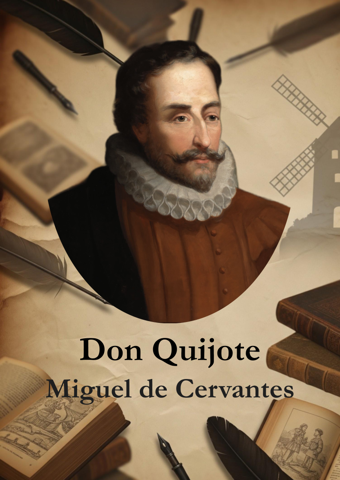
Don Quixote de la Mancha, the masterpiece of Miguel de Cervantes Saavedra, is a Spanish novel published in two parts in 1605 and 1615. Considered one of the most influential works of world literature and the foundational text of the modern novel, it narrates the adventures of Alonso Quijano, a fifty-year-old nobleman who, after reading countless chivalric romances, loses his mind and decides to become a knight-errant under the name Don Quixote de la Mancha. Accompanied by his faithful squire, the laborer Sancho Panza, he sets out on a journey through La Mancha where his overflowing imagination transforms reality: windmills into giants, inns into castles, and peasant girls into noble ladies. The novel masterfully explores the collision between idealism and reality, madness and sanity, and the nature of fiction through the comical yet moving adventures of its protagonist, offering a profound reflection on the human condition.
Reading ease score: 38.5 (College-level). Difficult to read.
Alonso Quijano, a fifty-year-old country gentleman living in La Mancha, Spain, spends his days and nights obsessively reading chivalric romances. Consumed by these tales of valiant knights and magical quests, he loses his sanity and resolves to become a knight-errant himself to revive the noble art of chivalry. Renaming himself Don Quijote de la Mancha, he polishes an ancient suit of armor, dubs his worn-out farm horse Rocinante, and declares a local peasant girl his lady love, naming her Dulcinea del Toboso. Recognizing his need for a squire, Don Quijote recruits Sancho Panza, a naive and simple farm laborer, promising him the governorship of an island in exchange for his service. Together, they ride out across Spain. Guided by Don Quijote’s vivid delusion, ordinary sights transform into grand chivalric trials. He attacks towering windmills, convinced they are monstrous giants; mistakes dusty inns for enchanted castles; and perceives herds of sheep as advancing armies. Sancho, practical and grounded, repeatedly tries to reason with his master, yet he remains devoted, drawn along by a mix of loyalty, affection, and hope. As their travels continue, Don Quijote’s misadventures bring him both renown and ridicule. His relentless idealism continually collides with the harsh, unforgiving realities of early 17th-century Spanish society, resulting in frequent beatings, comedy, and heartbreak. The turning point occurs on a beach in Barcelona, where Don Quijote is confronted by a mysterious figure calling himself the Knight of the White Moon. Unbeknownst to Quijote, this challenger is actually Samson Carrasco, a scholar from his home village. Samson had previously attempted to cure Quijote’s madness under the guise of the Knight of the Mirrors, but failed. This time, the Knight of the White Moon challenges Quijote to a duel on the condition that if Quijote loses, he must surrender his arms and return home to live peacefully for a full year. Driven by duty, Quijote accepts the challenge, but he is swiftly vanquished and thrown from Rocinante. Bound by the strict honor code of knighthood, a defeated Quijote vows to fulfill his pledge. After returning to his village, Samson unmasks himself privately, revealing that his scheme was designed out of deep pity and affection, hoping that a year of quiet rest would restore the old man’s health and sanity. Deprived of his heroic purpose, Don Quijote falls gravely ill with a fever, consumed by melancholy. As he lies dying in his bed, the fever clears his mind, and his sanity unexpectedly returns. Renouncing his former delusions, he declares that he is once again Alonso Quijano and condemns the absurdities of chivalric books. Seeing his master’s spirit broken, Sancho Panza weeping at his bedside begs him not to die, urging him to get out of bed so they can dress as shepherds and wander the countryside together in search of new, gentle adventures. Alonso Quijano gently refuses, asking forgiveness for leading Sancho into his madness. He settles his earthly affairs, ensuring in his will that Sancho is fully compensated and free from any debt, praising the simple squire’s unshakeable loyalty and honesty. Having made his peace with God and his companions, the former knight quietly passes away, leaving behind a profound legacy on the nature of reality, idealism, and human devotion.
Happy the age and happy the century wherein my famous exploits shall be revealed, worthy of being carved in bronze, sculpted in marble, and painted on wood as a memorial for the future. Oh you, wise enchanter, whoever you may be, whose destiny it shall be to become the chronicler of this wondrous history, I beg you not to forget my good Rocinante, my eternal companion in all my travels and courses!Original: Dichosa edad, y siglo dichoso aquel adonde saldrán a luz las famosas hazañas mías, dignas de entallarse en bronces, esculpirse en mármoles y pintarse en tablas para memoria en lo futuro. ¡Oh tú, sabio encantador, quienquiera que seas, a quien ha de tocar el ser coronista desta peregrina historia, ruégote que no te olvides de mi buen Rocinante, compañero eterno mío en todos mis caminos y carreras!Don Quixote Chapter 2. This passage perfectly captures Don Quijote's grandiosity, literary self-awareness, and endearing earnestness as he elevates his mundane reality into a mythical heroic narrative.
But our corrupt age is not deserving to enjoy so great a good as that enjoyed in those ages when knights-errant took upon themselves and laid upon their shoulders the defense of kingdoms, the protection of maidens, the succor of orphans and wards, the punishment of the proud, and the reward of the humble.Original: Pero no es merecedora la depravada edad nuestra de gozar tanto bien como el que gozaron las edades donde los andantes caballeros tomaron a su cargo y echaron sobre sus espaldas la defensa de los reinos, el amparo de las doncellas, el socorro de los huérfanos y pupilos, el castigo de los soberbios y el premio de los humildes.Don Quixote Chapter 1. It articulates the core philosophical motivation behind Don Quijote's quest, framing his madness as a noble attempt to restore justice and moral duty to a fallen world.
Don Quijote is considered a college-level text with a high complexity score, making it a challenging read due to its early seventeenth-century structure, dense prose, and elevated vocabulary. The novel employs expansive sentence structures, baroque dialogue, and frequent literary illusions that reflect the formal speech of golden age Spain. Readers must navigate complex thematic layers, shifting narrative voices, and embedded stories within the main plotline. However, the core narrative relies heavily on character interaction, situational comedy, and deeply emotional exchanges between Don Quijote and Sancho Panza, which keeps the story lively and accessible. While the sentence length and historical phrasing demand careful attention, the rhythmic dialogue and humorous plot premises allow modern audiences to follow the physical and psychological journey of the protagonists without getting lost. Exploring the work opens a rewarding doorway into foundational world literature.
Don Quijote is celebrated as a foundational masterpiece of world literature because it pioneered internal character evolution, psychological depth, and narrative self-reflexivity. Prior to Cervantes, literature largely featured static heroes in episodic adventure tales. Cervantes revolutionized narrative art by showing how Don Quijote and Sancho Panza influence each other over time, gradually exchanging worldviews through dialogue and shared suffering. The book functions as a brilliant meta-fictional commentary on reading, authorship, and the nature of fiction itself, as characters in Part Two are fully aware that a book about their Part One adventures has been published. By exploring the tension between subjective illusion and objective reality, Cervantes constructed a multi-layered masterpiece that defined the structural possibilities of the modern novel.
The tension between idealism and realism develops through the contrasting perspectives of Don Quijote and Sancho Panza as they traverse La Mancha. Don Quijote imposes his romantic knightly framework onto every obstacle, interpreting humble inns as castles and rural flock of sheep as opposing armies. In contrast, Sancho Panza uses grounded common sense to identify physical facts, warning his master of upcoming danger. Over the course of their travels, their perspectives begin to blend. Sancho gradually absorbs elements of his master's romantic hope, while Quijote is repeatedly forced to face physical pain and disappointment when his ideals shatter against reality. This dynamic forms a rich philosophical dialogue on human perception.
Dulcinea del Toboso is the central figure of inspiration in Don Quijote's chivalric framework, despite never appearing directly on the page as an active speaking character. In reality, she is Aldonza Lorenzo, an ordinary peasant woman from the town of Toboso who is entirely unaware of Quijote's quest. In Quijote's mind, she becomes the ultimate symbol of beauty, virtue, and high nobility, serving as the spiritual anchor for all his heroic deeds. Her presence highlights the themes of idealization and transformation, demonstrating how human belief can construct profound meaning out of ordinary elements.
Miguel de Cervantes explores the nature of human truth, the boundary between sanity and madness, and the transformative power of fiction. Through the comic and touching misadventures of his knight, Cervantes examines how societal conventions suppress individual dreams and how romantic idealists struggle in an unforgiving world. The novel also delves into loyalty, friendship, and social satire, mocking the absurdities of early seventeenth-century Spanish society while offering a compassionate reflection on human fragility and purpose.
At the end of this foundational novel, the long collision between visionary ideal and unyielding reality reaches its ultimate reckoning. What waits in these final pages is not merely the resolution of a knightly quest, but a quiet, breathtaking transformation in the relationship between master and squire. As the veil of illusion finally shifts, the story demands a profound accounting of what was gained, what was lost, and what it truly cost to hold fast to a noble dream in a world indifferent to chivalry. The ultimate truth of Don Quijote’s long journey is revealed not in victory or defeat, but in a moment of utter clarity that redefines everything that came before. Read these closing pages for yourself.
Miva: the next reading experience beyond audiobooks
Listen like an audiobook, then ask anything, anytime.
Start Miva's narrationMiva does not just narrate. It keeps explaining based on what you ask.